
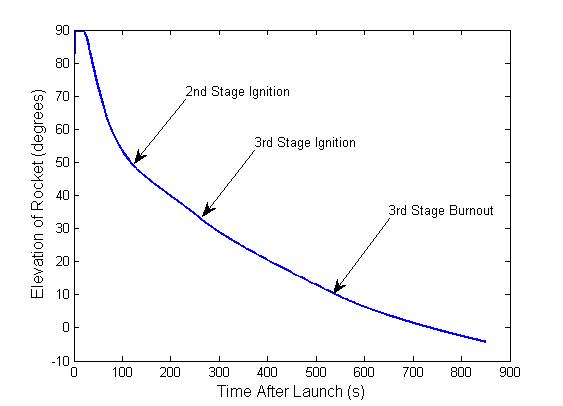
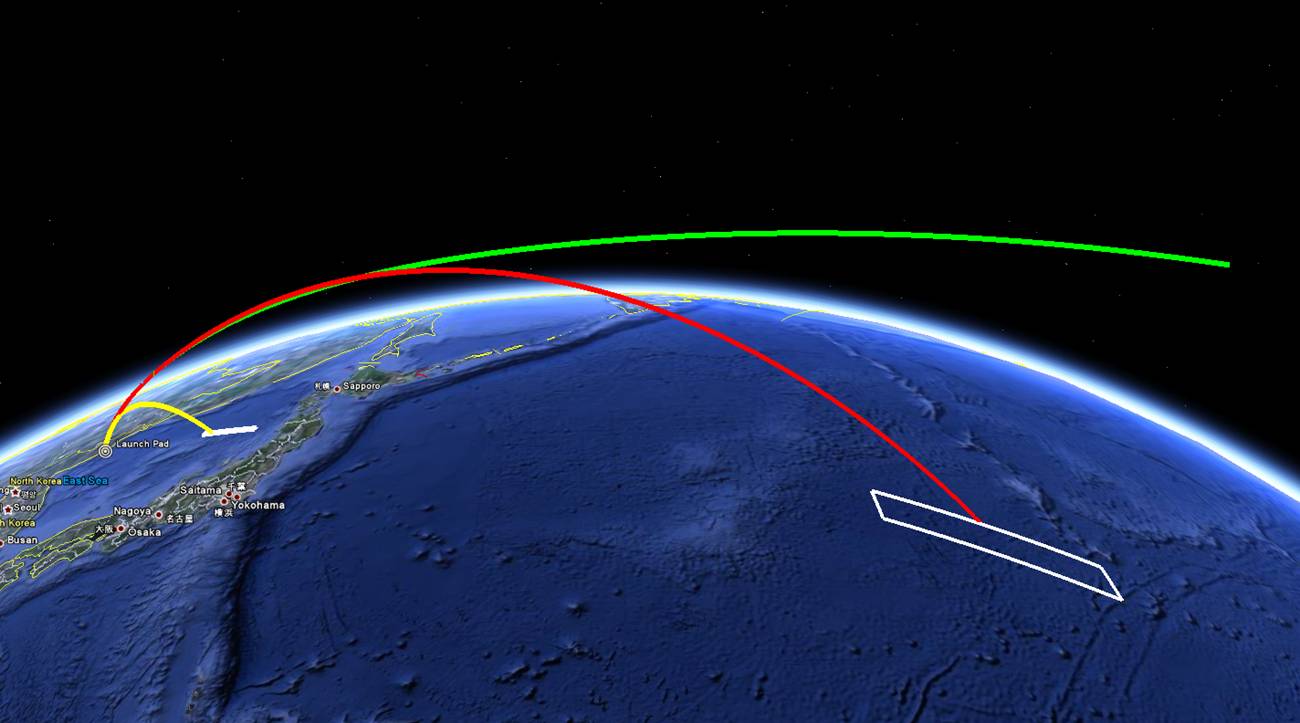
Never take anything for granted. I’m afraid I put off something that Peter Brown, who is always on top of the interesting stories in Asia as he writes for the Asia Times, has been bugging me about. Sorry Peter! I thought I knew what the answer would be and I put off calculating the elevation of the U’nha-2 as a function of time far too long as I worked on other stuff. I assumed that the U’nha-2 probably had its second staging event below North Korea’s horizon. It turns out that I was wrong. The rocket was almost certainly 10 degrees, or perhaps even more, above the launch pad’s horizon when its third stage would have burnt out. In fact, the rather simple model I have for the trajectory (which does fit the observed contrail and have its first and second stages splash down in their respective zones ) has the rocket finally disappearing below the horizon 736 (well past the 535 seconds the rocket was actually under power) seconds into its flight. North Korea should have been able to receive telemetry from the rocket using land-based receivers all the way to orbital injection and even past that. (Peter has been investigating reports that a ship he believes was sent out to monitor the rocket had to return to port before the launch because of mechanical problems. It turns out, however, that such a ship was probably not needed.
A couple of thoughts immediately jump to mind:
-They most likely have not had enough time to correct what ever problem caused the April 5th failure unless it was the same type of failure that caused the August 2008 Safir second stage to fail. (I believe that the U’nha-2’s third stage is the same as the Safir’s second stage.) In that case, they could use the Iranian expertise to quickly fix the problem. But if that was the cause of the failure, why didn’t they fix it before the April launch attempt?
-The fact that they already have a rocket body ready to move to the West coast launch complex means that they are following what in the US would be called “concurrent acquisition.” In such an development path, the North would be “mass producing” U’nha-2’s even as it develops it. This has been practiced in the US, and has in fact, been used for many of the US ICBM development programs; programs which are judged so vital to the national interest that the US has been willing to run the risk of building into a number of missiles any design/production problems that might be discovered during the testing program.
-The comments above assume that simply because the rocket was visible to North Korea, the DPRK had telemetry and was able to diagnose the cause of the April 5th failure. Just because that makes a lot of sense doesn’t mean they actually had telemetry. It is conceivable that they simply have no idea why the rocket failed. (I’ve argued before that the North’s rocket scientists might not have told Kim Jung-Il that the missile didn’t make it into space. I hadn’t really thought that they might not know it failed either. However, it would not be the first time a country spent years and millions of dollars on developing missiles without any telemetry. Iraq never had telemetry on any of Al Hussein’s it fired off.)
Update: Murray Anderson pointed out a significant error I had in an earlier version of this post. Thanks! I’ve corrected that error, which I blame on my bad eyesight in confusing Isp with stage burn time in my rush to get this analysis done.

It’s strange that the second stage would start at 250 seconds into the flight. That means upwards of 100 seconds of unpowered flight after first stage burnout. You don’t do that with a three-stage rocket, on account of gravity losses and control issues. I suppose it could be a scheme to avoid boost-phase intercept (but not likely on a development flight).
The second stage burn time is quite short (looks like about 140 seconds), consistent with the second stage being a converted first stage, like the SS-N-6. The third stage seems to have burned for about 260 seconds, which would put it almost in orbit. Is that right? I had thought the third stage didn’t work at all, separation failure or something.
I must say again that i’m skeptical if the Eunha-2 used the same upper stage as the Safir.
I estimate a delta-v-capability in the range of ~5300 m/sec for the Safir’s upper stage, while the first two stages of the Eunha obviously both generated a delta-v of over 3000 m/sec each; if i add these values together and consider the earth’s rotation, i get an overall delta-v for the Eunha in the range of 11-12 km/sec (that would be enough for e.g. a translunar trajectory!).
To reduce the overall delta-v of the Eunha down to the range of a typical LEO-launcher (~9 km/sec), the third stage would either have to execute a non-full-duration burn (possible but inefficient/unneccessarily expensive and complicated – without the additional weight of the third stage, two-stage-to-orbit might be feasible!), or the payload would have to be in the range of 2-2.5 tons (and that might be inconsistent with the vacuum thrust of ~3.5-4 tons and the rather low structural weight of the Safir upper stage).
Besides, if these two stages should in fact turn out to be more or less identical, then the North Koreans apparently mounted at least the ullage motors (the small black bulges at the rear end of the Eunha third-stage according to my interpretation) differently than the Iranians.
BTW, the news output about a second missile being readied for launch reminds me very much of the situation in 2006 (let’s see how long they’ll take this time for the next launch – 2.5 weeks, like some people seem to assume, or rather 2.5 years, like the last time when something went wrong)…
Let me clarify the plot: it corresponds to the trajectory assuming successful insertion into orbit. According to news reports, the rocket was successful at least through the second stage burnout. What happened after that is uncertain.
Also, Murray, you are reconstructing Ted Postol’s model and have correctly determined what he assumed. I think its a pretty good analysis but it is still only an analysis. (Certainly Jochen disagrees with at least parts of it.)
I would have expected LOS to fade around 600 seconds out.
Otherwise, whether or not there were any Chinese Yuanwang or Dongdiao missile tracking ships down range well to the east of Japan during the launch remains a mystery.
Geoff:
Do you have actual data about the burn-time of the second stage or are your figures only guesstimated (i, too, estimate a first-stage burn-time in the range of 100-120sec, but am unassertive in case of the second stage – actual flight data of the Eunha-2 would help big time)?
BTW, yes, i do not put 100% faith in Mr. Postol’s model (although “disagreement” may be a too harsh expression); for example, i’m absolutely not sure about the second stage being a R-27/SSN-6/Serb (does the DPRK have access to both components of the Isayev 4D10?), although the diameter of ~1.5m could match, or the diameter of the first stage of 2.4m (this could perhaps also be 2.5m according to my own measurements). Considering the third stage – maybe he’s right, maybe he’s wrong (one of the key issues could perhaps be the upper stage engine of the Paektusan/Taepodong-A). But i don’t say that he’s outright wrong – i think we simply need more details of the Eunha (e.g. which engines are used on the upper-stages, better pictures allowing an assessment of the tank-volume-ratios and more precise photo measurements etc.) for a credible reconstruction.
Let’s wait and see if (and/or when) the North Koreans show us more…
But it’s so strange that if DPRK continuoulsy fails in their launch programs, that the US would react with such vociferous denouncements. Despite technical calculations to the contrary, the US’s strongarmed response belies utter alarm toward DPRK’s capabilities and gives credence to China and Russia’s confirmation of the kwangmyongsong’s launch into orbit.