
click on the image for a larger version
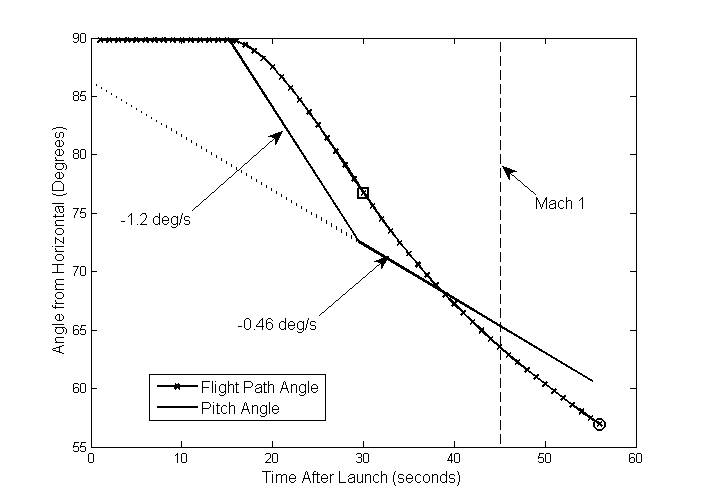
The reconstructed flight path angle and the fitted pitch program are shown as a function of time after launch. The flight path angle is found using the fitted trajectory to provide a smooth curve. The start and stop of the fitted trajectory are marked with a square and a circle respectively. (Note that the rocket passes through the speed of sound during the fitted trajectory.) The slope from the portion corresponding to the reconstructed trajectory is projected back, as a dotted line, to the launch.
I’ve just finished my paper on reconstructing a significant portion of the U’nha-2 trajectory using the DigitalGlobe/GlobalSecurity.org’s satellite image of the launch. (I’ve just submitted it to Science and Global Security.) It’s interesting because the U’nha-2 passes through both the speed of sound and the maximum dynamic pressure (Max Q) during the reconstructed trajectory. What’s particularly interesting is that the rocket is not following a gravity turn as it does so. Instead, it is changing its flight path angle at a much slower rate. Now, it is possible that it could arrange to pass through the speed of sound at a zero angle of attack , or it could pass through Max Q at zero angle of attack, but not both. It also indicates that the DPRK was trying to get the maximum boost from lift.
If it had been trying to do the same thing for its 2006 Tae’podong II launch, perhaps the rocket experienced too high of an aerodynamic load? Another tantalizing feature that I found, though since it was before the fitted trajectory it has to be considered only an interesting indication, I found the vertical rise time was about 15 seconds (15 seconds between launch and when the rocket kicked over) while the optimal vertical rise time for a rocket with a thrust to weight ratio of 1.35 would be 12 seconds. Not bad! What is certain, however, even if it does come before the fitted trajectory, is that the U’nha-2 was kicked over a lot harder immediately after the vertical rise than it was being tilted during the fitted portion of the trajectory. The North Koreans were trying to minimize gravity losses as much as they could before Max Q. An interesting feature that might also contribute to why the 2006 launch attempt failed.

Does this give any new information for the satellite launch/IRBM debate? Not that it really matters, from an engineering standpoint…
I believe that the structural strength of the rocket is THE key point right now. It hardly matters, from a guidance point of view, whether or not it flew a shallow trajectory like an ICBM might fly or a steeper curve that people associate with a space launch vehicle. But some people have questioned whether or not the third stage (which appears to be a “Safir” second stage) could lift a 1000 kg payload associated with a nuclear bomb. I have no direct knowledge of that. (Clearly, the second stage could.) But I believe that there is growing evidence that North Korea needed to strengthen their airframe—presumably at the cost of some range—from the 2006 test to the 2009 test. Having done that, they felt confident to use aerodynamic lift through either Max Q or through the speed of sound. They are clearly progressing in their knowledge of designing and flying missiles.
Geoff:
I agree with most of your last comment (and the article), but i’m not so sure if the third stage of the Eunha-2 is in fact identical with the upper stage of the Safir IRILV; Although both obviuosly share the same diameter of 1.25m, i think the length (and mass) is perhaps somewhat different. Also, apart from that it’s probably a storable-propellant liquid-fueled engine optimized for vacuum operation, i can’t make any substantiated statements about the used engine and type of propellant (due to lack of information). And the ullage motors (the small black “boxes” on the outside of the stage) seem to be at a different location on the Eunha.
That said, i also can’t exclude that possibility for certain (due to the frustrating lack of information/higher-resolutioned images…).
BTW, have you heard about the iranian Sejil-2-shot today?