
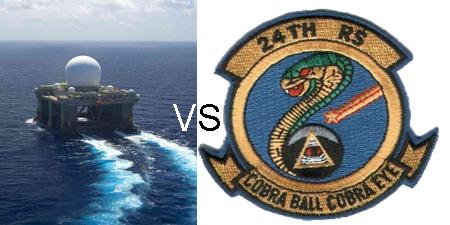
A number of us have been wondering why the US didn’t send the Sea-Based X-band (SBX) radar out to see (sorry, I couldn’t resist that!) the Unha-2’s launch. One of the best arguments I’ve heard comes from Victoria Samson who thinks that the real reason it didn’t put to sea was it is constantly undergoing repair and might not have worked under the crisis-like conditions surrounding the North Korean launch anyways. This discussion, however, has broken out into the general public by a recent “exclusive” by Bill Gertz at the Washington Times . Sec. Gates has countered that there were already “numerous ground- and sea-based radars and sensors in the region.” (Emphasis added.) I would also add that there undoubtedly were air-based sensors in the region, sensors that would, frankly, gather much more detailed and accurate information than the SBX.
In particular, I hope (and feel fairly confident) that they sent at least one Cobra Ball aircraft out to observe the flight. Cobra Ball is an advanced suite of infrared and other sensors stuffed into a RC-135 airframe. Positioning it just West of Japan would have given these sensors a perfect view of the Unha-2 launch from liftoff through third stage separation and ignition. If this suite of sensors, designed to watch foreign missile launches, had spectrometers as well as infrared imagers (or even more possibly, hyperspectral sensors that image the target in a wide range of wavelengths) than it could have answered a number of important questions that would have left SBX figuratively scratching its bald dome. These include the various exhaust color changes right at ignition of a stage that hint at the propellant used. (I doubt that spectrometry could tell the difference between fuels after the ignition transient ended, but I could be wrong about that.)
I agree that sending the SBX to the area would have provided an important test of its capabilities in a real world situation; one that it did not receive in the shoot-down of the errant USA-193 “spy satellite.” However, I also agree that the political implications of sending the radar to the region were sufficient justification for not sending it.
Update: Joshua Pollack at Total Wonkerr beat me to this story (and beat Bill Gertz too!). Sorry Josh! I promise to check your blog more often. All I can say is that for the past week or so I’ve been consumed with the Unha-2 trajectory; which I promise to blog very soon.

Since my comment pointing out that SBX’s (non)deployment had zero effect on NK’s petulant post-launch behavior (kicking out inspectors, etc.) was apparently moderated down the memory hole, I’ll toe the line a give you this helpful tid-bit —- two Cobra Balls were on station:
http://mdn.mainichi.jp/mdnnews/news/20090406p2a00m0na014000c.html
John,
I have searched our file of comments (including “moderated” comments) and can find no record of the posting you allude to. Perhaps you pressed “preview” and not “submit”. Its happened to me.
Understood, Geoff. The preview/submit interface is tricky (even as I type this, Submit is greyed out & unavailable). Sorry for getting my stinger out.
The Cobra Balls, AFAIK, gather optical and IR imagery/data, plus telemetry. It would have been very, very desirable to collect X-band radar data, particularly of the staging events.
So, absent SBX, I wonder if two other Cobras, Cobra Judy and Cobra Gemini, were present for the festivities.
Well, I can’t imagine what the extra spatial resolution in radar tracking would have given you unless you were planning on shooting it down. After all, the Aegis cruiser radar would give you pretty much the same thing. But if you think knowing its trajectory to the tens of centimeters as opposed to the tens of meters is important…
The thing about the X-band data is that they can be processed to give very detailed information — ISAR images if desired — about the payload separation process and the behavior of the various objects coming out of that process. That’s MDA’s best hope of getting significant discrimination between disguised warheads and decoys in a real engagement, since the VIS/IR sensors on kill vehicles are grossly inadequate. So they should be trying to get the radar information against more or less realistic targets every chance they get.
I think a better question would be whether having SBX in the Sea of Japan would still allow it to do its function as part of the tracking and targeting system for the GBIs in Alaska in defense of CONUS. I’m thinking that it would need to be much further north to be useful in that capacity, since a DPRK missile aimed at CONUS would need to fly in at an Az lower than about 52 degrees.
I’ll bet this has a lot to do with why the SBX-1 was not at its “forward operating base.”
http://pogoarchives.org/m/dp/dp-SBXOVA-06022006.pdf
I still don’t think I’ve seen a worthwhile answer to the question of what telemetry the NORKs hoped to gain over the horizon, and this para from the mainichi story linked above adds yet another angle to this:
“According to North Korea’s advance notice, the missile was to travel below the horizon, as seen from North Korea, when the artificial satellite split off from the rocket booster. In order to transmit an order to detach the satellite from the booster, the North needed to deploy a vessel with radio transmitting equipment in the Pacific Ocean, but there were no traces of such a deployment.”
Why assume that separation is a manual process triggered (apparantly literally) but some guy in a fishing boat pressing a button? If this is the case, why no transmitter?
> I’m thinking that it would need to be much further north to be useful in that capacity,
That’s why SBX’ forward operating base is at Adak.
Noah Schachtman quotes Bob Gates as saying it that it would have been too expensive to deploy SBX.
If I understand this congressional testimony correctly than it looks like there is an X-Band radar station in Sharaki, Japan that can monitor North Korea:
“…will be capable of exchanging information with U.S. missile defenses, including the forward-based X-band radar at Shariki and U.S. Aegis BMD ships in the region. The X-band radar at Shariki provides precise early detection and tracking to increase the probability we will destroy any lethal target launched by North Korea.”
> it looks like there is an X-Band radar station in Sharaki
Yes there is, AN/TPY-2, aka FBX-T. It should have gotten excellent data, including ISAR imagery, of the rocket during first-stage flight, separation of the second stage, and a bit after that. It probably did not get the very important data on the third stage and payload separations because of geometry.