

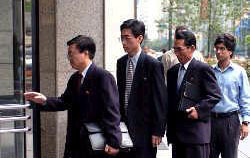
North Koreans In New York (I think).
Joseph DeTrani (Special Envoy for Six-Party Talks and U.S. Representative to KEDO) and Jim Foster (Director, EAP/K) met with for a second time with their North Korean counterparts though the New York channel. (The New York Times and Washington Post have more).
As usual, Chris Nelson has the inside dope:
A great deal of behind-the-scenes maneuvering was required to get today’s “New York Connection” meetings scheduled…but the “instant reaction” from Administration sources is negative. “They want us to accept them as another Pakistan, a declared nuclear state with which we negotiate”, says one. “This is a complete non-starter”.
Pyongyang in recent weeks has been sending signals by every available messenger to the effect that the DPRK is willing to rejoin the 6 Party talks, under certain conditions. Now, thanks to private visitor John Lewis, and others, we can see that Kim Jong-il has responded to US and Chinese pressure with a clever maneuver…saying he wants to resume the 6 Party talks, but with a larger agenda. Rather than the US-desired talks on nuclear disarmament which keeps the pressure on Pyongyang, Kim apparently is saying he’ll come back to negotiate a broad-based arms control agreement with the US covering the nuclear weapons of both sides.
Daniel Sneider with the San Jose Mercury-News debriefs John Lewis (no relation) on his return from the land of the morning calm. Lewis tells Sneider:
“They are willing to trade, but the price has gone up and the complications have increased significantly,’’ observes Lewis. “The chances of this working out are pretty close to zero.’’
Lewis reports that the North Korean position on a larger agenda for Six Party talks is the same as articulated in a March 31 statement released by the North Korean Foreign Ministry:
The six-party talks should provide a platform for seeking comprehensive ways of substantially and fairly realizing the denuclearization of the peninsula, not just as a bargaining ground where a give-and-take type way of solution is discussed.
Gone are the days when the six-party talks took up such give-and-take type issues as reward for freeze.
Now that the DPRK has become a full-fledged nuclear weapons state, the six-party talks should be disarmament talks where the participating countries negotiate the issue on an equal footing.