Transcript
Transcribed automatically: it certainly contains errors. It’s pretty good, just not perfect. We provide it here because, for accessibility, it’s better than nothing.
Aaron Stein
0:02
Don't compare us to a satellite. You are listening to the Arms Control Wong podcast, the leading podcast on arms control, disarmament, and nonproliferation. I'm Aaron Stein, a senior fellow at the Atlantic Council's Rafiq Kariri Center for the Middle East.
Scott LaFoy
0:21
And I'm Scott LaFoy, a master's candidate at Georgetown University Center for Security Studies and a freelance imagery and open source intelligence analyst.
Aaron
0:29
And also the super producer of this show. So welcome, Scott.
Scott
0:32
Oh, that's right. The most important title. It is. I forgot the most relevant thing to this pod. How are you doing, Aaron?
Aaron
0:37
I'm doing well. You know, listeners should know that Jeffrey is doing what Jeffrey does when he's not podcasting about nuclear weapons, which I would presume is researching some aspect of nuclear weapons for future podcasts. So stay tuned for when Jeffrey rejoins the show. Indeed. And I am recording this podcast from home. I've been drafted into dad duty.
And so long-time listeners of the show will know that I was on paternity leave for a while. And so I have a 16-month-old in the background. And he may choose to make an appearance on the podcast inadvertently or on purpose sometime throughout the show. So if you do hear him, say hello to Oliver for everybody. So, Scott, I'm staring out my window, and I think we're a week or so out since big changes that happened in Cuba, huh?
Scott
1:26
Indeed. Fidel Castro has passed away at, I think he was 90 years old. The longtime rough relationship with the United States... To say the least. And so everyone's sort of doing a retrospective this week on America and specifically Fidel Castro's relationship, specifically a particular 13-day period that drove everyone up the wall with stress.
Aaron
1:53
Right, and led to that movie, Kevin Costner.
Aaron
1:58
But, you know, we're going to talk about we're not going to do a tick tock of the of those 13 days in October. But we're going to talk about, you know, country near and dear to my heart, the fourth player involved in that saga in American and Russian and Cuban history, Turkey.
Aaron
2:18
And how it became a bit player, actually rather a central player in how that conflict got resolved. But despite its centrality in the trade that went on, an understudied topic along with the missile that was traded away in that agreement and what it was. And so I think we should just start there. Because, Scott, you are the missile man.
Tell the listeners about the Jupiter and about how that development led.
Scott
2:50
So most people, like you said, in the Cuban Missile Crisis are more familiar with what was all deployed in Cuba, in San Cristobal. But we had Jupiter MRBMs, medium-range ballistic missiles, deployed in Chile Air Force Base in Turkey prior to the whole incident happening.
Aaron
3:11
Yeah, it's an interesting... In fact, how they got there, you know, you had the first discussion about nuclear weapons being deployed in Turkey in the quote-unquote Adana area, which is where the big Air Force base is in Julik and where weapons are still stored in Turkey as early as 1956. But that was a year before these MRBMs were even flight tested.
Yeah.
Scott
3:40
Right. And so these things we were talking about at OffPod, these went very rapidly from flight test to not only deployed, but deployed in NATO ally countries. These things, the Jupiters had their first flight test in, I think it was March of 1957, right? October 1958 was their official first delivery to the United States Air Force. It started out as a missile being researched by the U.S. Army, because that's where we had a bunch of our ballistics research.
That's where von Braun was positioned. It's actually funny if you look at the organization chart for the Jupiter research. All of the top brass are somewhat recognizable U.S. general names. Then you hit operations and research, and all of the names switch to very German very quickly. Yeah. But yeah, so the Jupiter was not a great missile, honestly.
It was what we had at the time, but like almost all of our missiles in the late 50s, it was sort of our first stepping stone past V2 derivatives and the Redstone and the Sargent missiles.
Aaron
4:46
Right, and it's interesting in that part of diplomatic history is that the United States didn't try to hide that fact from Turkey. In the early discussions about the potential to deploy the Jupiter into Turkey, it was made clear, or at least you can never be completely sure, but you're looking at past archival documents, That the missile was always intended to be a stopgap.
Right. Because there was felt a need to be able to hold Russian targets at risk because of own concerns about second strike capability.
Scott
5:22
Exactly. And it complemented the Thor missile with sort of its compatriot, slightly longer range, but I think slightly slower timeline. And so this was a big stopgap for that. And I assume Turkey liked it because it kind of had a big warhead on it as well. It had the W49, which was a 1.44 megaton warhead on it.
So it may not have been accurate and it may not have been good, but it packed a bit of a punch.
Aaron
5:49
Right. I guess a little bit of background is that there were a lot of U.S. military studies about the vulnerability of Turkey at that time, as one would, because it was invited into NATO in 1952. And they weren't very good in that there was – The understanding is that the Turks would be overrun very quickly. And so that you, at that time too, within the American defense establishment, you had the idea that nuclear weapons could be relied upon to, as a cost effective way to blunt incoming invasion force.
And the Turks took to that, you know? And, and so, as I said, the first discussions about nuclear weapons being deployed in Turkey for at least what I found in my research was in 1956 You had the NATO discussions about forward deploying of nuclear weapons in 1957. And then you had in May 1959, it was actually the formalization or the signing of the memorandum or at least the agreement that allowed for the deployment of nuclear weapons inside of Turkey, culminating that September in the actual agreement to place the Jupiters there.
Inside of Turkey. So you had the first flight deaths in 1957, and then the agreement to deploy them in Turkey in September 1959. I mean, that's a fast timeline.
Scott
7:15
That's a very fast timeline. That's a crash course in getting a nuclear, especially a nuclear-capable missile working and delivered to what now, I mean, would be controversial because it'd be a foreign country in opposition to a growing nuclear threat. Yeah. Right next door. And you were mentioning off-pod, Turkey already had a number of nuclear weapons pre-deployed before the Jupiter.
The Jupiter was not Turkey's first deployed nuclear weapon through NATO.
Aaron
7:44
Yeah, well, maybe we should put a pin in this because we'll come back to it after they're removed. But Turkey began to incorporate this part of its NATO and really US defense planning to utilize nuclear weapons. And I think that's – we'll come back to this. It becomes ingrained in how the Turks think of nuclear weapons and inform their thinking.
So much so that – They like the physical presence of nuclear weapons on their territory as a physical sort of symbol of reassurance from the alliance. And I think that's an important place to come back to the Jupiter here, is that its deployment, while obviously theoretically military useful for the Turks, it was much more important than, say, the follow-on, or at least what the potential replacement was, which was Polaris.
Scott
8:39
Right. Especially because with NATO allies, you're releasing a lot of responsibility from the U.S. command chain. Even though it's still built into the command chain, you're releasing so much sort of authority and responsibility into a, I guess, from the U.S. general's perspective, less controlled element within strategy. It requires a lot of, like, trust at a nation-state or military-to-military level and can bring a lot of, you know, prestige to a country.
Yeah.
Aaron
9:09
Right. And so they were deployed under the dual-key arrangement in that both countries would have to, quote-unquote, turn the key. But the warheads were separated from the missile and always under U.S. control, which continues to this day. Right. But for the Turks, it was really about the symbolism of having these sort of big flower petal launchers. Right.
Sitting out on the on the on the outskirts of Chile Air Force Base that as we begin to move into the Cuban Missile Crisis are pointed out as you just make you a really big target for Soviet missiles.
Scott
9:46
Right. The Soviet Union had a robust IRBM and MRBM and SRBM programs, and so there was a lot in the Soviet Union that was capable of targeting all of Turkey in response to the Jupiters, even if they weren't the most accurate of missiles. But something I want to go back to, you mentioned offhand, is that flower petal arrangement.
The Jupiters were weird looking.
Aaron
10:09
Yeah, I was prompting you to... I was right there. You picked up on it.
Scott
10:15
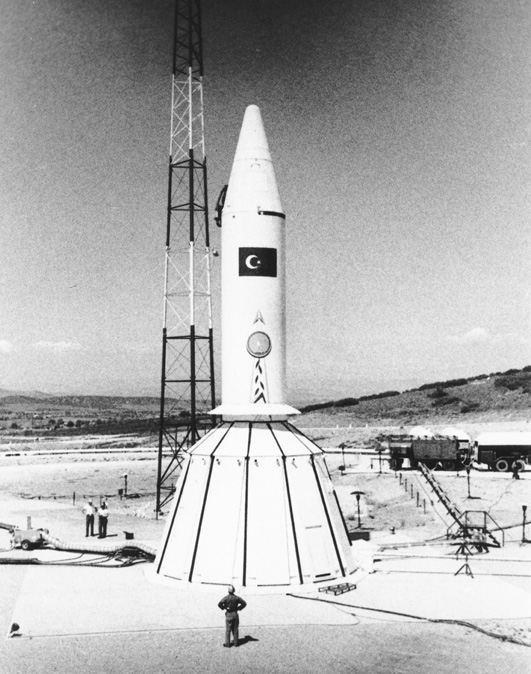
Yeah, for listeners, we'll put up a picture of this in the show notes, but the Jupiters are fairly unique. As far as I'm aware, this is the only missile of any country that I've seen use this, where the Jupiters had this very large, what they described as a flower petal arrangement that covered the bottom few feet of the Jupiter missile, just the bottom, and would unfold like a flower would bloom a few moments before the missile would launch.
And so I've been trying to figure out why exactly one would actually have a flower petal arrangement. And in these declassified histories, they seem to talk about being there for weather protection. Like it allows crews to operate and perform maintenance and preparation work on a Jupiter missile in inclement weather. What I was unable to figure out if that's actually the reason, because that's an expensive and a weird way to respond to rain.
I'd be curious if they actually mean it's there for launch under nuclear conditions, like if those inclement conditions are fallout, that would make a little more sense, because this is a very complicated metal lattice work that if it's just for rain, you could do that with a tent.
Aaron
11:33
But it wouldn't look as nice, you know, deployed in sort of the barren, like it's almost California type weather down there, you know, sort of dry. And you're on the nice Mediterranean coast. I don't think there's much rain down there in Turkey.
Scott
11:48
Yeah, the whole explanation for it for being weather reminded me of when they say that weather balloons crash. And you're like, okay, this weather balloon's pretty stealthy looking to be going for weather. I have a feeling this actually had a different purpose. So hopefully a listener can maybe chime in and clear this up for me. I'd also be wondering if there was an element of distrust or something.
Was it a security method? Was it to keep provocateurs and saboteurs away from the engine? I'm not sure. But they claim it was weather and some sort of inclement conditions. But it looks fantastic. It's such an interesting looking piece of tech, even if it's not the most helpful.
Aaron
12:31
Yeah, there's a great photo that pops up on the Google image search. Maybe we can put it in the Slack channel as well. There's a crew. It's obviously an American crew that's sitting in front of one. And if you look in the background of the missile, it's popped up out of the flower and the flower petals are down.
And then there's a little Turkish flag painted on it. And my favorite part is that there's a stray dog in the picture. So, you know, there were rogue canines running around the missile base around that time, you know.
Scott
13:01
Maybe that's what the flower petal for is, an anti-canine maneuver.
Aaron
13:04
Yeah, that's what I was going to say, is to keep the dogs away. Or maybe they're spy dogs. They were Soviet spy dogs. But what's interesting is that these missiles performed, at least in my mind, similar function to what the Russians were trying to achieve in Cuba, and therefore became ripe for potential bargaining.
Scott
13:27
Exactly. They formed kind of a pretty clear strategic one-for-one. Not quite one-for-one, maybe, but pretty clear the same class of threat. Direct targeting of the homeland, essentially. Because they had a range of about 2,800 kilometers, roughly, which gives them enough to range basically past Moscow from almost anywhere in Turkey.
Aaron
13:56
You know, the first time I went to Russia was from Turkey. And in your mind, you have it as far away. But I flew from Ankara. I mean, you're over the Black Sea and you're over Crimea. Now Russia, at that time it was not, in quotes, in about an hour. The flight to Moscow was just over two hours.
You don't realize how close it is until you're up there. And so you can see the geographical, at least, desire to get something up there, but also why it could be destabilizing. Absolutely. Right. And then... And then you can see why – but on the flip side, I've always thought that it goes the other way, is that these missiles were also extremely vulnerable to Russian attack.
Aaron
14:50
And you could see the other incentive to start – well, A, they were never expected to be there very long. They were always supposed to be a stopgap. But Y, you could at least theoretically – Make the case that these missiles are not military relevant from a U.S. perspective. From a Turkish perspective, we can get into that later.
Scott
15:08
Right. And if they had some incredible accuracy, they'd be incredible military weapons because they could... Their CEP, just for listeners, their CEP is a kilometer and a half, so they can't hit anything small. They can only hit cities. If they had a small CEP, they could have been counter-forcing ICBMs with MRBMs, which would be a pretty nice... That's a pretty nice trade.
But they weren't – they could hit Kiev and Moscow, but they couldn't hit anything smaller than that. They were not hitting military formations with those.
Aaron
15:38
Right. Exactly. And so we have October 1962, and then as the Cuban Missile Crisis – I think it's on – Day 11 or something like that, towards the end, is that when you begin to first hear, at least sort of in the telling of the tales, the idea of this grand bargain is that you can trade the Jupiters and Turkey for the removal of nuclear forces from Cuba, but the...
But you can't look like a trade in that the Jupiters have to come out later under the guise that they were made obsolete by, I believe it was Polaris.
Scott
16:21
Think so Polaris being though Polaris never had a ground deployment so this is a weird thing about Jupiter is Jupiter was originally meant to be like a land and a sea missile like there was a Jupiter at sea variant under investigation by the Navy that was it was actually supposed to be solid fuel and the regular ones liquid fuel but Polaris never made it to ground so I'm not totally sure what the next one for one replacement of the Jupiter would have been.
But I think Polaris was at least what was mentioned as the thing that invalidated it as a useful military tool in Turkey.
Aaron
17:00
Right, and that was what the U.S. essentially offered Turkey once they were Once they were removed, and we will come back to this in the wrap-up, is dedicated Polaris patrols in the Mediterranean. And that was, we can still continue to reassure, even though the missiles are no longer in Turkey. What's interesting at this point, though, is the Turks were not directly consulted about the trade, but it was floated with them.
And it was, what would you think About such a trade should it ever take place. And the Turks didn't want this trade to take place. You know, despite all of the risks we talked about, knowing that the missiles were basically obsolete, even before they were deployed that they were going to be redundant with Polaris And that they were probably more vulnerable to counterforce strikes than they were for offensive counterforce.
Is there value for offensive counterforce? But with all this, the Turks did not want to see missiles removed. One, for two reasons, the best I can tell from my research is one – Is they physically like the idea of having power projection, offensive nuclear capability from their territory, different than the tactical weapons that were already there, gravity bombs for delivery by aircraft, artillery shells, and then warheads for the Honest John.
And two, they didn't like the political symbolism of, Of a one-for-one trade involving a full-fledged NATO member and then Cuba, which wasn't in the Warsaw Pact. And so their counterproposal was, yeah, we're okay with it, but find somebody else.
Scott
18:59
Don't compare us to a satellite.
Aaron
19:00
Don't compare us to a satellite. And this becomes a problem. Well, it doesn't become a problem. It becomes sort of The Cuban Missile Crisis, quote unquote, ends in mid-October. And then somebody from the United States has to go tell the Turks that the missiles are going to be destroyed. And they have to convince them that this is in their best interests.
I can imagine that it was simply, you know, this is going to happen. There's not much you guys can say about it. We'll do our best. Oh, do you know about Polaris?
Scott
19:42
Can I interest you in something you don't get?
Aaron
19:44
What's interesting is that one of the things we tried to give them was the NATO multilateral force, the MLF.
Scott
19:53
Oh, that worked so well.
Aaron
19:55
Right. And that history was one of the most – there's a lot of weird things that go on in sort of the nuclear – I mean, there's a lot of Cold War history involved with nuclear weapons. You just look at it and you scratch your head and you sort of turn to the right like a dog. This was one of them, you know, the stationing of multinational crews on essentially U.S.-made but NATO – what do you say?
NATO – you know, reserved for NATO armed with nuclear weapons. Yeah.
Scott
20:24
Right. And interestingly enough, the Italians, the other operators of the Jupiter in Europe, kind of went a different route when Polaris... This is about a decade later, so it's not the immediate response. The Italians, once Polaris started to be clearly the way forward, tried to build a SLBM of their own. I didn't know this. Yeah, it's called the Alpha.
It's Alpha, the first one. They tested it... As in Alpha Romeo, like their car?
Scott
20:54
I don't, it's not the same producer, but I think it may be the same word. It's alpha like a Greek. But they, they built the alpha, they tested it a couple of times, but they were never going to build submarines. So it wasn't actually an SLBM. It was going to be a CLBM, a cruiser, or maybe a BLBM, a battleship launch.
I can't remember if it's a cruiser or a battleship launched ballistic missile. And they even have a test ship, the Garibaldi, where it's got these four ballistic missile tubes on the back for firing out Polaris. The Alpha was basically a Polaris. For firing out Polaris. But that's sort of taking a different direction from the Turks, where they went, well, if you're going to take our missiles, we're going to build our own.
And then didn't. They canceled the program.
Aaron
21:42
Yeah, so that's always the question, is that this incite the Turks to proliferate, and all of my research says no, it didn't. But it's, you know, picking up on our, you know, the last podcast Jeffrey and I did is, you know, the themes of deterrence is that... The Turks bought in big time to deterrence, and I would say that they still are proponents and believers in it.
And one of the problems they had after that is that the battle was supposed to take place on their territory.
Aaron
22:26
You know, and that's one of the advantages that Jupiter gave them is that the battle didn't have to necessarily take place on the Anatolian plane or in the – On the little sliver of Europe that makes up Turkey now and Trakia or Thrace. Because if you remember the map back then, Bulgaria was not friendly. And then the Soviets had forces in the Black Sea and then all the way up on the – Northeastern borders with Turkey.
That's right.
Scott
22:58
Just like West Germany, they were sort of in the thick of it. They're always talked about as sort of this peripheral NATO ally, but in reality, they were pretty much one of the front... I mean, I guess a flanking front line, but a front line...
Aaron
23:12
Right, and they were, and all the battle plans the Turks had that involved nuclear weapons, obviously none of them have been declassified, well, elements have, but you can get a sense of the battle plan is that nuclear weapons in Turkey would have been used... If you think about the Bosphorus and you're looking down on the map, you know, to the left, right where they want to build a big fake canal now, connecting the Black Sea to the Marmara Sea.
Right there against the advancing Bulgarian forces, and then in the northeast, in areas adjacent to Iran, as well as now sort of Azerbaijan and Georgia. And so that becomes, in Armenia, excuse me, and that becomes your areas in which nuclear weapons could be conceptualized to use, and then falling back into the Adana Plain, where Angelic Air Force Base is, which is down south, down near the coast in the Mediterranean.
Scott
24:13
Right. And I'll post this up in Slack. There's a great, there's a map, like a strategic map of Europe and like NATO territories, Europe and Turkish areas. But as shown from Moscow looking west, so the map is oriented where west is sort of up on the map. And it's much easier to sort of visualize from an American perspective, like, oh, wow, Turkey becomes very important very quickly.
For people who sort of haven't thought all the way through the strategy involved there and the geographic importance.
Aaron
24:48
Yeah, geographic importance is still there. Oh, yeah. We can joke that it's almost at the center of the world.
Scott
24:58
Absolutely. But...
Aaron
25:01
What becomes interesting again is how this comes back into play. It's not so much that the decision to remove these weapons as part of the bargain over the Cuban Missile Crisis prompts Turkey to proliferate. But it hardens their views on the value of nuclear weapons. And you see that pop up again in their own debates about the Non-Proliferation Treaty.
It's really fascinating. It's a wonderful archival document I found when I was doing my dissertation research. It's where some American diplomats summarized Basically, the NATO countries, it was Germany and a few others, I can't remember, Turkey and Greece as well, and Turkey's on there, what their objections were to the basic outlines of the NPT.
Scott
25:51
And what was Turkey's?
Aaron
25:54
They were concerned that the NPT would constrain the non-nuclear weapon states from having pre-delegated control to use nuclear weapons.
Scott
26:04
So they weren't interested in actually proliferating. They were just interested in command and control restrictions that emerged from the treaty.
Aaron
26:11
Right. And you can see that in a wonderful document that's been declassified by the 1967 Nuclear Planning Group meeting inside of – it was actually held in Ankara. In that Secretary of Defense McNamara was basically chiding the NATO members there for not thinking creatively about how to actually use nuclear weapons. And Turkey put forward a proposal to have pre-delegated control of atomic demolition missions.
And you know they were pretty detailed about it and one thing you know they never tell you exactly where they wanted to use them but you know ADMs are you know in other places were like Iran next door or reserve for mountain passes right they were pretty like localized as far as atomic weapons went they were less than a kiloton in yield so they were pretty localized Right, and so the Turkish plan, at least sort of laid out there in this document, was that they would pre-delegate control, at least NATO would, for their use in mountainous areas.
I presume, if you look at Turkey's geography, probably on the eastern border, And that they would be pre-delegated and able to use them when faced with an invasion of a division strength or larger. And it was to slow down the invasion, because as best as I can tell, the US and UK response to a Soviet invasion of Turkey itself, so not part of the wider war, would be to rush forces up through the Middle East.
Scott
28:06
Russian NATO forces up through the Middle East?
Aaron
28:07
Russian American and British forces flying under the flag of NATO up through the Middle East or at least down through the port cities that would probably be protected because at that time, you always assumed that Bulgaria was going to go as well. So Istanbul also came under threat. So best as I can tell is that the resupply comes up from the south.
Scott
28:28
Which would be interesting because I assume war plans in the 50s and 60s are going to echo World War II a lot. That was a big part of logistical support in World War II to support the Soviet Union came up through from the United States for like Lend-Lease and whatnot, came up through the South.
Aaron
28:45
Right. It's a fascinating history. And what's funny is that, you know, the Turkish targets that they would have to bomb were Baku, right? Because, you know, there was Soviet oil supplies up there. And, you know, Azerbaijan is Turkic, you know, and so they would be bombing their cousins, you know, even though they're under Soviet control. And so there's very interesting dynamics that go on with Turkey and the Soviet Union and how it played out.
But, you know, and the effect, the after effects of the Cuban Missile Crisis was not to turn Turks off on nuclear weapons despite the risk of catastrophic war. Sorry, that's my son, so everybody say hello. It's not the risk of catastrophic war that would probably end life on Earth as we know it, but to harden the resolve to have pre-delegated control because certain tools and capabilities were taken away from them.
Scott
29:43
Right. They wanted to make sure they get their slice of the deterrent nuclear pie and not get left out in the cold on the edge of the potentially encroaching Warsaw Pact areas.
Aaron
29:57
Exactly. And I would say that defines the way Turkey conceptualizes nuclear weapons to this day, is don't leave us out in the cold. We want physical reassurance. Hence why you have 60 to 70 B61s still sticking around up there.
Scott
30:10
Absolutely. Fascinating.
Aaron
30:12
Yeah. So the fourth player in the Cuban Missile Crisis, the country that I studied the closest, and for listeners, half the subject of my dissertation on nuclear weapons history, nuclear decision-making history. Pretty fascinating. And so thanks, Fidel Castro, for kicking off so we can talk about it. Yeah. So, Scott? Do we have a happy note to end on here?
Scott
30:43
Turkey not having long-range nuclear strike capabilities? Less proliferation of nuclear missiles? It's not a negative week, even if there's not an explicit positive note.
Aaron
30:53
No, I was going to go with the latter. Exactly. We've removed missile capabilities from around the world, and we are no longer on that type of flight time hair-trigger alert. We just have a different hair-trigger alert. Exactly. Yeah, and if you want to listen to that Command and Control, the last podcast. So that's the positive note. Yeah.
Scott
31:11
I'm personally comforted knowing Turkey bought into deterrence hardcore, but not into proliferation. Thank you, Turkey. Thank you.
Aaron
31:18
And so, Scott, thank you for joining us. Jeffrey will be back with us next week, presumably off from his hiatus, from his overwork. And I'd like to thank all of the listeners. And if you like the show, please rate us on iTunes. It helps get the word out about the Arms Control Walk podcast. And if you really like the show, head to our Patreon page, which is at patreon.com slash acwpodcast to support the pod.
If you give $3 or more per month, you can come hang out on our Slack channel where you can find a lot of the cool documents that we talk about on the show each week and on this week all about Turkey. So thank you again, Scott, and thanks to the listeners.