
Jeffrey and I have an article in Survival in which we reveal that, during 2024, South Korea deployed more than 300 Korea Tactical Surface-to-Surface Missile (KTSSM) short-range missiles. The numbers themselves are astonishing. But it’s the basing mode that really alarmed us – these missiles are deployed in fixed, concrete blockhouses, tightly clustered, across three sites in northern South Korea.
We were unfortunately not able to include all of our analysis in Survival, and some of the nitty-gritty survivability analysis had to be left on the cutting room floor. But as this is Arms Control Wonk and you are probably here for the nitty gritty, we felt it appropriate to elaborate on it here.
How did we geolocate the first of the bases?
The South Korean military released two pictures of a tour the Chairman of the ROK Joint Chiefs conducted of a missile base at an undisclosed location. One picture was of the inside of a clearly reinforced facility, where a fixed launch stand containing four KTSSM canisters was shown at a 45 degree angle. The other was a picture of the outside of the facility. It was immediately clear to us that we were dealing with an above ground bunker.
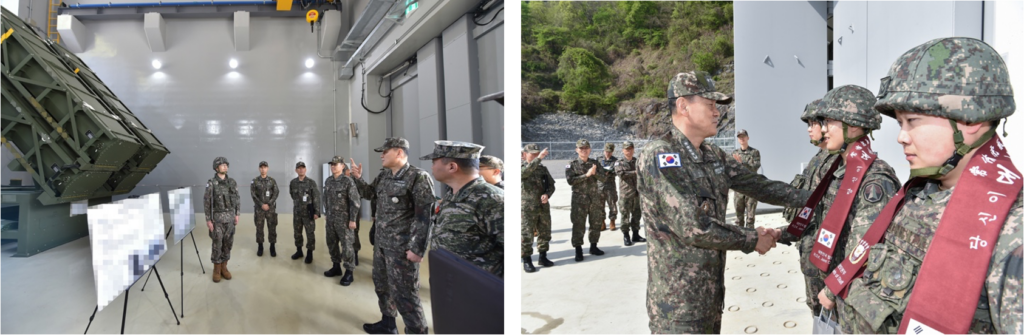
South Korean strategic missile forces are organized under the Army Strategic Missile Command, which is headquartered in Wonju. As I have written about before, the South Koreans have missile bases all over the dang place, many of which have attached launch sites. We assumed that these bunkers must have been built at one of these missile bases, and there are only a handful that are close enough to the DMZ to make a KTSSM deployment make sense given the missile’s short range.
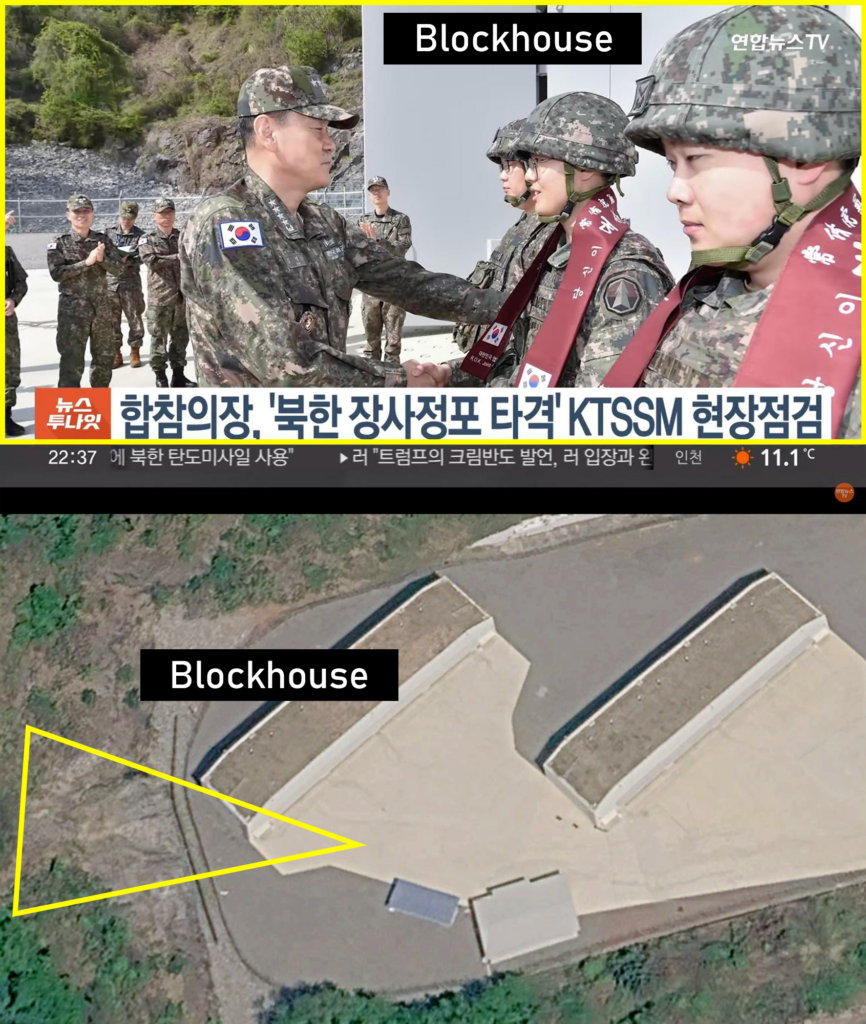
And presto, we immediately got a match. At an Army Strategic Missile Command missile base just outside Seoul (the rule of thumb we sometimes use in North Korea studies that leadership probably doesn’t want to travel too far from Pyongyang, so closer is better, works here for South Korean leaders too), we matched up the picture to a recent satellite image, showing that the angle of the bunker, the fencing, and the nearby topography was an exact match.
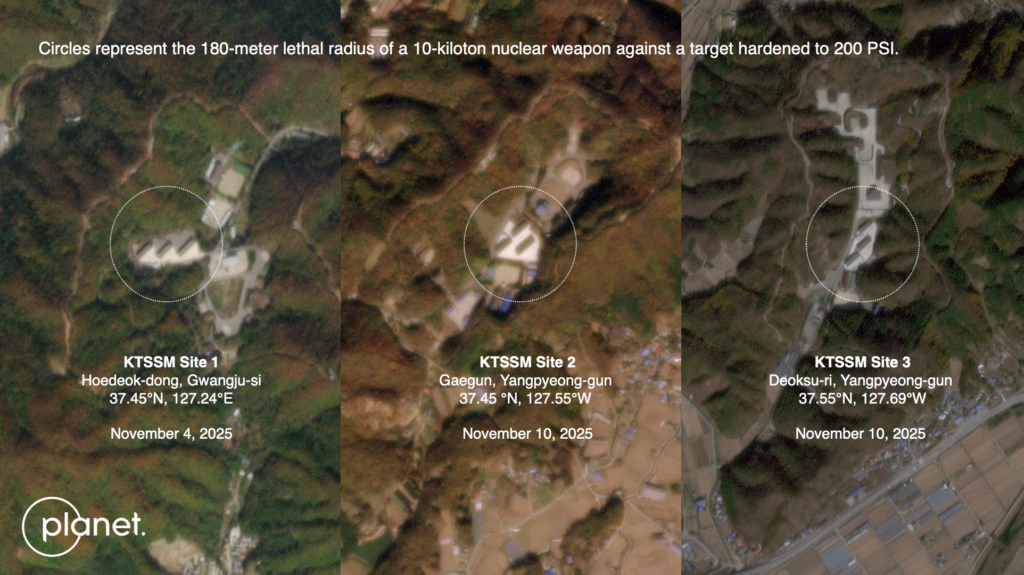
Once we had a signature for the facility, we looked to see if these sorts of bunkers were under construction anywhere else by looking at other Army Strategic Missile bases close to the DMZ. Two more bases had sets of bunkers, bringing the total number of bunkers up to nine.
How did we estimate the number of launchers and missiles?
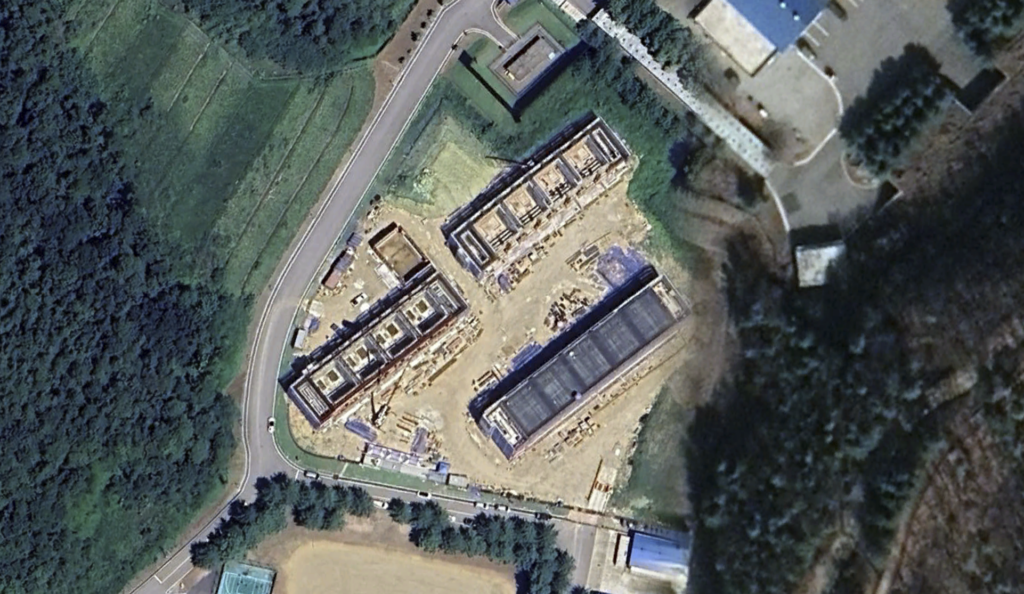
We also luckily got a shot of the bunkers during construction, which revealed their internal layouts. The bunkers are divided into cells, which each have a capacity for two hardstands. If equipped with the KTSSM, the hardstand can fit four missiles, which makes each cell capable of hosting eight KTSSM missiles. Each bunker usually contains four to five cells, making each bunker capable of hosting 32 to 40 KTSSM missiles. As each site has three bunkers, each site is capable of launching about 100 KTSSMs. This brings the total across the three sites to 304.
| Table 1: KTSSM Fixed-Launcher Order of Battle | |||||
| Site | Place | Latitude, Longitude | Construction dates | No. of launch bays | No. of missiles |
| 1 | Hoedeok-dong, Gwangju-si Gyeonggi | 37.45, 127.24 | Mar. 2024—Nov. 2024 | 13 | 104 |
| 2 | Gaegun, Yangpyeong-gun, Gyeonggi | 37.45, 127.55 | Mar. 2024—Jan. 2025 | 13 | 104 |
| 3 | Deoksu-ri, Yangpyeong-gun, Gyeonggi | 37.55, 127.69 | Mar. 2024—Dec. 2024 | 12 | 96 |
| Totals | 38 | 304 | |||
Hardness of the sites
The sites are between 60 and 90 kilometers from the DMZ – outside of the range of North Korean artillery, but positioned close enough for the 180 km range KTSSM-I could easily target North Korean artillery positions. The sites are not, however, outside the range of North Korea’s stockpile of nuclear-armed short-range ballistic missiles, including North Korea’s 600 mm nuclear-armed artillery. (In August 2024, Kim Jong Un oversaw a delivery ceremony for 250 launchers for nuclear-capable Hwasong-11D (KN-24) to “frontline units,” representing about 1,000 such missiles.)
This is why Jeffrey and I were initially so surprised at these sites – they are extremely vulnerable to North Korean missile systems. The blockhouses were above ground, not covered in earth, and clustered very close together. We estimate that the blockhouses are probably hardened to withstand less than 30 PSI.
A single North Korea KN-23 short-range ballistic missile, with a 10 kiloton warhead and a circular error probable of 80 m, would have a greater than 99 percent chance of destroying all three buildings at the site. Even much harder sites would be vulnerable at much lower yields. Below is a table demonstrating the problem – even at higher levels of hardness, North Korean nuclear weapons would have more than a 97% chance of destroying all three buildings. Even if you dropped the yield of the nuclear warhead down to 1 kiloton, you get a 50% SSPK.
| Table 2: SSPK At Different Yields (1 and 10 kt) and Target Hardness (30 and 200 PSI) | ||||
| 10 kt | 10 kt | 1 kt | 1 kt | |
| Target Hardness (PSI) | 200 | 30 | 200 | 30 |
| Lethal Radius (m) | 180 | 420 | 82 | 196 |
| Accuracy (CEP m) | 80 | 80 | 80 | 80 |
| SSPK | 97.01% | >99.99% | 51.72% | 98.44% |
| Warheads to >95% | 1 | 1 | 5 (97.38%) | 1 |
The vulnerability of these sites leads us to conclude that South Korea either does not believe North Korea would target these sites with nuclear weapons in a conflict or, more likely, intends to fire these missile preemptively before North Korea has a chance to target them with nuclear weapons, which is fully in line with South Korean “Kill Chain” doctrine. CJCS Kim described the KTSSM deployments as providing the ability to “proactively respond” (주도적으로 대응할 수 있다) to North Korean long-range artillery threat. The idea of a “proactive response” is self-contradictory: a response is, by definition, a reaction. The phrase itself appears primarily in Korean military discourse, where it functions as a euphemism for preemption.
The problem with South Korea deploying more than 300 missiles to preemptively strike North Korea in a crisis is fairly straight-forward. When we submitted the draft, the idea of a successful effort at leadership decapitation may have struck some as fanciful. Following the successful Israeli decapitation of the Iranian leadership during the 12 Day War, planners in Pyongyang must certainly worry the same thing might happen to them.
The DPRK would not be able to be entirely confident that these bunkers did not contain some other, longer-range missile system intended for targeting Pyongyang. One of the versions of the KTSSM can certainly target Pyongyang from these bases. The ROK censored the photograph inside the launch bay, removing any details from the launcher or the display boards that might have indicated which variant of the missile is deployed in the sites. In other words, South Korea removed precisely the sort of information that would be necessary for Pyongyang to conclude the missiles are not intended to target Pyongyang.
South Korea plans to use its missiles preemptively, but so does North Korea. As we have long-argued, North Korea has a preemptive doctrine that emphasizes targeting US forces in South Korea and Japan with nuclear weapons in the opening phase of a conflict. All of North Korea’s nuclear plans depend upon being the party that initiates the use of nuclear weapons. This requires that Kim Jong Un be alive to issue the order.
These two approaches are mutual exclusive. It is simply not possible for both South and North Korea to go first. Only one can gain the advantage of initiative by acting first, which creates enormous pressure on leaders in both countries to escalate early and dramatically in a crisis.
The Survival article got some interesting comments from South Korean academics. Some of these comments made little sense to me. Shin Seung-Ki, a researcher at the Korea Institute for Defense Analyses, got quoted in response to us in NKNews (reprinted here in Korea Times) claiming that the ROK does not have a preemptive doctrine. “If deterrence fails, we use them [KTSSM] to rapidly neutralize North Korea’s major nuclear capable missiles and forces that can attack us; we do not approach this from a preemptive strike standpoint.” This is nonsensical – if you are deploying hundreds of missiles in fixed hardened structures and placing launch sites at missile bases so you can quickly destroy the adversary’s military forces before they can act, you have a preemptive doctrine.
We don’t, in the essay, have a glib solution to this problem. Our primary goal was to simply reveal a dramatic and previously undetected change in South Korea’s missile deployments, while pointing to the dangers it might pose. Neither South Korea nor North Korea are likely to change their military plans because of an academic article. But, if we could make one suggestion, it would be this. Once a serious crisis begins, escalation might be very difficult to control. A reasonable goal, then, is to work very hard to ensure that such a crisis does not occur in the first place.
