
This is the longer analysis of a news story (“Patriot Missile Involved in Bahrain Blast Likely U.S. Operated, Analysis Finds,”) we did with Jonathan Landay, M.B. Pell, and Travis Hartman at Reuters on the Patriot incident in Bahrain on March 9, 2026.
By Jeffrey Lewis, Michael Duitsman, and Sam Lair
1. Summary Assessment
We assess with moderate-to-high confidence that a U.S. operated Patriot Advanced Capability (PAC) interceptor passed over Block 602 of the Mahazza neighborhood in the early morning of March 9, 2026, when an explosion caused significant damage to residential buildings. Given the damage sustained, where that damage occurred, and the absence of Iranian UAV debris, we believe the damage was mostly caused by the explosion of the Patriot interceptor at a low altitude.
This conclusion is based on a video of a Patriot intercept attempt filmed from Road 1119 in the Riffa neighborhood, about a kilometer from the launch site, as well as video and still images of the damage to two distinct sections of Block 602 of the Mahazza neighborhood on Sitra island.
(Stabilized version of the video showing a U.S. operated Patriot attempting launching in Bahrain.)
The video of the intercept attempt records a Patriot interceptor launching. At the time of launch, exhaust from a previous interceptor hangs in the air, showing a steep upwards trajectory. The interceptor captured on video takes a much lower, northwestern trajectory. This second Patriot interceptor flies toward the horizon, disappears behind a building, and a bright flash is visible 1.3 seconds later. The video ends nineteen seconds after the flash – shortly before the sound wave from the flash reached the viewer.
We are confident that a Patriot interceptor was fired from a U.S. operated Patriot battery near Riffa. We are also confident that the interceptor flew at low-altitude over the neighborhood where the explosion occurred. On balance, we believe the level of damage to the neighborhood and the characteristics of the explosion are broadly consistent with the detonation of the warhead and possibly some residual propellant of a PAC-2 interceptor at a low altitude. Alternative explanations, including the impact of an Iranian drone, appear less likely in light of a video placing a Patriot interceptor at the time of the flash, the amount and pattern of damage to Block 602, and the lack of drone debris.
2. The Patriot Battery
A U.S.-operated PAC battery has been identified at coordinates 26.114°N, 50.586°E near Riffa. Five launchers at this site were visually confirmed in imagery dated March 7, 2026. The Riffa site’s location and orientation are consistent with the trajectory analysis described below.
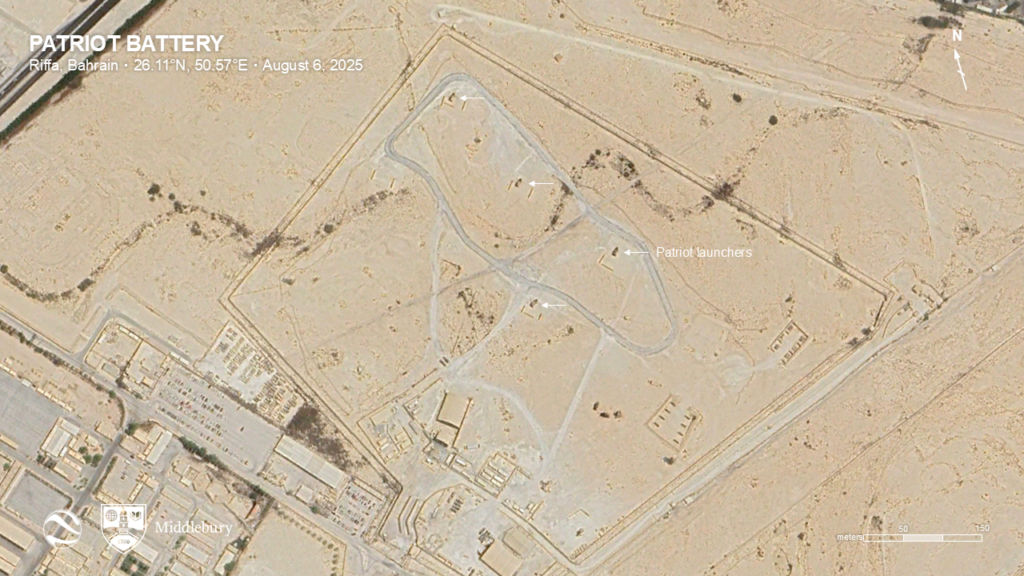
We believe the Riffa PAC battery is likely operated by the United States, rather than the Bahrain Defence Force for two reasons. First, the Riffa battery has been present since at least August 2009. Bahrain did not possess Patriot prior to 2024. Bahrain purchased a pair of Patriot batteries (nine launchers, two radars and two sets of control equipment in total) from the U.S. in 2019 and reportedly began receiving those systems in 2024. There were no significant changes to the infrastructure or layout of the Riffa site after the agreement was made in 2019. This timeline indicates this battery has been continually operated by the U.S.
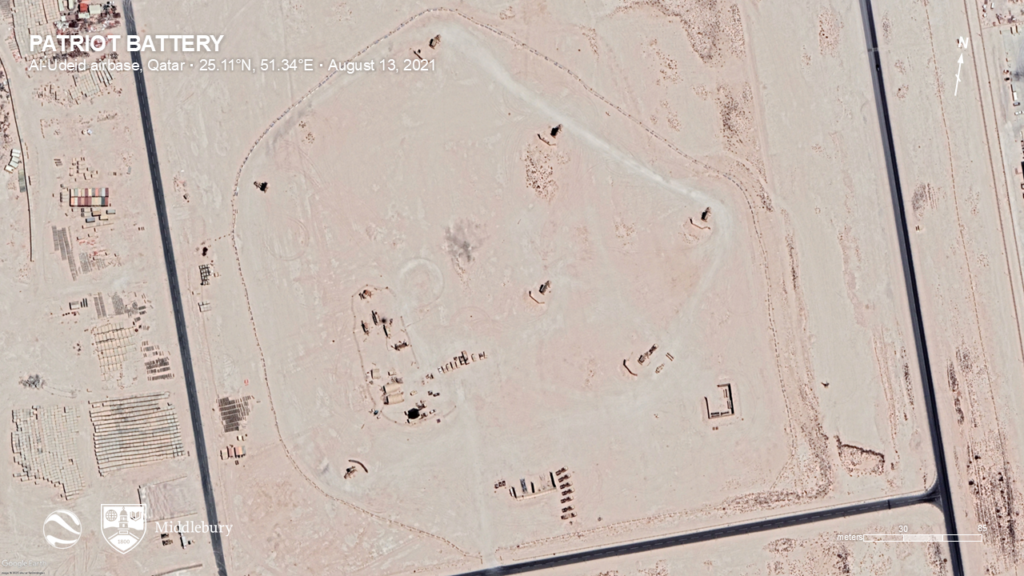
Second, the physical characteristics of the Riffa PAC battery resemble other such U.S. air defense batteries in the region, but not PAC batteries we identified that are operated by the Bahrain Defence Force. The battery near Riffa shares many characteristics with U.S. Patriot batteries at Al-Udeid in Qatar, for instance.
The Riffa and Ul-Udeid sites both feature protective walls for launchers and unpaved roads, and lack permanent buildings.These characteristics are distinct from Bahrain’s Patriot batteries. In 2024, Janes reported the Bahrain Defence Force inaugurated a Patriot air defense base at Ras-al Bar Camp. A month later, a U.S.-Bahrain Joint Command Center was unveiled at the Camp as well. Reporting, official statements, and social media posts surrounding the announcement helped us to geolocate the Camp to a site in southern Bahrain.
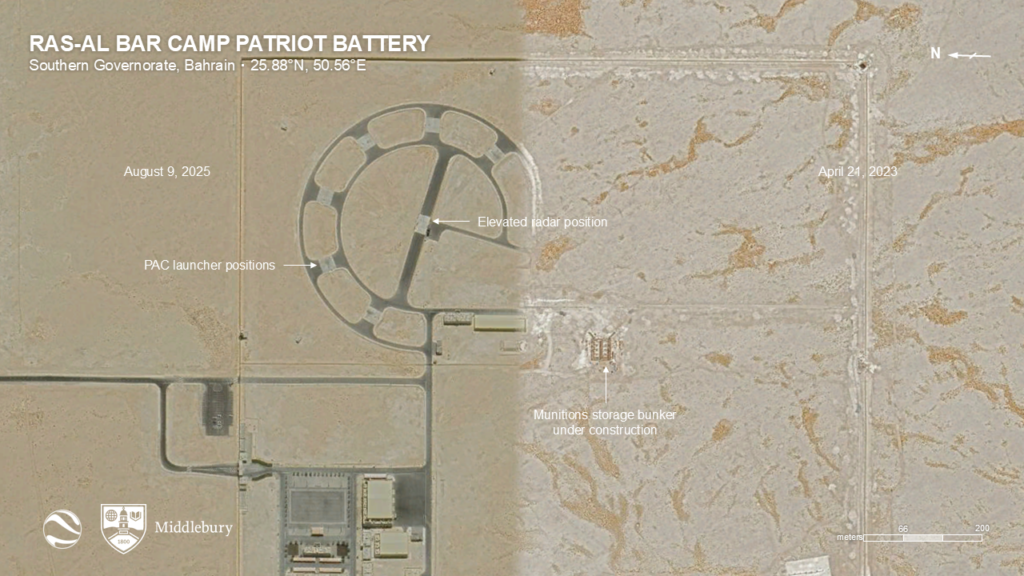
The Ras-al Bar site was only completed in late 2023, aligning with the early 2024 delivery of the Patriots to Bahrain. The site includes an elevated concrete position for the AN/MPQ-65 radar, paved launcher positions, a munitions bunker, a mosque, and several buildings and garages. A Patriot radar and three launchers were visually confirmed at the site on February 28, 2026.
We identified a second site similar to Ras-al Bar Camp just south of Safreh Camp, another BDF facility. We believe these two sites are the only locations where Bahrain deploys its pair of Patriot batteries.
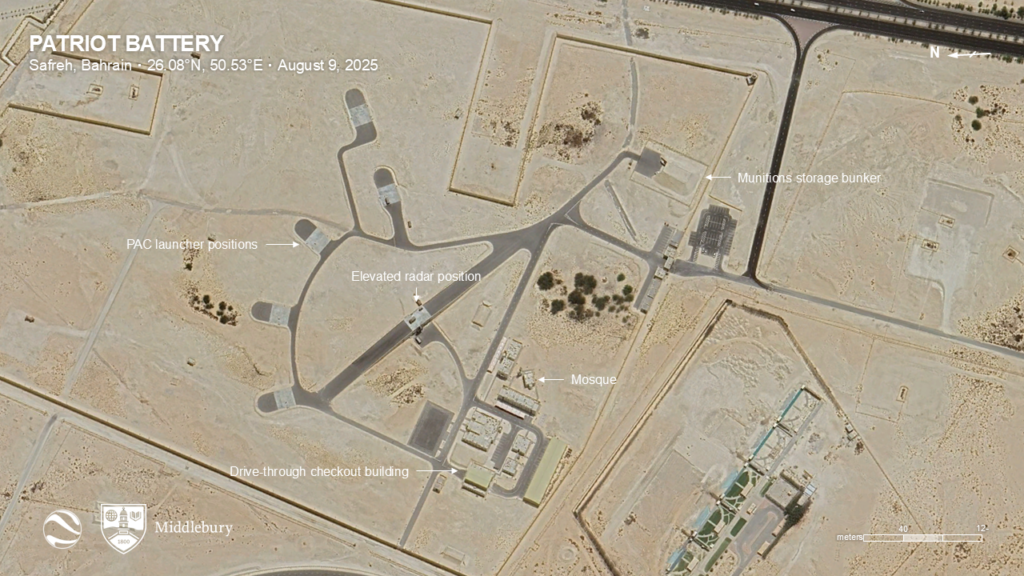
The Safreh and the Ras-al Bar Camps have similar layouts, featuring drive-through checkout buildings for missile launchers. A radar and four launchers were visually confirmed at the Safreh site on February 22, 2026.
These Bahraini sites (Safreh and the Ras-al Bar Camp) are quite distinct from the Riffa battery. Paved roads, permanent infrastructure, elevated radar positions, munitions bunkers, and mosques all distinguish these two batteries from the older Riffa site. This further suggests the Riffa site is operated by the U.S. rather than the BDF.
3. Impact Area — Mahazza Block 602
The explosion reportedly damaged approximately 60 residences and injured 32 people, with blast effects distributed across a few city blocks (1, 2, 3). Multiple open-source videos and images (1, 2, 3, 4, 5) document damage from an explosion in two distinct areas of Block 602 of the Mahazza neighborhood, located north of the PAC battery site. Ground-level footage was geolocated by tracking an observer walking north along Road 220, then west on Road 225, with visible street addresses confirming the location. Morning-after videos were cross-referenced to verify the impact area.
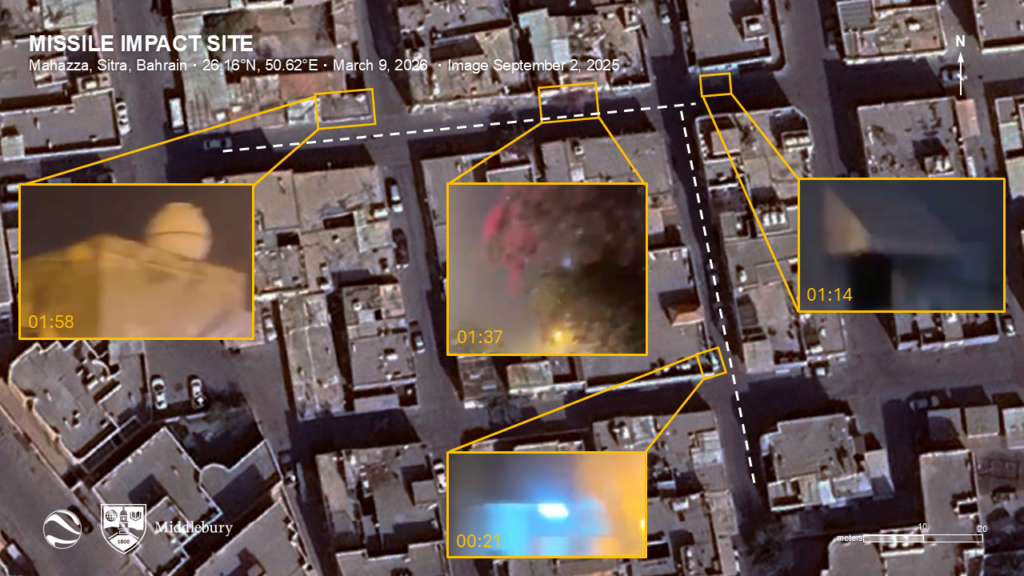
In the course of geolocating the damaged areas, we determined that debris impacted a second area about 120 meters away from the area of main damage. This location is precisely downrange of the Patriot battery near Riffa and consistent with an explosion over Road 220, leading to debris striking a building on Road 221.
4. Trajectory Analysis
Projecting a straight-line trajectory from the Patriot battery near Riffa (26.114°N, 50.586°E) toward the confirmed impact area in Block 602 is geometrically consistent with a northward intercept attempt. A separate video, geolocated to a position adjacent to the battery, shows a Patriot interceptor launch. The interceptor is observed passing behind a building and detonating approximately 1.3 seconds later. The direction of the observer’s gaze at the moment before detonation aligns with the battery-to-impact trajectory.
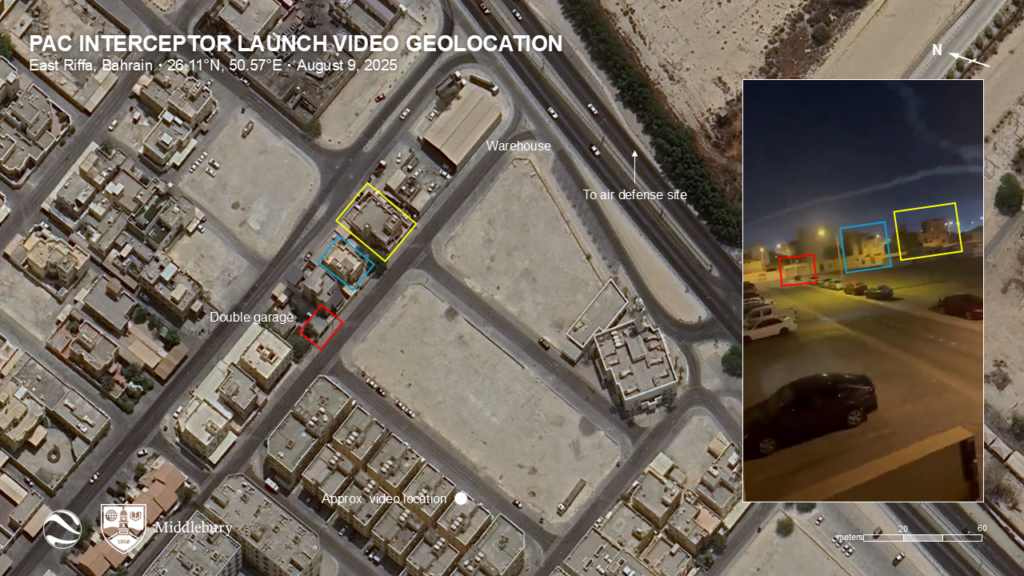
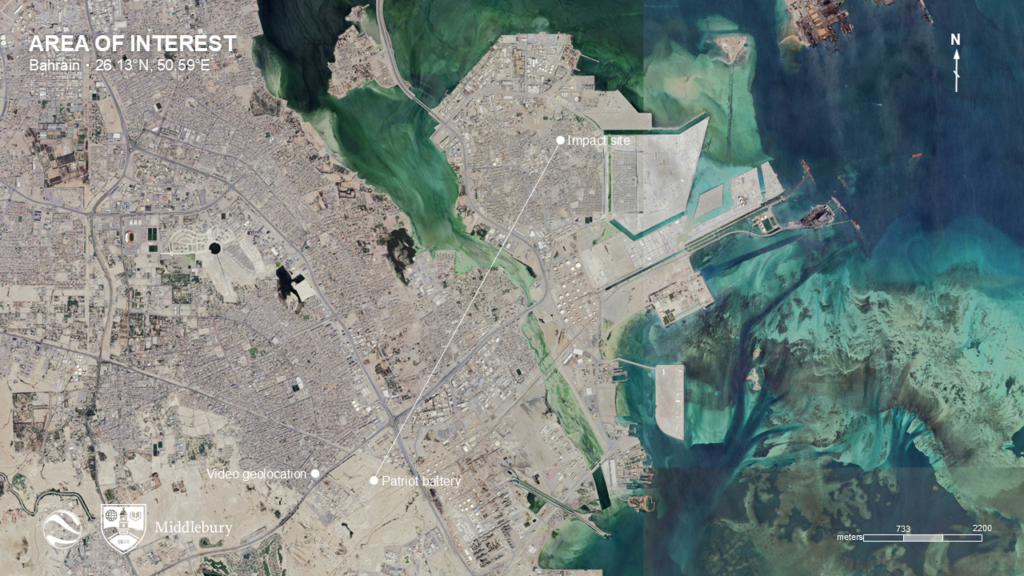
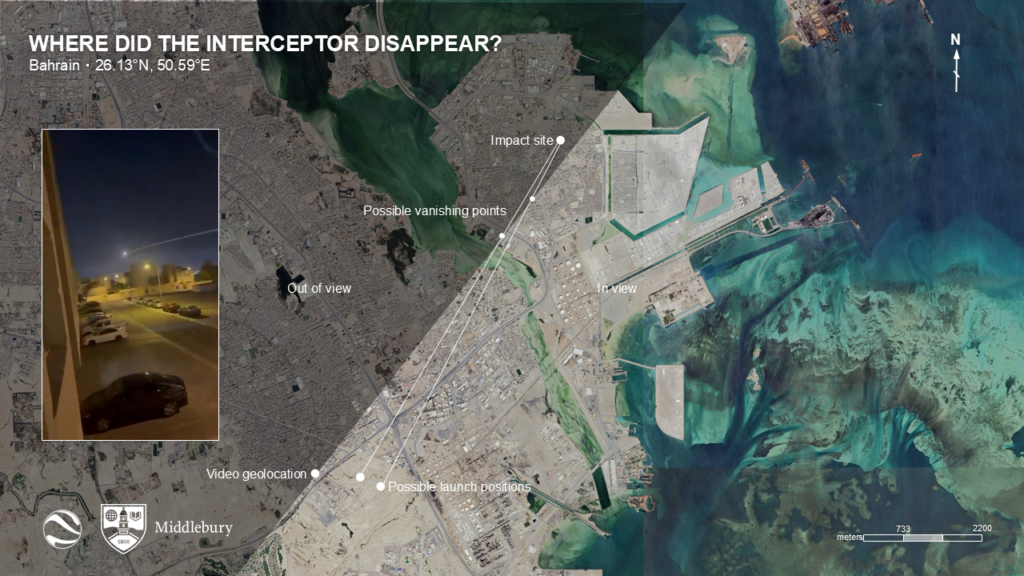
Based on an analysis of the buildings in the video, the interceptor was approximately 240 meters (+/- 20 m)) above sea level when it passed out of view behind the group of buildings in the background. The building the interceptor disappears behind was geolocated to this point, 26.117047°, 50.579113°, roughly 170 meters from the observer. The top of the building is about 6 m above the observer.
Using basic trigonometry we were able to determine that the angle between the observer and the top of the building the interceptor disappeared behind was 2.0 degrees. Given that angle and the distance between the observer and the top of the building, we estimated the altitude of the interceptor when it disappeared behind the building, correcting for the altitude of the observer (~40 m) and the curvature of the earth.
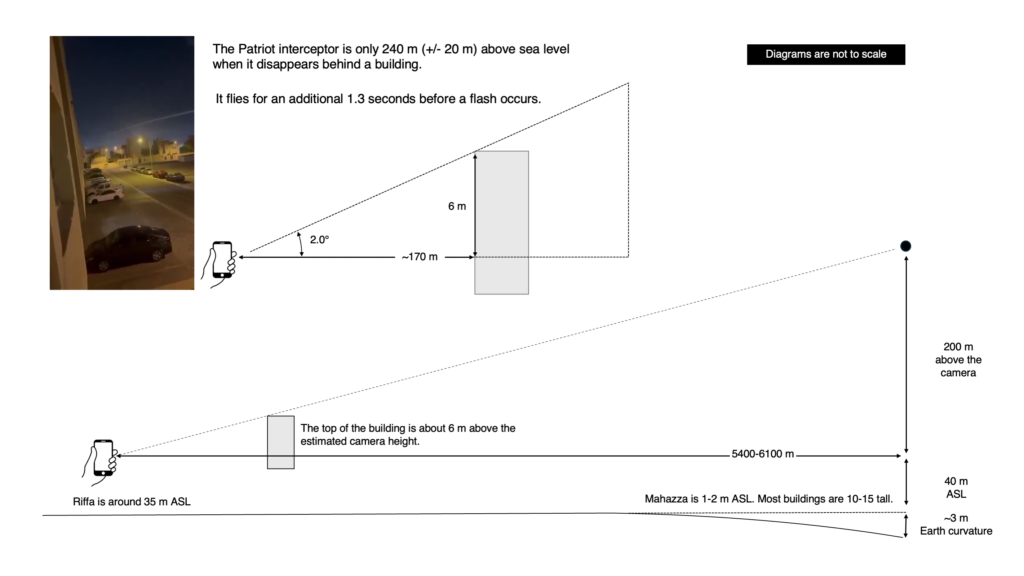
However, the distance between the interceptor and the observer at the time it disappeared varies depending on which launcher the interceptor was fired from. By drawing a line from launch pads to the impact site and seeing where it intercepts with the line of sight of the observer when the interceptor disappears, the rough location of the interceptor’s distance can be determined. From the video location, the interceptor originates from a point to the right of this warehouse (26.115695°, 50.579023°) and to the left of this lightpost.
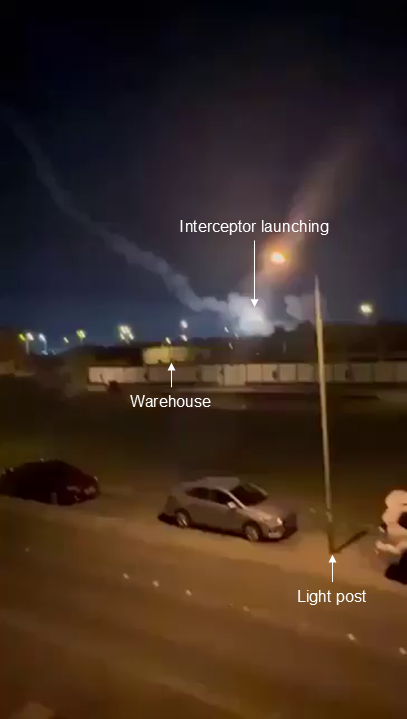
This angle of view excludes one PAC launch site (26.115633°, 50.585939°). Maximum and minimum altitudes can be determined by assessing the trajectory from the eastern-most and western-most launch points. The eastern most, Launch Site 1, is at 26.112841°, 50.588642°. The westernmost, Site 2, is located at 26.114875°, 50.585006°.
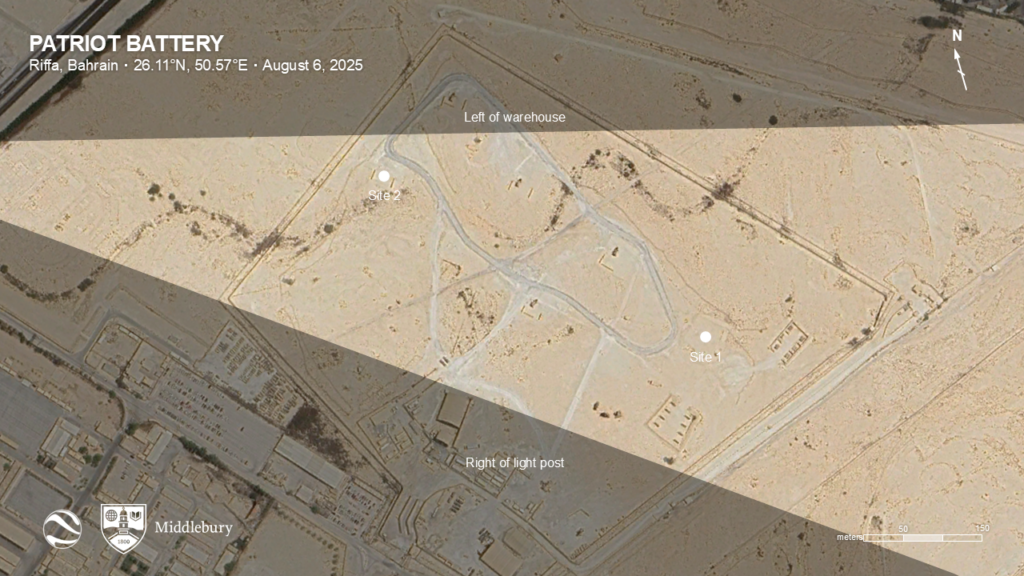
If fired from Site 1, the interceptor is 6,100 m from the observer when it passes out of sight. If fired from Site 2, the interceptor is 5,400 km from the observer. Given these distances, the interceptor is between 232-255 meters above sea level when it exits the frame. Accounting for some uncertainty in our parameters, we assess the interceptor was likely ~240 meters (+/- 20) above sea level when it disappeared.
Given the observed downward trajectory of the interceptor when it passed out of view, it was likely at an altitude lower than 240 meters (+/- 20) at the moment the flash occurred. 240 meters (+/- 20) is therefore a ceiling on the interceptor’s altitude during the flash.
We also determined the distance between the interceptor and the approximate area of the blast at the moment when it passed from the camera’s view using the same method. The center of the area of damage is about 7,100 m from the launch sites. The interceptor disappears about 1,000 meters short of the damaged area when it passes behind the building if fired from Site 1; 1,700 meters if fired from Site 2.
The burnout velocity of a PAC-2 and PAC-3 are both around 1.5 km/s, but this is for a full burn on a normal trajectory. The interceptor would be experiencing substantial atmospheric drag due to the low-altitude of the trajectory. When the interceptor disappears, it is still accelerating, but also experiencing significant drag from the atmosphere and probably falling. A little more than one second (1.3 s) after the interceptor disappears behind the building, a flash is appears. Based on the observed velocity of the interceptor, roughly estimated at 1.1-1.3 m/s, it would have traveled around 1,400-1,700 meters. Given these parameters, it is likely the Patriot interceptor is above the damaged neighborhood when the flash occurs.
5. Technical Assessment — Damage Assessment
According to Bahraini Ministry of Health, the explosion over the Mahazza neighborhood injured 32 people and damaged more than sixty homes.
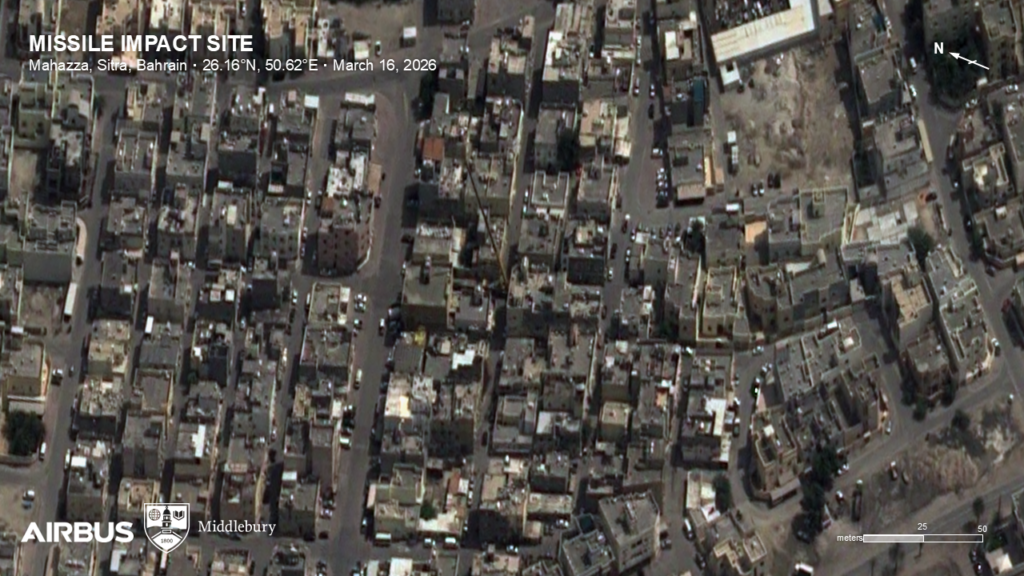
Videos taken after the attack and images released by the Bahrain authorities show most of the damage concentrated along four streets – two blocks of Road 218, two blocks of Road 220, three blocks of Road 225, and three blocks of Road 226. This damage area is rather wide, approximately 20-30 meters in radius with the worst damage concentrated on a few houses.
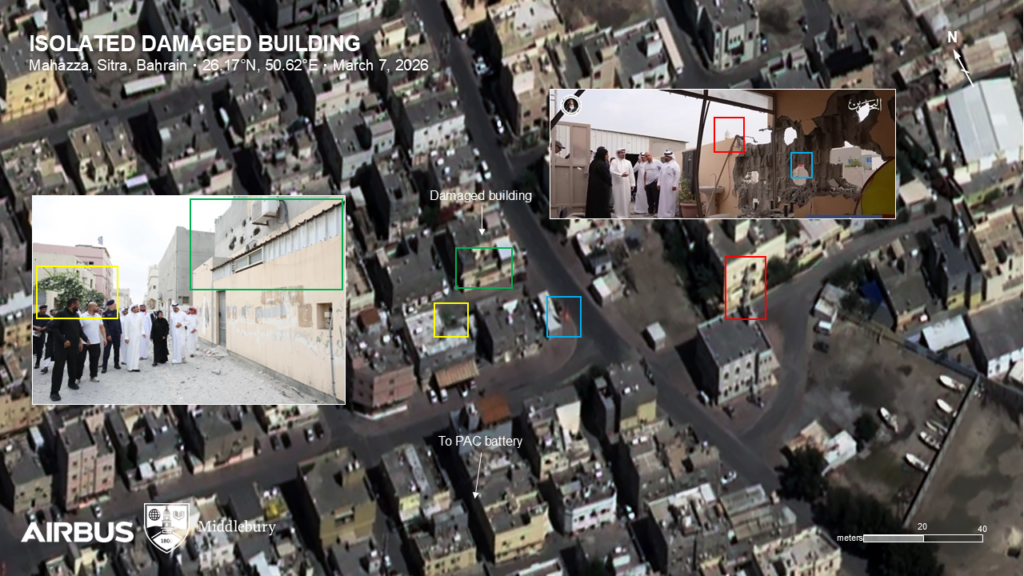
Isolated damage also appears northeast (26.170551°, 50.622611°) where blast fragments penetrated the wall of a home and damaged a car. A Bahrain TV news broadcast and a press release from March 9, 2026 showed an additional damaged home far from the main damaged area. Exterior photos of the home showed a unique roof structure and placed it next to a flowering blush. Interior photos of the home displayed holes in a wall created by shrapnel from the explosion. The damaged area was identified by geolocating which areas of the neighborhood were cordoned off by police in the aftermath of the attack, and comparing it to videos taken in the immediate wake of the explosion.

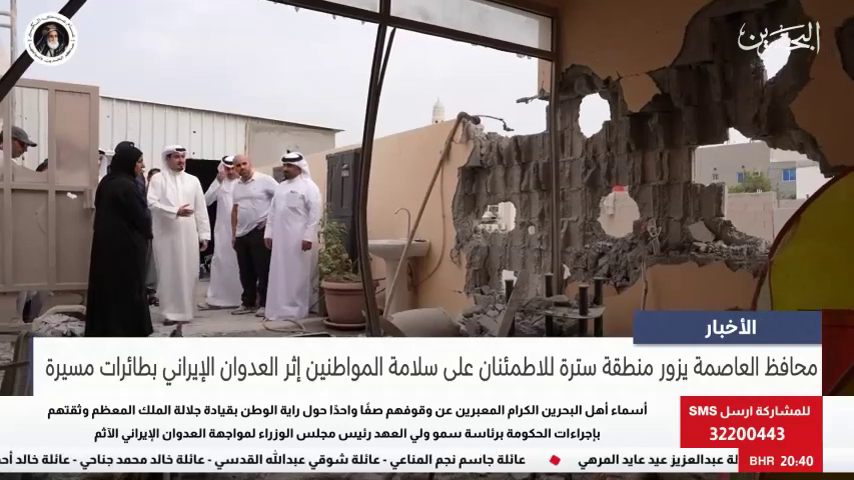
Looking out of the home, a minaret can be seen in the background, as well as a red flag which is visible through one of the shrapnel holes. The bush was located to 26.170407°N, 50.622492°E, the red flag to 26.170324°N, 50.622742°E, the minaret to 26.170178°N, 50.623302°E, which places the building at 26.170558°N, 50.622623°E. This geolocation confirms the site as a distinct impact point separate from the main area damaged.
Taken together, the two damaged areas are consistent with the explosion of the Patriot warhead and/or booster roughly over the intersection of Roads 220 and 225 and fragments from the Patriot warhead continuing for another 120 meters before striking another residence. This pattern, along with the scale and character of the damage, isolated fragment damage, and lack of drone debris, suggest the explosion was the result of the detonation of the warhead and unexpended propellant of a Patriot interceptor rather than an Iranian drone.
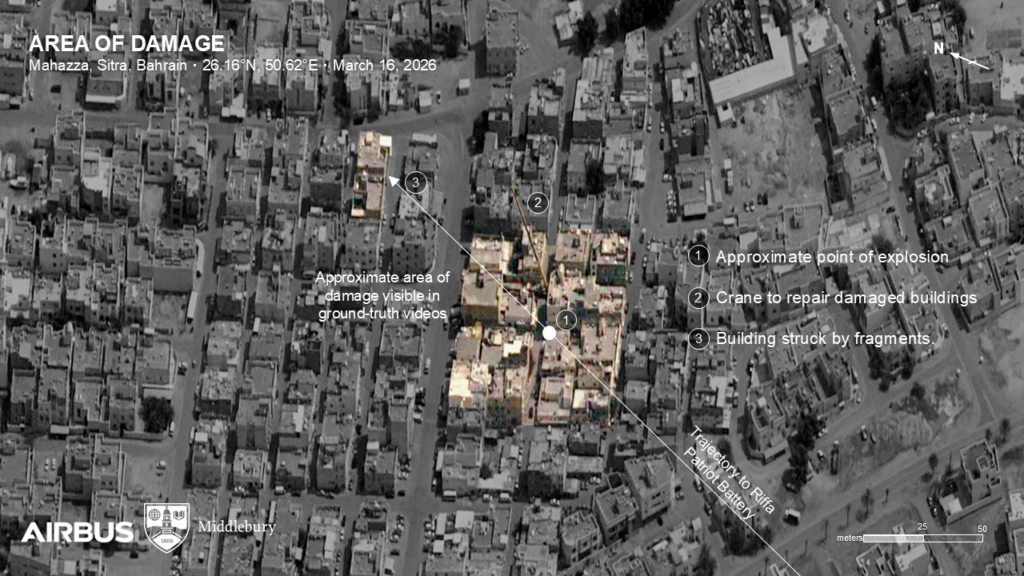
Satellite imagery of the neighborhood does not show a crater or other area of localized damage. Instead of a large, focused explosion originating from an Iranian drone like a Shehed-136, the damage is spread over several blocks, implying a mid-air detonation above the residences. The Shahed-136 carries a 50 kg warhead, and typically explodes on impact with a target. Had the explosion been caused by a Shahed or a similar drone, we would expect to see a primary impact site which experienced significant damage. No such impact point can be seen either in the videos or in satellite imagery. Rather, the distributed nature of the damage is consistent with a small explosion at an altitude of 100 meters or less above the area. That is more consistent with the detonation of a PAC-2 warhead and perhaps some residual propellant.
Whether there is propellant left in the interceptor at the time of the flash depends on which launch site it was fired from. The video of the interceptor launch records about 8.8 seconds of interceptor burn. However, since the interceptor is airborne and accelerating when the video starts, some burn had already occurred. The observer is between 700-1100 meters from the launchers. Given the speed of sound at sea level (340.3 m/s) at the temperature in Manama that morning (~66℉), it would take 2.1-3.2 seconds for the sound to arrive after launch. The sound arrives 1.4 seconds into the video, indicating the launch began 0.7-1.8 seconds prior to the video starting. The observer is about 7400 meters away from the explosion, which would take 21.7 seconds to arrive. The video cuts off about 19 seconds after the flash, before the sound arrives, explaining why the sound of the explosion is not recorded in the video.
| Time | Event | T (Time Launch) | V (Time Video) |
| T0 | Launch | 0 | -0.7-1.8 |
| T1 | Video Start | 0.7-1.8 | 0 |
| T2 | Sound Arrives | 2.1-3.2 | 1.4 |
| T3 | Disappear | 9.5-10.6 | 8.8 |
| T4 | Flash | 10.8-11.9 | 10.1 |
| T5 | Video Ends | 29.2-30.3 | 28.5 |
| T6 | Sound Arrives | 32.3-33.4 | 31.6 |
The flash therefore occurs 10.8-11.9 seconds after burn begins. Depending on whether the interceptor was a PAC-2 or PAC-3 variant, this burn time indicates there may have been some propellant left in the motor when the flash occurred. Textual and video evidence indicates PAC-2 burns for about 11.5 seconds. PAC-2’s motor, the Thiokol TX-482, weighs 592 kg. 10.8 seconds of burn is about 93% of PAC-2’s total burn time. If the PAC-2 motor has a consistent burn rate, then the interceptor had at most about 36 kg of unspent propellant at the time the flash occurred.
The PAC-3 motor likely weighs 158 kg and burns for approximately 18 seconds based on analysis of test footage. At a consistent burn rate, 10.8-11.9 seconds of burn would leave about 63-53 kg of propellant in the booster at the time the flash occurred. Since PAC-3 has a dual-thrust solid propellant motor and likely has a grain configuration designed to accelerate more aggressively and burn more propellant during the initial phase of flight, this is probably an overestimate. Nevertheless, it is a useful approximation for how much propellant might still remain in the booster.
PAC-2 carries a 84 kg blast fragmentation warhead with metal fragments designed to help kill incoming aircraft and missiles. Since those fragments make up a large portion of the warhead’s weight, perhaps 30 kg or so, there is likely around 50 kg of explosive in the PAC-2 warhead. While PAC-3 also carries a warhead, it is very small, about 330 grams or so.
Images of the damage released by Bahraini authorities show holes in the wall of a house consistent with pieces of shrapnel from a fragmentation warhead. The location of that isolated damage also suggests the explosion was caused by a fragmentation warhead. The damaged house is approximately 120 meters northeast of the damaged area, along a downrange trajectory from the PAC battery in Riffa. These fragments were likely carried by the momentum of the interceptor downrange from the blast point over the neighborhood in Mahazza, where they then damaged the house. The abrupt cutoff of damage between the upper and lower half of the building suggests the trajectory of the missile fragments was such that some of them hit the building across the street to the south while the remainder continued, impacting the building visited by the Bahraini Capital Governor.
This isolated damage, around 120 meters away from the rest of the destruction, is inconsistent with damage from an Iranian drone. Based on these warhead characteristics and the observed damage, we assess the most likely cause of the damage is the detonation of a PAC-2 warhead and perhaps some residual propellant over the neighborhood.
6. Alternative Hypothesis and Caveats
We see four possible explanations for the explosion and the presence of the Patriot interceptor over the neighborhood at the same time.
The first explanation is that the Patriot battery fired two interceptors at an inbound drone or missile, and one misfired or suffered a failure, heading towards the neighborhood and exploding. Launching two interceptors at one target is consistent with other observed Patriot intercept attempts during this conflict, and is likely a strategy to raise the probability of kill of an inbound target. Based on the difference in observed exhaust of the first and second interceptors launched, the second interceptor misfired. We regard this as the most plausible explanation.
A second explanation is the interceptor was fired against a genuine low-altitude target, perhaps a drone. In this scenario, the interceptor hit the target at low-altitude, triggering the target’s payload along with any remaining propellant and damaging the residential area. (Note: After having claimed that a drone alone was responsible for the damage, Bahraini authorities have now advanced this explanation.) The U.S. army previously tested Patriot against low-altitude threats like low-flying cruise missiles. If this was the case, this was an irresponsible intercept attempt as it endangered the lives and homes of allied civilians in a residential area. Without debris from an Iranian drone, this explanation is less compelling.
Third is the interceptor was fired against a false radar return at low-altitude over the residential neighborhood. Our assessment of that course of action being irresponsible still holds.
Fourth is that the interceptor was fired at an Iranian drone, but missed and fell into the ocean while the drone detonated over the neighborhood. We believe this explanation is unlikely to produce the damage observed without an unlikely series of coincidences involving the drone exploding in mid-air as the interceptor passes over the neighborhood and fragments from the drone follow the tractor of the interceptor but only the trajectory of the interceptor.
In the absence of any debris indicating the explosion was from an Iranian drone, including airframe or engine components, and in the absence of evidence for a secondary explosion, we believe the first explanation to be the most likely. If this was indeed a genuine intercept attempt against a genuine Iranian drone, the low-altitude of the threat makes this an irresponsible defensive action that is out of character with past U.S. military intercept attempts. The kinetic energy and, if it is a PAC-2, the high-explosive fragmentation warhead, aloing the potential for something to go awry, place civilians at as much risk as the threatening drone itself — something evident by the scale of damage and the injuries to local people.

Leave a Reply