
Today’s Guest Post is from Josiah Durfee a Middlebury College grad and former Team member in Monterey. He is currently based in the UK where he is getting a Masters of Strategic Studies at the University of St Andrews. In this article Josiah will take us through his deep interests in OSINT data sources, UAVs and excellent artistic presentations of data.
Observers of the Russia-Ukraine war have often commented on the vital role of drones. Unmanned aerial systems (UASs), the technical term for drones, caused 60–80% of the vehicle destructions in 2025. Both Russia and Ukraine have formed new military branches dedicated solely to unmanned systems. Other countries have taken note and begun investing heavily into drone technology. Although the exact extent of their impact is debated, it is safe to say that drones have played an important part in the war.
However, drones are not a monolith. Both Ukraine and Russia have consistently developed new drone technologies and techniques over the course of the war. One of these innovations was the fiber-optic drone in the summer of 2024, which quickly proved effective at defeating radio frequency jamming. Jamming was the main defense and highly effective against wireless remote-control drones, so the emergence of wired fiber-optic drones was significant. Analysts have reported that the enhanced range allowed by jamming resistance and physical connection has resulted in a proliferation of strikes deeper behind the frontline, with zones previously threatened only by artillery suddenly vulnerable to punishing drone strikes. While wireless drones would usually be lucky to get 10 km behind the frontline before losing connection or being jammed, fiber-optic drones can reach 20 km, or even 40 km in good conditions.
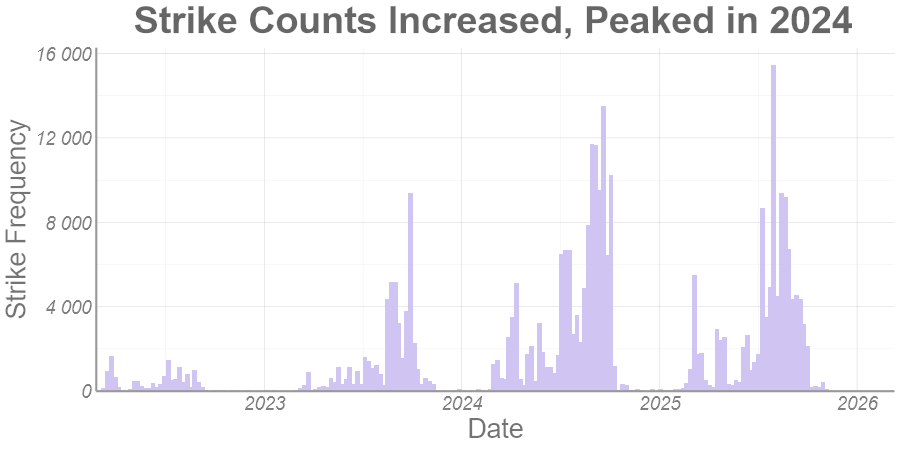
Figure 1: Weekly war-related FIRMS detection in Ukraine since the start of the full-scale invasion. Data from The Economist and FIRMS.
I sought to give this commentary on the impact of fiber-optic drones a quantitative backbone by using open-source intelligence (OSINT) data to compare the range of strikes in 2025 to 2024, before fiber-optic drones gained prominence. The conclusion that fiber-optic drones have increased the range of strikes would be supported if the range of strikes in 2025 is statistically greater than in 2024. I used two datasets for the analysis, accounting for the locations of strikes and the location of the frontline at the time, respectively. The first is the Economist’s filtering of NASA’s Fire Information for Resource Management System (FIRMS), a public tool displaying active fire locations across the globe using real-time satellite imagery. The Economist was early to observe that these data could be used to track the fighting in Ukraine, given that bombs and strikes produce fires, and created a daily mapping update showing what regions were experiencing the most fighting. Included in their workflow is a machine learning algorithm that filters the FIRMS data to include only those fires assessed as war-related and caused by deliberate artillery, drone, or missile strikes. The model is consistently accurate but limited by flaws inherent to machine learning and local variance, such as inclement weather. Despite these limitations, a significant difference in a large dataset should indicate a notable change – thus, I used over 500 days of data spread across 2024 and 2025 for a robust comparison. The Economist provides all their code and methodology open-source here. 2025 has seen fewer war-related fires overall (Figure 1).
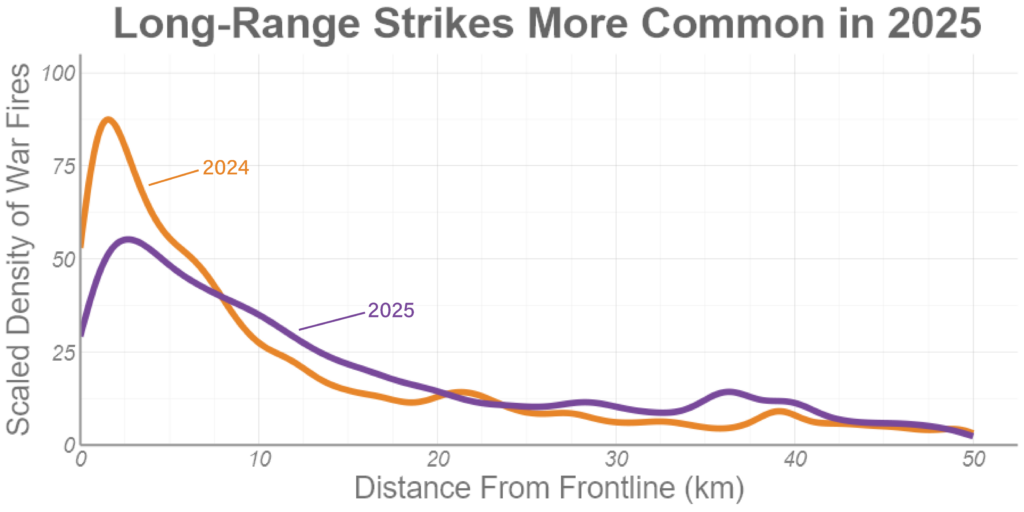
Figure 2: Density of war-related fires in May-September, 2024 vs 2025. Data from The Economist, FIRMS, LiveUAMap, and my own calculations.
The second set of OSINT data I worked with are geolocated maps of the frontline. Numerous OSINT publications, including the Institute for the Study of War, LiveUAMap, and DeepStateMap, gather geolocated troop positions and battles along the frontline to map the resulting changes in control. These data can be acquired for specific dates of the war and provide exact coordinate geodata of the extent of the frontline for any given day. I used the Economist’s war-fire data and LiveUAMap’s frontline data to calculate the distance of war-related fires from the frontline for every week of the war. War-related fires further from the frontline would presumably be caused by longer range weapons, so a significant increase in distance would imply that longer-range weapons, such as fiber-optic drones, are increasingly employed with success.
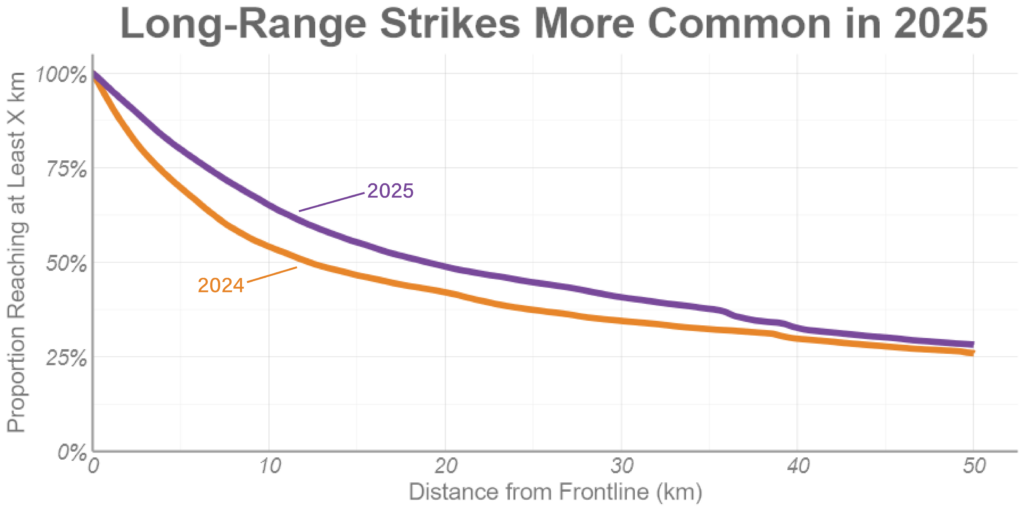
Figure 3: Density of war-related fires in May-September, 2024 vs 2025. Data from The Economist, FIRMS, LiveUAMap, and my own calculations.
The results are clear: the war fires in 2025 were significantly further from the frontline than those in 2024, before fiber-optic drones gained prominence. This supports the qualitative reports that the introduction of fiber-optic drones increased the range of strikes. Figure 2 shows a density plot of the distance of strikes for 2024 and 2025, and figure 3 shows which proportion of strikes reach which distances; only the months of May through September are included, as the others were generally too cloudy for the satellites’ data to be useful. In 2025, there were proportionally fewer short-range strikes and more long-range strikes, with a median distance of 19 km compared to 12.3 km in 2024. Strikes reaching at least 10 and 20 km both increased about 12% in relative prevalence. The most common strikes in 2024 were around 1.6 km from the frontline compared to 2.6 km in 2025. Maps 1 and 2 display these trends in the eastern Kherson region where the frontline of which has stabilized along the banks of the Dnipro river, making a visual comparison viable. This analysis supports the qualitative observations on the effects of fiber-optic drones, but it is not a conclusive study; that would require further research on the relative frequency of different drone and artillery systems to suggest causation.
Maps
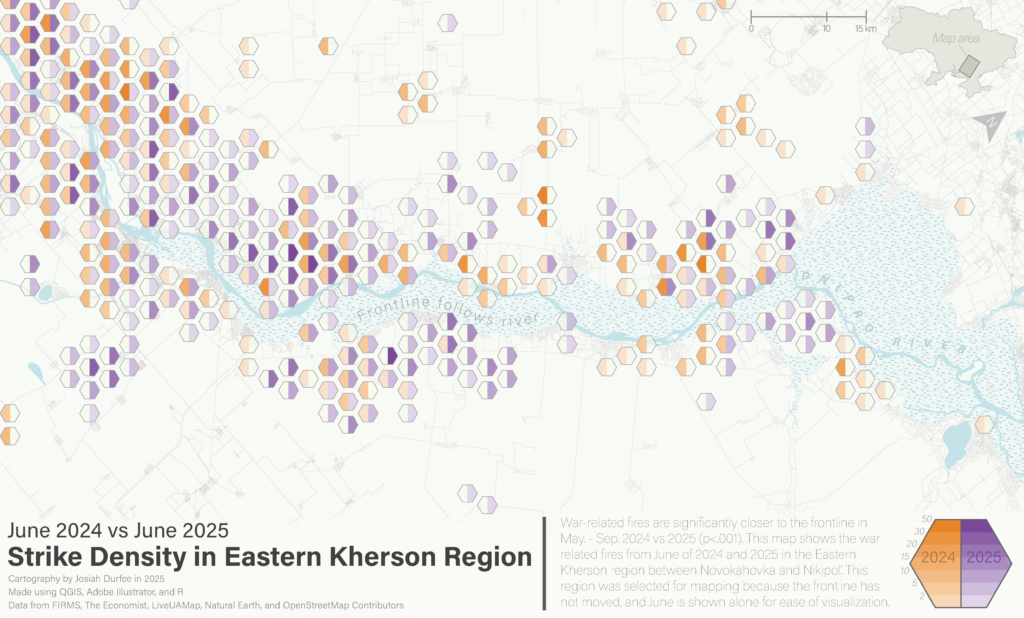
Map 1: Strike density in eastern Kherson region.
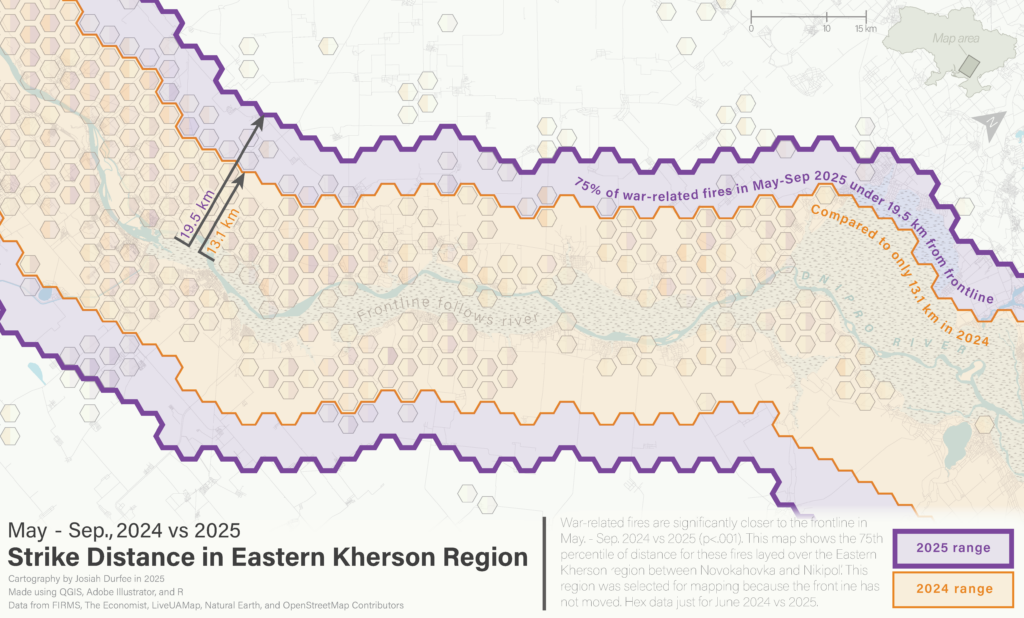
Map 2: Strike distance in eastern Kherson region.
