Transcript
Transcribed automatically: it certainly contains errors. It’s pretty good, just not perfect. We provide it here because, for accessibility, it’s better than nothing.
Jeffrey Lewis
0:02
What the fuck? You are listening to the Arms Control Wonk podcast, the leading podcast on arms control, disarmament, and nonproliferation. I'm Jeffrey Lewis, the founding publisher of the Arms Control Wonk blog and a scholar at the Middlebury Institute of International Studies at Monterey.
Aaron Stein
0:25
And I'm Aaron Stein, a senior fellow at the Atlantic Council's Rafiq Hariri Center for the Middle East.
Aaron
0:32
Yes?
[Sponsor message]
We have to talk about the tweet. We have to. I mean... I don't want to talk about the tweet. In true Arms Control Wonk podcast fashion, I don't want to chase the tweets, but last night was something special.
Jeffrey
1:32
Yeah, you know, I think we should probably talk about it because it's not really just a question of the intemperate remarks that the president made yet again about North Korea on Twitter. It really goes to a fundamental question that I think has been dominating our discussion about North Korea, which is, is the Trump administration truly considering a military strike?
I get a lot of emails about it. People are very worried about it. People like Colin Kahl and John Wolfstahl think that they truly are. I have been of the view that they are bluffing. And kind of regardless of what you think about that, just seeing the president's tweet Brings forth this enormous anxiety. I mean, and I can tell it because I can watch traffic for my article in the Washington Post on what a nuclear war with North Korea look like.
I can see its spike. Well, what I see is people retweeting it. So I think we got to talk about the tweet, not to talk about how much we Loathe the president for a man for whom I have nothing but contempt, but as a policy matter to talk about what this tells us about policymaking and where we are in terms of the threat of war with North Korea.
Aaron
3:00
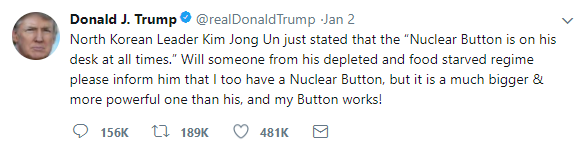
Well, firstly, we should read it for the listeners, just in case they're like the small percentage of the self-selecting crowd that tunes into our podcast who have not seen the president's tweet. So last night, we were recording this on Wednesday, January 3rd, so on the evening of January 2nd, President Trump tweeted, North Korean leader Kim Jong-un just stated that the nuclear button is on his desk at all times.
Will someone from his depleted and food-starved regime please inform him that I too have a nuclear button, but it is a much bigger and more powerful one than his, and my button works. What a f***ing child. I mean, I'm speechless. I read it last night and I don't follow the president on Twitter, but his tweets make their way into my feed.
And at first I thought somebody had been duped by a parody account. I really have to be honest. And I flipped over to his feed and I said, that can't possibly be what he wrote. And he wrote it. And it brings up just, in me, deep-seated anxiety about the policymaking process. And questions about whether he's taking this seriously, which I think is also a reflection of the policymaking process.
Because he is the boss.
Jeffrey
4:18
Yeah. I mean, I think the place we start with, there is no button. Yeah. I mean, yes. I mean, I know Kim Jong-un said he had a button. He was speaking metaphorically. It's not a button.
Aaron
4:29
Yeah. No, I actually almost tweeted that last night, but then I decided I would not. But let's talk about what it actually looks like, the biscuit and the football.
Jeffrey
4:37
Yeah. And the reason I want to do that is because during the campaign, the role of the president in ordering a use of nuclear weapons was a kind of regular tool for discussing his fitness or lack thereof for office. You know, the proverbial 3 a.m. phone call, the finger on the button, those metaphors are all meant not really to be discussions about nuclear policy, but rather discussions about the awesome responsibility of the presidency and his manifest inability to fulfill those responsibilities.
Yeah. So, I mean... There is no button, and his desk is probably not involved, but yes. There is a football, which is a way for the president to communicate with the National Military Command Center in the Pentagon. Sorry, it is the president's emergency satchel. Satchel sounds much less macho, I guess. It's better than man purse. Oh my god.
You know what? I think we should absolutely insist that the president's military aid be forced to carry a satchel that looks like a man purse. Call it the Merce? I mean, look, if you're going to carry around the destruction... Like the capability to destroy the world in a matter of a few keystrokes and a voice command. There should be an emasculating component to this so you don't get so high and mighty on yourself.
Like, if you're going to destroy the world, you have to ask it to bring over the man purse, right?
Aaron
6:25
We can come back to maybe emasculation and issues of size later.
Jeffrey
6:29
Well, I mean, this is all about penises right down to the size of his button. You're right. Okay. But the point, which I do think is important, and I think we should talk about the two command and control systems in a moment, because... One of the questions I get is, well, does this make you more or less worried than a normal layperson?
And usually the question is, are you as an expert less worried than the rest of us are who are looking at this? And the answer is, no, I'm more worried. And one of the reasons I'm more worried is because the... President has the full and unfettered authority to order a use of nuclear weapons, right? So there is the football, aka the president's emergency satchel, which allows him to communicate directly with the National Military Command Center, which will then format emergency action messages, which will then go out to launch units.
And the only safeguard is the biscuit, right? Which is just a code that authenticates the president's voice.
Jeffrey
7:32
And so, in fact, really the only safeguard against the president ordering nuclear weapons is the election. And that's a safeguard that failed.
Aaron
7:39
Right. We... By voting for this person and putting them in office or empowering them to have this authority. Because I don't think, you know, these systems were not set up for a person who tweets like Donald Trump tweets. I mean, I just have to say it.
Jeffrey
7:54
That's right. If this is in any way, shape or form a reflection of his mind and everything that we've seen in reporting suggests that it is right, that he, you know, sits in a bathrobe and watches a bunch of cable news You know, the system is not designed to safeguard us against a person like that, except through the process of the election.
You're just not supposed to elect an unfit person. You know, and it's like, okay, I loathe the man. I have nothing but contempt for the man. I mean, but, you know, like, Republicans know this is true. You know, as best I can tell, virtually every Republican who works for the man in Washington hates his guts.
Aaron
8:39
Or is deeply uncomfortable with his approach to policymaking and understanding complicated issues like, say, deterrence or a strike against North Korea.
Jeffrey
8:49
Right. So, you know, I mean, this is not a normal moment. This is not a comment about all Republican candidates. This is a comment about this particular man who is a nightmare. Absolutely. But, you know, it raises this other question, like, what does the North Korean command and control system look like? I mean, the North Koreans picked this phrase button because it was ambiguous.
You know, they weren't... They weren't honestly describing a button, right? They were using it as a metaphor so that they did not have to describe their command and control system. And I worry about that because Ankit Panda and Vipin Narang have a really nice article speculating about North Korean command and control. But the answer is we don't know.
Aaron
9:31
Yeah. And by the way, caveat, all of their articles are good. And the other thing is that we absolutely have no idea as outsiders what it looks like. And I would venture to guess on the inside, it's a lot of guesstimation and guesswork.
Jeffrey
9:44
Yeah. So, I mean, just as we begin to consider what this tweet means, I mean, I think the backdrop for this is You know, I think people imagine that there are these systems in place that will save us. But the reality is that we don't know what the North Korean command and control system looks like at all.
And the American command and control system is one that we should be worried about. Not worried about if you had a normal president, but worried about if you have this particular president. And we say that, I think, as both people who are a little skeptical of the Markey-Lew bill that would have restricted the president's authority to use nuclear weapons.
Aaron
10:25
Yeah, and I think, you know, against this backdrop, it was before the new year, as you reference it up top, is that there was speculation about this. Whether the next time the North Koreans are considering a test, whether the U.S. would give them a quote-unquote bloody nose. And I think Wolfstahl and Colin Kahl both put this out there as real concerns about this idea that you can control escalation with the North Koreans and that you could try and compel them to make changes through what is often floated out there, particularly amongst the right, of this idea that you can take the missile out on the launcher, give them a bloody nose.
Jeffrey
11:04
Yeah, this is where one of the interesting things happens. You know, so I wrote a column for foreign policy, but things have moved a little bit since then. There basically were a pair of stories, one in the Daily Telegraph, which, you know, is the subject of that famous Yes Minister episode, where... Jim Hacker, the minister in question, is asked if he knows who reads the papers, and he gives a picture-perfect description of British news, and it ends with a joke at the expense of the Daily Telegraph.
Jeffrey
11:37
That was then followed up by a piece, I think, in Yahoo News, which had similar but different sourcing. And it basically all said that there was a debate inside the White House about what to do, and there was a range of options being considered. Now, at the high end of this is something that was being called the bloody nose, which, by the way, I hate metaphors when we're talking about killing people and risking a nuclear war.
Especially one as stupid as bloody nose. Right. Because punching someone in the face, they don't necessarily know that you intend to stop at the bloody nose.
Jeffrey
12:13
Like, imagine you were going to go up and a person had a gun and you punch him in the face. If he pulls out the gun and shoots you as you're bleeding to death, you don't scream, but it was only a bloody nose! Right? Like, you're assaulting a person. And I think the same is true here. ...
It's a crazy idea, but the idea would be to blow up a symbolic target, not to actually interfere necessarily with a test or to disarm the North Koreans. More on that in a second. But to go ahead and blow up a facility like, say, the Yongbyon nuclear reactor or maybe the Nuclear Weapons Institute or maybe one of the missile locations in order to punish them.
The problem, of course, is you don't disarm them in doing that. You're blowing up one location symbolically that's involved in the production of stuff. They still have an arsenal of, you know, up to 60 nuclear-armed missiles, which then is pointing at you, and they're very pissed off. And they may not even know that it's limited, right? Right?
When the lights go out and things start blowing up, All kinds of rumors go crazy. So, yeah, there's a discussion. I actually think, though, that while that may be under consideration, I think they're bluffing. And I know that Colin and John don't agree with me. And I think we all agree that this is a terrible thing for them to be contemplating and a terrible thing for them to be bluffing.
But I think the reality is that they don't know what to do. And Steve Bannon admitted it as much in that interview with the American prospect, right, where he said there was no option in North Korea. And the president fired him for it. But I think it then raises this bigger question about policymaking, which is they don't know what to do, and yet they know that the president watches cable TV.
So when somebody like McMaster goes out Knows he's going to be quoted. He has to put on like this little show for his boss. And I think that they have, they're kind of enablers in this way that the president, I think, does actually probably want military options, probably is pushing in this direction. The staff knows it's crazy, but I think they are trying to take the fundamental dysfunction that's on display and turn it into some kind of good cop, bad cop routine, hoping that maybe the Chinese will be frightened enough to do some unspecified thing.
But I think it's really dangerous because it's very irresponsible.
Aaron
14:41
Yeah, I mean, I think it should be said that within a normal policymaking process, through the course of, you know, how policy gets made, you know, there will be input on potential military responses. You know, as a matter of course, and it's not all that noteworthy that, you know, some variation of bloody nose would be put out there.
I mean, it... It makes some sort of logical sense if you're being forced to sit down and write some language about military options for the president to try and stay below the nuclear threshold, but to convey American seriousness about punishing them for... For provocative missile tests or nuclear tests or both. But I think the ultimate problem is I do think that there is a strain of thinking within the White House that tries to take advantage of the crazy, that Trump is just so unpredictable that you don't know what he's going to do.
And so this becomes part of a policy to try and force negotiations.
Jeffrey
15:46
Well, and I think that's right. I think that they are, in this sense, enabling the president.
Aaron
15:51
Yeah. And the Twitter feed in this is viewed as a tool. Even though you can't control them, you sort of shrug your shoulders and say, well, he's just crazy. So you might as well come to the table with us.
Jeffrey
16:02
Right. Well, so when you're dealing with an addict, right, what enabling is, is when the third party makes an accommodation for a person's harmful conduct, right? Yeah.
Aaron
16:11
Yeah. I mean, I guess.
Jeffrey
16:13
And that's what they're doing, right? They're making such an accommodation that the president is suggesting things that are unwise and dangerous and saying things that are unwise and dangerous. And instead of an intervention and confronting him about the behavior and trying to change his behavior. Which I get it is hard because he's the president of the United States, and so he's very powerful, and he's 71 years old, and so he's very unlikely to change.
But instead of mounting an intervention, they're enabling it. And I think that they fancy themselves as the kinds of people who will be so good that this will all turn out fine, which is Potomac fever, right? That is the classic case of Potomac fever, where you think that the world cannot do without you. That's one reason why I'm so tough on McMaster for being, I think, a toady and a sycophant.
But, you know, one other thing I worry about, and it's kind of a function of this enabling behavior, is because they're looking at this range of options, there is this set of high-end options like the bloody nose that sort of everybody agrees are probably too dangerous. By comparison, I think that's going to make a bunch of really dangerous things look good.
Aaron
17:29
Good point. I hadn't thought about it like that.
Jeffrey
17:32
You know, like somebody like Mattis might well be in one of these meetings and the president's rambling on about like a bloody nose. And it would be the easiest thing in the world to suggest, as for example, the Reagan administration did at the beginning of Ronald Reagan's term, that they were going to step up psychological operations against the Soviets, right?
And they did a bunch of air and naval probes. And those air probes, right, which consisted of aircraft flying right at the Soviet Union, forcing them to scramble fighters and flip on their air defense radars before the airplanes went home. Played an important role in what ultimately resulted in the shoot-down of KAL 007.
Aaron
18:09
Tell us what that is.
Jeffrey
18:11
That was a civilian airliner that strayed into Soviet territory, and the Soviets shot it down, killing everybody aboard. It was MH17 before MH17.
Aaron
18:23
We laugh about this, but it's true.
Jeffrey
18:25
Oh, it's horrible, right? There was a U.S. congressman on board. It killed an enormous number of people. And, you know, the worst part of it is there have been interviews with the pilot. And he, like, thinks he did nothing wrong. He was like, I was a spy plane. And, like, no matter how much evidence they show him that it was a Boeing filled with innocent people, he's like, oh, it's very easy to take a Boeing and convert it to a military plane.
Like, he just he's not at all apologetic. So, you know, I worry that they may find themselves tempted to do things that they think are short of a bloody nose. That will nonetheless run very similar escalatory risks. And that is the challenge when you are enabling, right? That you think that you are making the situation better, but you're actually allowing it to persist in still fairly malignant form.
Aaron
19:17
I think it's important To the best of our ability, to try and figure out what it is that... I mean, well, A, I think the president last night was reacting to Fox News. I mean, I think that's been fairly well documented, is that he was about eight minutes behind the segment on Fox News about the Kim comments about the button.
And therefore, it was reactive, probably gut-feeling approach, just firing out a tweet. But I do think that he thinks... That this is all some game of deterrence and that he is trying to signal something to the North Koreans, even though it is a sort of reactive spur of the moment.
Jeffrey
19:59
Oh, that's interesting. I actually, I have a much more cynical interpretation of it.
Aaron
20:07
I mean, I really want to underscore that this is not, I'm not trying to sound like a partisan hit job. This is not about Republicans. I mean, this is just about him. I've dumbed it down. I mean, I used to try and figure some stuff out psychologically. What could he possibly be trying to telegraph? I just think he was watching TV, Jeffrey.
Jeffrey
20:29
Oh, well, that part I think is true. Did you see the Alan and Van de Hey piece in...
Aaron
20:35
Yeah, I did. It's an axios. Summarize it.
Jeffrey
20:39
Well, so it's very short. I mean, I'll probably take longer to summarize it than they did to say it. The short version is that it's the president who constantly wants to talk about military operations and meetings, not the staff. And that the president's comments on these matters make the staff very nervous. And that it asserts that many of the leaks about the president's unfitness follow meetings about North Korea.
Because staff leave and they're so upset and dismayed. And I have this idea that like, and this is very unkind, but I have an older family friend who I have one of these conversations with about North Korea, and he struck me as very Trump-like in this way. Which is when you sort of explain that North Korea is going through this transition where they're becoming a country with whom we have a mutual deterrence relationship, and that means that they can hold some targets in the United States at risk, it's just very unacceptable.
And you see people cycle through these kinds of very angry and ill-tempered considerations like, well, we got to take that guy out or we got to do something about that, right? And it's like what you're doing is you're taking an old person who is set in his ways and you are confronting him with a reality that he does not like.
And that cognitive dissonance expresses itself in anger. And so my sense is that he has now said this is not going to happen, even though it has happened. And he goes into these meetings and he's angry about it. And he wants like the plan for fixing it. And the answer is that there is no plan. And so he gets worked up in the meeting.
And then because he's watching all this TV, I think when this stuff comes on TV, he's just outraged.
Aaron
22:34
I think that's a very articulate way to say it. I don't disagree with anything you said other than the original tweet when he said it wouldn't happen on my watch. How did that original tweet happen? You know, this goes back to the policymaking process. You know, like, what is it that set him off? You know, it was a couple months ago.
I can't remember the exact thing. He basically said North Korea is not going to get a nuclear weapon on his watch. And we all laughed about it because we're like, oh, the crazy man saying something again. He has no idea what he's talking about. But it has real consequences if what you say is, you know, accurate or even close to being accurate.
So how does that first tweet happen?
Jeffrey
23:09
Well, I don't know. I wasn't there. I mean, it was when he was president-elect, so I'm guessing there was a lot of Diet Coke and cable television involved.
Aaron
23:17
Right, exactly.
Jeffrey
23:19
But I do think that, you know, I think it goes back to this idea of cognitive dissonance, that he fancies himself as this great leader, and the fact that he is doing a poor job And that, objectively speaking, the things that he has promised to prevent are happening, he can't really reconcile those things. And so his only recourse is to take to Twitter and bluster.
And I think you see that reflected in the way that administration officials talk. I think one of the reasons that McMaster and Mattis and others pretend like North Korea hasn't tested an ICBM, even though they have done it now three times, Is precisely because they don't want to be on cable TV forcing the president to confront that fact.
You know, I think they're they they know that if McMaster goes out and says, look, they already have this capability, there's nothing we can do. Then, you know, you're going to get a crazy tweet storm from the president and he's probably going to scream at McMaster and maybe fire him.
Aaron
24:21
But then you settle into this thing where the bureaucracy then begins to, like, think through without telling the president, which which wouldn't be abnormal because everything that you can read about John Kelly suggests that his entire job is to keep people away from Donald Trump. And to manage the flow of information to him, which I think is literally unprecedented.
Jeffrey
24:41
Right. Well, and we saw this with the Iran deal where Rex Tillerson was privately telling people that the problem with the deal was not the deal, but it was the certification requirement. It was forcing the president to think about it.
Jeffrey
24:52
And generally speaking, I can't remember actually who will have to dig it up and put it in the show notes, but there was a story where Tillerson basically was very... He was quoted by a third party as being very blunt that the problem was not the deal, but the certification requirement. And that generally they tried to keep the issue off the president's agenda.
And my guess is the same thing is happening here, which is they try to keep North Korea off his agenda. But then, you know, there's a New Year's Day speech and Kim Jong-un says, I have a button on my desk. And, you know, he doesn't Trump doesn't respond to a briefing the next day, which is when you and I read the speech.
Right. He responds to the news report a couple of days later. Right. Because they probably didn't even tell him about the speech. Or if they did, they sanitized it in such a way as to avoid this reaction.
Aaron
25:41
Or he was golfing. I mean, because he was on vacation when this thing happened.
Jeffrey
25:45
Yeah, well, you know, there are a myriad of ways you can keep adverse information away from a policymaker. But, like, he sees it on TV and then he reacts. So, actually, I will say, I think that, you know, I don't think the tweeting... Reflects any underlying policy? I think the tweeting reflects a lack of a policy. Like, the tweeting is his effort to manage his image on the cable news networks because he feels embarrassed by what he is seeing. It doesn't necessarily correspond to any policy process. And, and, you know, I, my understanding is, there's no sustained effort to engage the intelligence community on the things the president says. Like, there's no like.
Okay, the president is going to send this deterrent message to Kim Jong-il. He's going to call him Little Rocket Man. Could you please write us a memo on what that's likely to accomplish? Like, it's just, he just does it. And so I think that it's actually true that the tweets are disembodied from the policymaking process, which doesn't mean that they aren't harmful and dangerous, and we can talk about why.
But I do think that they're entirely domestic in orientation. They're about how he appears to himself on the cable news that he's watching. They're not...
Aaron
27:09
Messages to Kim Jong-un in any meaningful sense of the word? Yeah. And his, even, and we should get to the signaling aspect of this. You know, just last point on this is that even his defenders, that they shrug off tweets, could say he, he's stirring the pot. You know, this is just how he operates. So it sort of echoes what you're saying. But we should, we should talk about, you know, you know, he can stir the pot all he wants.
You know, it's his pot. And he is the leader of the United States. And his Twitter feed, whether we like it or not, is read by probably every foreign government on the face of the planet, certainly in Pyongyang.
Jeffrey
27:50
Right, you know, and people, that goes back to that original question, like, why am I more worried? And I think I'm more worried because for lay people, the idea of how a president is supposed to act seems to be an issue of decorum.
Aaron
28:03
A lot of normative stuff that we're now realizing was basically just norms and everybody doing what their predecessors did.
Jeffrey
28:10
Yeah, but I mean, people seem to respond to the tweets like they're breaches of decorum, like they're rude or they're inappropriate or they're beneath him. But they don't... Really ascribe more judgment to it than that, just like that's unseemly. But I actually think as a policy person, they strike me as worse because I don't look at presidential words as being an issue of decorum.
I look at them as nuclear signals. And I'm somebody who's pretty skeptical of nuclear signaling to begin with. I'm somebody who thinks nuclear signaling is usually a dangerous thing to do because there is an enormous amount of stuff that happens between the utterance of the signal and its receipt. And you don't always get... The proper interpretation of the signal, and you don't always have the right model for how the signal receiver is going to react.
And so I actually don't like signaling. But we have these rules, not just to be polite, but so that we don't have an accidental nuclear war. The rules are in place for a reason, and they're not matters of decorum. They're matters of stability. And the way that I explain it is I sort of imagine you're in the middle of the Cuban Missile Crisis, and there's Twitter.
You know, and Kennedy decides to, like, tweet some absurd response to one of Khrushchev's letters, you know, like... Yeah, or an excerpt, you know, gets leaked, and then they respond to the leak with something absurd and then something bellicose. Yeah, so it's, you know, in day-to-day situations, these tweets are, like, jaw-dropping and shocking, But they're not, I think, particularly dangerous.
Aaron
30:01
I think that's exactly right. And I do think the media chases them too much sometimes. This is why I don't like to talk about them on the podcast, but we had to about this one.
Jeffrey
30:10
Yeah, because I think, you know, there is a warning here, which is what happens if this tweet comes out in the middle of a crisis? Where the North Koreans are looking for a sign that the U.S. is about to attack because they know that they have to use their missiles first. You know, or some situation that we can't even imagine, you know, because we aren't inside their heads.
So I, it's... I don't wanna always chase these tweets. And I think we've generally done a pretty good job of ignoring them. But this is one of those ones that, while I think it is important to say that it probably reflects the lack of a policy, and it's just him blowing off steam, I think we should be clear that, you know, in the wrong situation, this kind of thing could be escalatory.
Aaron
30:59
Right. And that's where I don't have sympathy for people who laugh this off. And like, this is Trump being Trump. And, you know, this is how he blows off steam at night while he's watching Hannity. I actually, and you hate to use the word normalize, like I've actually sort of gotten used to that. And I know that's a big red siren, yada, yada, yada, you know, troll me on Twitter.
I don't care. But like this, Right here is because it brings up the scenario, like, let's just play out the bloody nose thing. You know, a tweet after the bloody nose. Something crazy in a crisis where you're actually signaling, even though you're projecting inward, so that Sean Hannity says that you're the greatest thing on the face of the planet at the 9 o'clock news hour when you're settling down for your cheeseburger.
Jeffrey
31:46
Oh, to just say that really directly, like... Imagine you do the bloody nose, and the whole point of the bloody nose, it's supposed to be limited, right?
Jeffrey
31:54
But you don't necessarily know that the North Koreans will know that it is limited, because they will have reports that things are being blown up, there will be rumors, some information Kim Jong-un will get will be wrong. If you, in that information environment, then release a tweet that suggests that it's not a limited strike but the beginning of something bigger, you might really come to regret that.
Exactly.
Aaron
32:21
You know, and it makes me think of the Syria strike earlier. You know, like how fast they made the decision to strike Syria, and obviously Syria can't strike back, but that's exactly the point. It's like something that was limited, signaled as limited. But when you have a country that you're dealing with that can shoot back... And you add in the volatility of the Twitter feed, you can begin to put together some very, very nasty scenarios, particularly if the policymaking process or the sort of implementer-in-chief isn't well-versed in risks or doesn't take them seriously or... You could have just stopped at the implementer-in-chief isn't well.
Isn't well. I mean, or believes his own... I mean, I can't believe I'm saying this, but, like, believes... His own self-reinforcing media narrative. This closed cycle. If you only watch Fox, you would think he's doing well. And that's really dangerous in a crisis. Especially if you get a pundit on TV who starts turning the screws because they're looking inward to try and make nice with their own constituencies and to look tough because they don't have to deal with any consequences.
Jeffrey
33:33
That's what scares me. Yeah. Well, I think it ultimately it comes down to, I mean, the subtext of the tweet. Right. Which is the president's emasculation or feeling of emasculation. I mean, the stuff about like my button is bigger than yours is pathetic. It's just pathetic.
Aaron
33:49
If you have to talk about how big it is and you have problems.
Jeffrey
33:52
But it makes me think of a lot of behavioral research. You know the game that behavioral economists sometimes study in which you give two parties a sum of money and the rule set is one party gets to divide the pot and then the other party decides whether they keep it or not. And so the idea is that obviously if you divide it 50-50 then the other party will always say yes.
But some people are more aggressive. They'll divide it 60-40 in their own favor, counting on the other person to decide that 40% is better than nothing. From a strictly rational standpoint, even if you divide it 99 to 1, 1 is still better than nothing. The other person should never blow up the pot. But they do. Right. And the argument or the reasoning for why they do this is found in the fact that men do it more than women.
Men blow up the pot with a much greater frequency than women will. And the idea is that when you are thinking about the value of money, it's not a purely rational calculation of what is the value of the money. It's that money is tied into questions of status. And the reason that you see this as being more prevalent for men than women is it's tied into senses of reproductive opportunity.
And the answer is like, well, why do you want the money? And it's because you want to get laid. And if you're the kind of guy who accepts the 99 to 1 breakdown, you're not getting laid. The reproductive opportunity represented by that extra dollar is nothing compared to being the wimp who took it. And that is irrational behavior.
And the problem is, I think that as the president reveals when he says, you know, my button is bigger than his, he's not making rational decisions. He is thinking with his.
Aaron
36:05
Yeah. Yes. And that was pointed out by many people last night on Twitter is like, you know, he didn't have to say his button was bigger. He simply could have said is like something along the lines is, you know, I mean, I think Barack Obama.
Jeffrey
36:20
This is a man who could not resist boasting about the size of his penis in a Republican primary debate. Like, it is very important to him personally that the public presentation of his masculinity involves him having an above average sized penis. Like, that's not I'm not I mean, I realize this is like Carol Cohn would have made up, but I'm not making it up like he did it.
Aaron
36:45
Yeah, I was about to say, if only our current crises was that he boasts about the size of his dick. In public, but he's tying it to nuclear weapons, which I know, I know, there's a whole subfield in our industry about this, but it's overt and on Twitter and it's part of his signaling.
Jeffrey
37:02
The point is that he is worried about the appearance of his masculinity on TV. The reason he is tweeting like this is because he thinks he looks like a cuck on TV and he is upset about it. And so the good news is it doesn't necessarily correspond to any policy, But the bad news is he's carrying that sense of insecurity into those meetings.
And the staff isn't really... Intervening to stop that from dominating their discussions. They're just trying to manage it. And my, my concern ultimately is that they're enabling that behavior. and while they think they may be making it slightly better over the long run, they're enabling it and forcing us to run this risk for, you know, at least four years, which is well, three, three, three, now, three more, three more, three more, thank you, three more. But like, we've, we've, we've run it for a year. Let's not, yeah.
Aaron
37:59
We've been involved in this.
Jeffrey
38:00
It was not fun. I don't know if you remember. It sucked. And now we've got to do it three more times.
Aaron
38:04
The fire hose of information. Because in that same... I mean, just preceding that, he... He blew up U.S.-Israel-Palestine policy, which set my Middle East colleagues, like, literally on fire last night. Like, I'm reading it going, I don't think the president knows what he's talking about. And then there was the North Korea tweet. And, oh, by the way, he's hosting something about fake news next Monday.
You know, all of it... What the fuck?
Jeffrey
38:31
I'm sorry. What the fuck? Now he's on to Bannon and the Wolf book. Right, right.
Aaron
38:38
Looping this back around, I mean, my main point is, and it's actually just, I want to ask just one last question as we wrap this up. I mean, and it's about the policymaking process and how he fits into it, is I can't think of a parallel to this, you know, where the functions, so while you say they enable, They have told themselves that they are protecting the country.
And one way they're trying to do so is through rigorous protocol to keep information away from the president. But they do not seem to have gone in. Sort of the top tier, to advance the president's agenda, but to protect institutions that they hold dear. Is there a precedent for that?
Jeffrey
39:19
Possibly. I mean, I don't know. It's been a long time. You know, one thing I was thinking about comparing it to, it was on a much smaller scale. But, you know, Jimmy Carter very much wanted to remove U.S. troops from South Korea.
Jeffrey
39:34
That's one of the... And... It's a case study I teach in my class this spring. And, you know, it was something he campaigned, promising to do. It's very popular in the United States, which I think is far more isolationist than those of us who spend a lot of time in D.C. think. And he appointed a series of people, including the late Richard Holbrook to jobs, who strongly opposed the president on this issue.
And they worked very hard to prevent him from removing U.S. nuclear weapons and ultimately from removing U.S. ground troops from Korea. And so, you know, that is a much more limited case where staff sought to constrain the president. And Carter's very bitter about it in his memoir. There's a great... There's a great moment where the, I believe it was the CIA reassessed the number of North Korean armored units.
And it's like, oh, we missed a third of them. And I'm prepared to believe that, you know, Given the way that technology was changing, they may truly have missed them, or they may truly have thought that there were more than they initially thought, like it may have been an honest mistake or honest evolution in their assessment. But Carter very bitterly felt like it had been concocted to pull the rug out from under his effort to withdraw troops.
So I think in that way, the case with Carter is a little bit like it, but that's a discrete policy. It's not a sign of mental unwellness. It's not an across-the-board problem. You know, I mean, it did manifest itself in Park and Carter having a shouting match in Seoul at their one meeting. So they definitely went, you know, things went badly in a kind of Trumpian way.
But it was, you know, it was a very specific event. It wasn't, I don't really think it wasn't across the board. And, you know, it must also be said that, like, you know, Carter was... Doing many of these things that his staff did not agree with, and which I actually I don't agree with. But he was doing it out of a fear of nuclear war, you know, he wasn't, wasn't openly courting the prospect.
So maybe some precedent, but but maybe maybe not exactly apples to apples.
Aaron
42:21
So have we violated all red lines of decorum here in our discussion about the president? Is there any good news to tease out here?
Jeffrey
42:29
You know, my version, I think some people were genuinely offended by the not my president stuff. You know, the thing that I have consistently said is I don't believe that the president intends to uphold his oath of office. And so while I have a lot of respect for that office I don't have any respect for a person who I believe intends to violate that oath of office.
And so that's sort of where I am with Donald Trump at the moment.
Aaron
42:52
I, I actually agree that my president was, was absurd and he is all of our president. I genuinely mean this. I didn't root for him to fail when he was elected. I mean, I didn't support the guy, but who wants anybody to fall on their face because we all fall on our face. But I'm so concerned about this to the point where we sort of broke one of our rules where we went, I mean, we try not to do this on the show.
And then we felt like we had to talk about it because the consequences are great. They're considerable. And responsibility matters and upholding that oath matters because you're in charge of all of us, even though we get to kick you out in three years if we're lucky. But, you know, you ultimately are given great powers. And nuclear weapons are just sort of the ultimate manifestation of the power he has.
Yeah.
[Sponsor message]
Jeffrey
44:38
Hey, Scott, things any cheerier over there on the Slack channel? I've been off a couple of days because the family was down with the flu. Cheeriness. The, the Twitter, Twitter sucks the cheeriness out of everything. But the Slack channel marches on through this arduous time. And if you too would like to join the arms control wonk Slack channels arduous march through these trying times for three dollars a month if you are a student, or five dollars a month if you are not, you too can come hang out with us on the Slack channel. You can find us over at.
Patreon.com slash acw podcast and again that's patreon.com slash acw podcast yeah i find i mean we have a link on the blog but i i find we're not clear enough to people you've got a if you want on the slack channel you have to access it through our patreon account because that's how we putting that in the show notes actually i'll start putting that in the show notes then It's how we find the funds to carry on.
It's nice because it means I can do more potting and less freelance writing. Keeps the lights on over here.
Aaron
45:50
My son's revolting.
Jeffrey
45:53
Thing to hear him on the podcast. That's a happy note. I understand that you mean he is in revolt rather than that he is gross. That's right. He is in revolt. I'm actually holding my arms. Say hello, Ollie. He's waving. Oh, well, that's less than helpful. All right, well, Aaron, thank you for joining me. Always a pleasure. And thank you for listening.