
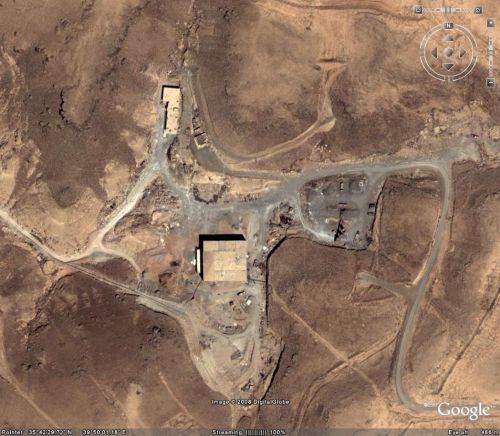
ISIS have released an impressive and comprehensive report detailing the deception techniques used by the Syrians for the Box on the Euphrates (Andreas has already beaten me to blog it—you obviously haven’t got enough work to do, mate!).
It answers a question that has been bugging me for a while: Where are the protrusions?
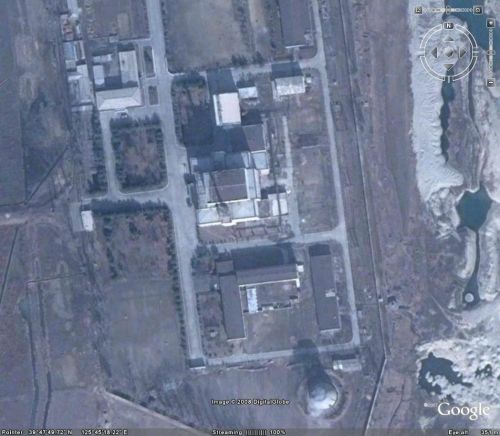
North Korea’s reactor (below) has two such protrusions. There is the tall, thin stack attached to the reactor building itself and the much thicker but shorter cooling tower to the South. The stack is for venting carbon dioxide from the primary cooling circuit. The cooling tower is for the secondary water-cooled circuit. Syria’s reactor (above) has (or more relevantly had) neither.
You can do without a cooling tower if you happen to have a large river nearby that you can discharge the hot water into and, well, the BOE is not called that for nothing. But where is Syria’s stack?
I had blithely been asserting for a while before USIC presented its evidence that if the BOE was a reactor it couldn’t have been all that close to completion because there was no stack.
I was wrong. Abright and Brannan explain (see their paper for the pictures):
According to U.S. government experts, the reactor’s ventilation system was carefully hidden. The air intakes of the ventilation system are assessed to be along one wall of the building, according to these experts (see figure 23). They noted that two rectangular structures located against the wall have louvers at the top through which air can enter.
…One structure visible is what the intelligence community assessed could be the foundation and remaining part of the stack (see figure 25). According to U.S. government experts, a pipe or small stack could have been extended through the fake roof after the reactor started operating. Until that time, the top of the stack may not have been more than a hole or cover in the fake roof, according to U.S. government experts (see figure 24).
Cunning.
To add a bit of human interest (I know Wonk readers love it), I’ll add that reading it made me feel a bit sorry for the workers in the plant. Stacks are tall for a reason; they contain slightly radioactive carbon dioxide that ought to be dispersed away from ground level. Makes you wonder what other safety corners Syria cut.

I would expect to see more pumps. Am I wrong? There’s the facility at the river, but I thought you would be doing some more water pressurizing and lifting between there and the reactor. Is it under the false roof?
I was disappointed in ISIS’s analysis. Most importantly, they totally ignore making any independent comment/analysis on the size/power of the reactor. Instead, they refer the reader to their Yongbong reactor analysis. Second, many of the things they had to say about how Syria went about camouflaging the site (i.e. leaving off air-defense etc.) were mentioned here first.
The larger issue here is the diffusion of not only relatively inexpensive satellite images, but the knowhow and skill to interpret them, and conversely, the skill to spoof analysts. The Syrian effort was a C grade effort at best, and possibly a F in the overall scheme of things.
Any serious effort to violate the NPT (and other illicit activities) by states should almost certainly pay as much attention to concealment, camouflage, creating diversions, and protecting the facility from attack as the illicit program itself.
Had the Syrians went to the trouble of hollowing out a large, deep underground bunker, with extremely well concealed ventilation vents and entrance / exits that are built to withstand even a direct hit with a conventional bomb (and multiple vents and entrances that are intended to be decoys), it would have made a conventional aerial attack much more challenging.
One of the more amazing things to me is the remarkable stupidity of the Syrians in not anticipating an attack on what is basically a common industrial building with not much around it beside the natural cover provided by the terrain, protected by an air defense system which can be, and was in fact, spoofed. Not much public information has come out as to what defenses were deployed on the ground —- to prevent either spies from approaching or just planting sensors on the hills to monitor the site, or to prevent a commando raid.
Clearly, they did not learn the lessons from Osirak (which had a containment dome that was breached to destroy the reactor inside).
My question: how are the smarter proliferators doing it?
There is much left to be done in analyzing the data and the maybe-data about the Box. I esteem both ISIS and ACW for what they have done, because nobody else has come close. Doubtless various aspersions can be cast, but I think those two have much credit in their accounts.
That said, there is a ton of imagery that hasn’t been analyzed; there are many questions left about the analyses that have been done. And there is the matter of what the Episode of The Box has taught and is teaching us about how NGOs and just plain folks out in cyberspace can contribute to discovering and analyzing matters of interest.
All in all, this seems like a heaven-sent opportunity to address such matters, and I’d hope some of the organizations involved — ISIS, New America, FAS, etc. — would consider sponsoring two or four seminars on the lessons learned, what went right, what went not so right and how to do better in the future.
Well, the ISIS did publish an image of the pipelines/power running to and from the facility..I’d say that adds credence to the covert nature of the facility, but not necessarily a reactor per se.
Still, you have to weigh in Syrian intentions and actions, not just technical analysis.
The fact is, the Syrians haven’t allowed an IAEA inspection and went to great lengths to bury the evidence, including erecting a new building in situ.
The ventilation question is interesting…perhaps the NORKs will step forward one day and tell the USIC how they did it (eh, in exchange for 600,000 tons of crude).
I have to wonder what the phony roof was made of..steel or corrugated tin? What would US synthetic ap radar imagery make of it?
The tarps covering the reactor vessel components look like canvas, which would only hide from multi-spectral imagery.
Makes one wonder if the US made SAR overflights of the area in a TR1 or using the space shuttle on previous missions.
Has anybody considered the possibility that this site was a decoy? – it all seems a bit too easy. Highly visable, easy to destroy etc. Knowing that the inspectors would move in once it had been destroyed, thus conceling the fact that it was a decoy?
Unconvincing – all Albright has to say is “according to U.S. government experts”. Not one independent thought in the paper.
A box in the desert, someone says “reactor” and after that everything is constructed to pretend that it must have been a reactor.
ElBaradei says “no reactor”. I find it likely that the IAEA has the better evaluation here.
There is NO conclusive evidence that a strike even took place. No video of the bomb slamming into the target. No radar recording of the track of the alleged bombers over the Syrian desert (which the British almost certainly have!)The only images we have of any damage are a few grainy low-resolution photos that have been photoshopped to color our view of what we are looking at. Is that the best the NRO can do, then just what do they spend all those billions on? For all any member of the public knows, the Israelis could have identified a building that the Syrians were demolishing anyway and constructed a legend around it.
There is NO conclusive evidence that the building was a reactor. There are external images from 2003 which show a large opening in the exterior of the building without a single person or vehicle in sight so, using Occam’s Razor, I think we can suggest that the person with the camera was there on his own. If he was trying to acquire information about the purpose of the building you would think that he would walk the extra few yards required to take a photo through that opening to demonstrate the existence of the reactor hall within the finished structure. I know that I would.
As to the building alleged to be the unadorned exterior of the reactor, the photos very clearly show horizontal lines caused by the shuttering used while pouring the concrete and the window openings cast in concrete. Look at the photos of the finished build and while you will see what maybe the outlines of the window openings (they may also be stains applied with Photoshop), you will not see the horizontal lines left by the shuttering.
For anyone who still thinks this isn’t a disinformation exercise connected with the Vice-presidents office go read up on the history of FUSAG in World War 2 or, better yet, read one of the books on the use of deception in WW2 such as Strategic Deception in the Second World War by Michael Howard.
BTW the reason British deception in WW2 was so effective was that British Intelligence “owned” every single agent that the Germans placed in the United Kingdom – Ireland was independent at this stage so doesn’t count.
“My question: how are the smarter proliferators doing it?”
Who would you place on that list, out of curiosity?
You mention they should have constructed a large underground space – surely Scene Change Recognition, as applied to countries like Syria, is on the lookout for heavy earthmoving machinery, fresh groundwork and the like?
J House – TR1 or the Space Shuttle? Really? Don’t you think either of these platforms (ignoring the fact one is largely fictional) has been surpassed by UAVs and stealthy satellites?
Now, bring up the Navy’s “Non-terrestial officers” Gary McKinnon saw listed and we can talk.. 😉
> I have to wonder what the phony roof was made of..steel or corrugated tin? What would US synthetic ap radar imagery make of it?
Probably steel panels — any sort of metal would be as opaque to radar as it would be to visible light and IR. Although internal heating that raised the temperature of the panels would produce an IR signature.
> The tarps covering the reactor vessel components look like canvas, which would only hide from multi-spectral imagery.
Good point. Ordinary dry canvas is pretty transparent to radar. Canvas with metallic thread in the weave would be radar-opaque, but that’s definitely a specialty item.
> Makes one wonder if the US made SAR overflights of the area in a TR1 or using the space shuttle on previous missions.
No need. NRO “LACROSSE” SAR satellites frequently pass over the site.
The problem, as it has turned out, was that the US had no notion the Box was there before late 2005 and therefore didn’t task its spysats to look at the site.
Allen Thomson is right when he says that Syria’s attempt to build a covert reactor deserves its own series of seminars covering what works for detection and what doesn’t. At least one of those seminars should also address what this collaboration with North Korea says about the new world of proliferation we face. Let me take this opportunity to state a couple of observations:
1) Syria’s gamble of not putting in air defenses paid off. The USIC apparently missed it and a lack of air defenses is almost certainly a major reason. On a related point, I believe—though I certainly cannot prove it—that Israel only discovered the facility because an agent placed somewhere higher up in the Syrian administration discovered evidence of it. (Those pictures were almost certainly taken by Syrians themselves for documentary purposes and were later “stolen” by an agent someplace other than at the reactor.)
2) The question of the power of the reactor is significant not only for how much plutonium it produced but also for how much the reactor has changed since the original Yongbyong reactor. That would tell us a lot more about not only North Korea’s progress in reactor design but also how willing Syria would be to increase risks of failure in a major project like this. I still believe that the images released indicate this reactor had significantly less uranium than the Yongbyong reactor but since I do respect David Albright’s knowledge of reactor physics I wish he had considered this question. That is why I was disappointed that he did not.
3) This one is certainly related to point 2 above but it deserves to be restated in its own right. Proliferators, as any group starting a major project, want to reduce the risk associated with failure. That is why they find it so desirable to get help from somebody outside who might have experience and help reduce that risk. Syria seems to have taken this to the extreme of retaining all the civil engineering of the original Yongbyong reactor site and then erecting a false facade around it. (Why, I keep asking myself, were they willing to buy a different reactor and yet not even change the outside of the building in the original design?) You can find my research on these questions, certainly written before Syria’s reactor was discovered, in “How the World’s Most Undeveloped Nations get the World’s Most Dangerous Weapons”, available at http://mit.edu/stgs/proliferation.html )
My analysis of the ISIS report here: http://whirledview.typepad.com/whirledview/2008/05/the-isis-report.html
> On a related point, I believe—though I certainly cannot prove it—that Israel only discovered the facility because an agent placed somewhere higher up in the Syrian administration discovered evidence of it. (Those pictures were almost certainly taken by Syrians themselves for documentary purposes and were later “stolen” by an agent someplace other than at the reactor.)
I completely agree: the pictures probably came from an album the Syrian construction project maintained. In early summer 2007 the Israelis providentially hooked up with someone with access to the album and willing to make a deal. As an aside, in my experience of such things, the hooking up was probably at the initiative of the album-guy, not the Israelis. I.e., it was probably a walk-in, not a targeted recruitment.
Whatever the case, it was a close thing.
Geoffrey – the Mossad is laughing its head off, you are building its legend for it.
What evidence do you have for the Israelis having “an agent placed somewhere higher up in the Syrian administration”?
None!
What evidence do you have that “those pictures were almost certainly taken by Syrians themselves for documentary purposes”?
None!
What evidence do you have that the pictures “were later “stolen” by an agent someplace other than at the reactor”?
None!
Maybe the reason that there are no air defenses at the site is very simply that the Syrians considered they had nothing that was worth defending at the site.
Maybe also the Syrians have learnt from the Iranians that if they respond to “points” raised by Washington or Tel Aviv with satisfactory answers then Washington and Tel Aviv will just raise more “points” and each time this happens people like you will claim that there is no smoke without fire so the Syrians must be guilty of something.
Both Washington and Tel Aviv have a long history of fabricating evidence such as Team B and OSP or touting fake evidence from others such as the Niger uranium documents so why does anybody continue to accept everything they say as truth. After Powell’s fake presentation to the UN on Iraq’s WND we should all have taken to heart the saying that George W Bush could not bring himself to complete.
“Fool me once, shame on you. Fool me twice, shame on me!”
@Grid
I would rather not put my suspect(s)list out for public consumption. Sorry.
As for the use of Scene Change Recognition software to detect illicit activity, there are ways to defeat it.
Go back to the Libyans efforts at building bunkers —- and use that as an example of how not to do it: a construction project that is plainly visible, with visible entrances, etc.
If you are hollowing out a large space (inside a mountain, for example), the stuff have to go somewhere.
Here are a few ways to get around that activity being too easily noticed:
Use either a working or abandoned mine —- like a coal or salt mine that has a fairly large cubic volume of removed material rather than a mine that follows a more narrow seam of minerals as your “base” and then expand from there.
A similar version of this would be to create a cavern out of a salt dome akin to the Strategic Petroleum Reservoirs which can be “hollowed out” by injecting water.
If you really want to get esoteric, a stone quarry or some form of an open pit or strip mine is another possibility. Under the guise of “restoring” the mine, you can dump in a lot of stuff from somewhere else.
What about starting with an oil sands / shale oil mining operation?
As for the work involved in tunneling, there are now extremely capable and sophisticated tunneling machines available on the open market that can make the task of boring tunnels in solid rock go pretty quickly.
By no means will concealment come cheap. But, it might beat the alternatives like the Box in the desert.
Someone once said that, no one has ever found anything that was successfully hidden.
Despite Syria’s best efforts at CCD,(camouflage,concealment & deception) its “reactor-on-the-Euphrates” in the end was not successfully hidden… from the US Intelligence Community and the Israelis.
The smoldering crater was proof.
The Syrians were however successful in hiding their reactor construction from the NGO non-proliferation community.
It took news of the Israeli air strike to draw the nonprolif community’s attention to the alleged reactor construction.
Had the US IC or whomever purchased the pre- and post strike images of the site, paid a premium price, they could have kept the images out of the Digital Globe and Geoeye archives.
With the images not available, it is doubtful that anyone not in the IC would have had the first clue where to look.
Relying on commercial overhead imagery archives and Google Earth is not good enough to detect covert proliferation.
Overhead commercial imagery alone will never be good enough. Ground truth imagery, HUMINT, SIGINT, MASINT — mutiple sources are required to detect determined covert proliferators. It is folly to think that the civil non- proliferation community can compete with the USG IC which has a $40 billion dollar annual budget.
Starts to make one wonder how many other non-descript ‘boxes’ have eluded the USIC and IAEA thus far.
Lao has some good points about the benefits of the use of tunnels or mines for concealment.
In this case, the Syrians likely didn’t have that option given the geography and need for a significant cooling source (assuming ‘box’=reactor).
If you had to pick a place to build a covert reactor in Syria, that one near the border was as good as any, especially in times when Iraq was ‘friendlier’ under Saddam.
If you get a walk-in that is going to rat out the project (complete with photo evidence), no amount of overhead concealment matters.
But, if you are working or storing your hardware under a hundred feet of granite, destroying it is another game entirely.
If it is true that the project was conceived ~1997 under the previous Assad regime, circumstances at that time allowed them to consider this site as viable.
Assad would not know that US forces would be occupying Iraq in 2003 and on.
The Iraq-Syrian border has been under much higher scrutiny by US technical means since early 2003 and might have included Al Kibar area.
Still, all this goes to show that nothing beats having a pair of eyes on site, with documentary proof to back it up.HUMINT matters greatly.
Too bad we didn’t have a similar source in Iraq pre-2003 that could get it right.
The US went to the UN to argue Iraq had CB weapons, but the ‘evidence’ the USIC had on Iraq didn’t come close to this level.
I think Allen Thomson is right, there is much work yet to be done, however a seminary is a solution excluding those who can’t physically attend.
I suggest a complementary solution to Allen’s, a joint ACW report on Big Box. Let everyone who have something to say on this matter write it as tersely as possible and post on some website (or if not available on ACW). I guess we will find capable volunteers who will edit the various documents into a coherent report.
The open source community competes successfully with the software giants. There is no reason this success can’t be duplicated in the Arms Control field.
What do you think?
> HUMINT matters greatly.
>Too bad we didn’t have a similar source in Iraq pre-2003 that could get it right.
One of the frustrating things about HUMINT, at least of the classical agency variety, is that it’s just about the perfect INT — but for all practical purposes it’s impossible to obtain by trying. According to a couple of senior former CIA officials (including Mr. Gates) the US never got a high-level source in the USSR as a result of targeted efforts. The handful of HLS that did exist (Penkovski, Tolkachev, etc) were walk-ins. If the Israelis really did go after a specific person or one of a set of persons in the Syrian program and succeeded in getting someone to give them the pix, that would be truly extraordinary.
I still think the real story goes like this. See if it doesn’t turn out to have been so.
US and Israel knew about the box and suspected it was a reactor almost from the beginning, and warned the Syrians in very seriously ominous tones to stop, which took on new meaning after the invasion of Iraq. So Iran shut down its bomb work and Syria mothballed or back-burnered its reactor project, but site construction on the reactor continued, slowly. Four years later, the North Koreans privately give us the photos and basic info on the Syrian reactor, as part of the NK deal, but some in the admin wanted the Norks to go further and publicly admit their role. Plus they and Israelis wanted to threaten Iran. With the Nork info, they knew the reactor remained far from completion and there was no radioactive material present. So the bombing was greenlighted. The recent press release was to put more pressure on the Norks to fully and publicly come clean, or else deep-six the NK deal.
I also told you it was Qaddafi who sold out AQ “al Qaeda” Khan, and made Bush look good and his PSI look brilliant in exchange for his rehabilitation.
I’ll tell you something else. False-front sting operations are the basic form that the struggle to prevent nuclear terrorism has taken. That’s what the Sibel Edmonds thing is all about. The “secrets for sale” conspiracy she thinks she uncovered was part of the frontline bulwark against a nuclear 9/ll.
How do I know all this? Mark my words.
@Mark
Completely agree with the “false front stings”.
They trap the non-state actors who are naive and inexperienced.
State proliferators have been driven to do discrete, state to state deals in a way that is very hard to identify and trace, with little actual physical movement of restricted material or devices.
The Albright/Brannan report makes for interesting reading, but there are still a few high level questions regarding this site:
1. Why is there a water-treatment facility in the middle of no-where? What is it’s genesis and history? Any overhead photo history?
2. The Syrians have admitted that the BoE was a secret military building. That they have protected underground electrical cables and water pipes does not prove anything. You need water and electricity to run a bathroom.
The only “proof” this may have been nuclear related are the internal photos which have not been tied to the BoE by any publicly available intelligence.
> 1. Why is there a water-treatment facility in the middle of no-where? What is it’s genesis and history? Any overhead photo history?
Good questions. The putative water treatment facility (which produces the perhaps felicitous acronym “WTF”) is over five kilometers from the Euphrates, at a local high point in the plateau over 100 meters above river level. And there is nothing but barren desert nearby.
Two apparent pipelines run from/to it, one to the Box, one to a flume next to the nearest point of the river (35.6700 N, 39.8465 E). The second line may be tapped by what appears to be a gravel pit or something similar (35.677 N, 39.859).
So where is the water being treated coming from, how is it being treated, and how is it being used after treatment? And why not use river water in the first place? (I’d guess the water table under the facility isn’t much above river level.)
As to the photo history, there may be some hope. As detailed in Appendix B of the sourcebook, there’s a good deal of 5-meter IRS imagery available for the period Sep 1997 – Nov 2001, then the ISS image of Sep 2002, then the Ikonos image of Sep 2003, then SPOT 2.5 meter imagery 2004 forward. Somebody needs to look at those pix.
It’s a fantastic find, AT.
Maybe BoE used river water for some purpose, contaminated them, then they were sent to the WTF and after being cleaned they were dumped back in the river. Asad protects its citizens.
What kind of contamination? Maybe short lived isotopes, maybe Sarin/VX or its precursors.
By the way, near your second point there are earthworks that remind me of the old SA2/3 batteries, but there is only one launcher post.
I only have one thing to add to this. When the DPRK reactor was inspected we found some problems with their nuclear engineering and determined that about 1/3 of the fuel rods were not really participating in power generation (or Pu production). One might well imagine that a current DPRK design for a 25MW(t) plant would use fewer fuel assemblies.
Let me comment on what’s above:
Change detection is a very powerful tool. It’s critical to finding new activities in wide-look imagery, for example, or for checking when a site is active. Because we as outside analysts rarely have access to a series of pix of the same target, our analyses are often attempts to deduce the plot of a movie from a single frame.
Probably no need for the US to have done its own SAR flights; Israel surely has side-look radar in some of its recon jets.
The amateur (NGO) verification community cannot possibly compete with the USG on a global basis. It is almost certainly not going to be the first to detect something new. What it can try to do is to keep intelligence services just a little bit more honest (see my old articles in the St. Petersburg Times of FL on the lack of Iraqi troops in Kuwait in September/October 1990).
And as to HUMINT, with rare exceptions I will take good technically collected intelligence. And defector intelligence will almost always throw you a Curve Ball. 🙂
-pz
Peter Zimmerman said,
>The amateur (NGO) verification community cannot possibly compete with the USG on a global basis. It is almost certainly not going to be the first to detect something new.
I think the jury is out on that, because the ability of the USG intelligencers to detect and recognize new stuff has proven to be not all that great. Because, it turns out, the official organs tend to be highly focused on known problems and to devote relatively little resources to looking for the aforesaid new stuff.
Certainly the NGO/amateur bunch could and probably should do better, but it isn’t as if they’re totally outclassed by the official bunch as things now stand.