

There have been two Russian cruise missiles in the news lately. One is a ground-launched cruise missile that apparently violates the 1987 Intermediate Range Nuclear Forces Treaty, the other is a sea-launched cruise missile that Russia recently fired against targets in Syria.
Both of these cruise missiles are made by the same firm, Novator. I have a sneaking suspicion that they are closely related. In fact, I bet they look exactly alike. Here is my best effort at a hypothesis. It is speculation, since the United States is not releasing any information about the missile that violates the INF treaty. But I think we can make an educated guess or two.
1.
9M729 GLCM (SSC-X-8)
Bill Gertz (I know!) claimed that Russia had, on September 2, conducted another test of the ground-launched cruise missile that the United States claims violatesthe 1987 INF Treaty. Gertz indicated that the US designation is the “SSC-X-8.” I believe this missile is designated 9M729. There was a Russian announcement by GosNIIP, the design bureau that builds guidance for cruise missiles, that Russia completed state acceptance trials of the “ground-based system 9M728, 9M729 and its modernized version.”
(Here is the text of the passage, which describes the 3M54, 3M14, 9M728 and 9M729:
Важным итогом работ, которые велись с большой интенсивностью с участием лучших сил института – завершение Государственных испытаний изделий ЗМ54 и ЗМ14 комплекса морского базирования и начало серийных поставок этих изделий с системами управления нашей разработки и изготовления. Завершены Государственные испытания и автоматизированных систем контроля этих систем. Комплекс автоматизированной подготовки полетных заданий для этих изделий проходит межведомственные испытания. Не менее важной вехой в нашей жизни явилось завершение Государственных испытаний комплекса наземного базирования 9М728, 9М729 и его модернизированного варианта. В них установлены системы управления нашего института.)
We know the 9M728 is the Iskander cruise missile. (It is also called the R500 — the name of the missile is different from its GRAU number.) The way Russian GRAU numbers work is formulaic — the 9M means it is an Army missile. That means the 9M729 is also for Iskander or a new launcher that we have yet to see. Let’s presume that the 9M728 is a reduced-range version of the 9M729 — an INF-compliant version of its bigger brother. That’s not hard to believe — Russian officials have long said they could extend the range of the cruise missile for Iskander beyond 500 km with little difficulty; their confidence was probably rooted in some evidence.
2.
3M14 Kalibr SLCM (SS-N-30A)
Patrick Lyons, writing in the New York Times, recently reported that the Russian cruise missiles used to strike Syria were SS-N-30A sea-launched cruise missiles. These missiles are referred to as the Kalibr, which is actually a whole family of Russian sea-launched cruise missiles.
Now, this is where it gets tricky. We know the Russians make an export version of the Kalibr family missiles, which they call Klub. So, Klub missiles are reduced range versions of the Kalibr systems that can be exported without violating the MTCR. (You may recall they are marketed with the awesome video about how great it is to hide cruise missiles in shipping containers.) So, for example, the 3M14E (e is for export) Klub is a reduced range (~300 km) version of the 3M14 Kalibr that Russia used to strike Syria (2,000 km). It is hard to know how Russia reduced the range, but one option is just to reduce the size of the fuel tank. It is possible that the Kalibr and Klub versions are externally identical, although we don’t know that for certain. The few images we have of the domestic-use 3M14 suggest it looks a lot like the e-version for export.
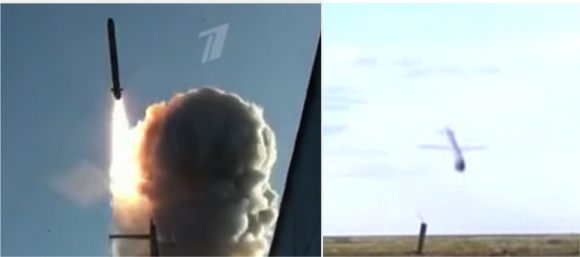
Image on the left is from Russian Stealth Frigate “Dagestan” (Project 11661K); image on the right is from Russian Stealth Frigate tests new missiles in Sea Trials.
3.
Comparing the 3M14e and the 9M728
But there is one resemblance that is really quite attention grabbing. It is this one, between the shorter range versions of each missile.
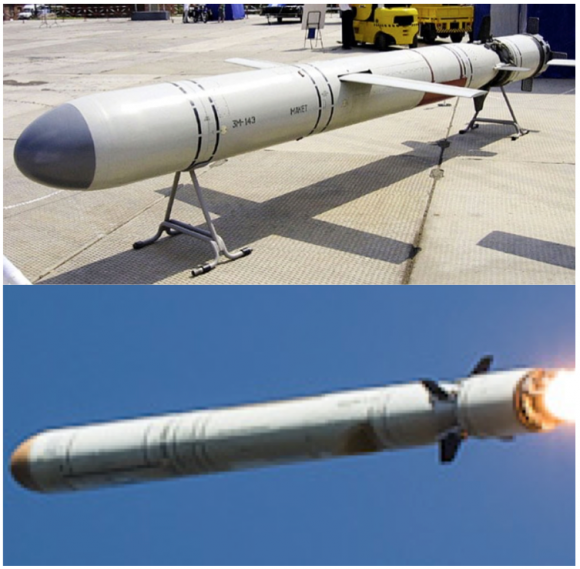
The top image is the 3M14E Klub. The bottom is the 9M728 (R500). They are the same in the important respects. (The visual differences largely reflect the fact that 3M14 is on static display, while the 9M728 is in flight: the cover over the air intake has popped off the 9M728, while its little wings have not yet popped out.)

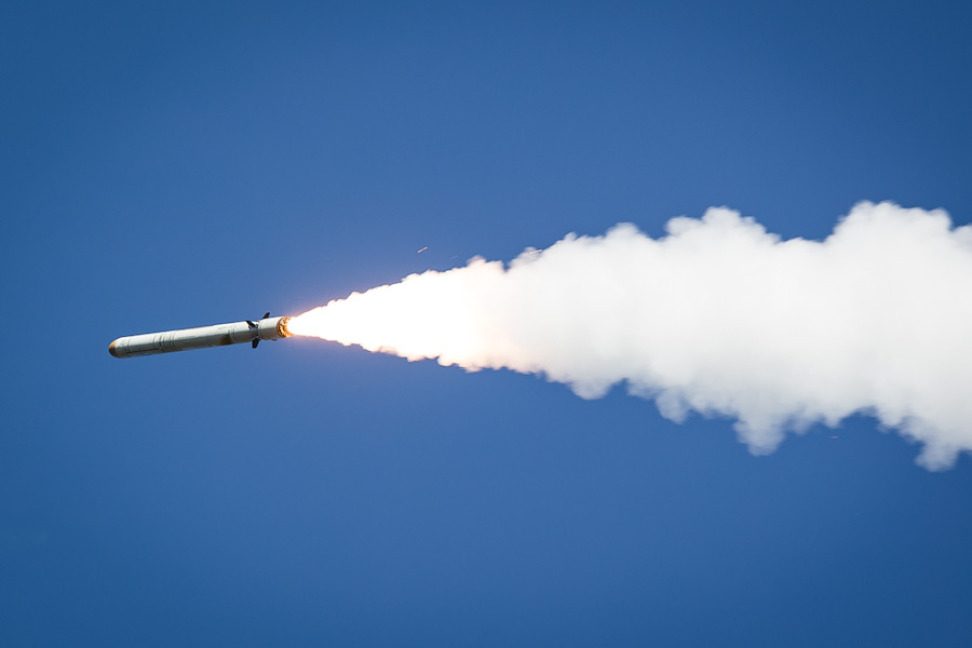
If the 9M728/R500 deployed with Iskander (~500 km range) is a reduced range version of the 9M729 (~2000 km), and if the 3M14E is a reduced range version of the 3M14, what does it say that the reduced range versions appear to be identical? That would strongly imply, to me anyway, that the 9M729 and the 3M14 are probably externally identical. We are looking at a single family of missiles.
Now, I want to be clear about something. This does not/not suggest that Russia’s violation of the INF Treaty is a technicality — quite the opposite. Under the 1987 INF treaty, the United States was required to eliminate the BGM-109G Gryphon, which was the ground-launched variant of the well-known Tomahawk family of sea-launched cruise missiles. The 9M729 missile has an Army designation and, according to the State Department, a launcher. This isn’t the Russians being lazy and testing a SLCM from land. I made a little chart to help our Russian partners better understand the scope of the treaty, illustrated with the Gryphon and the Tomahawk.
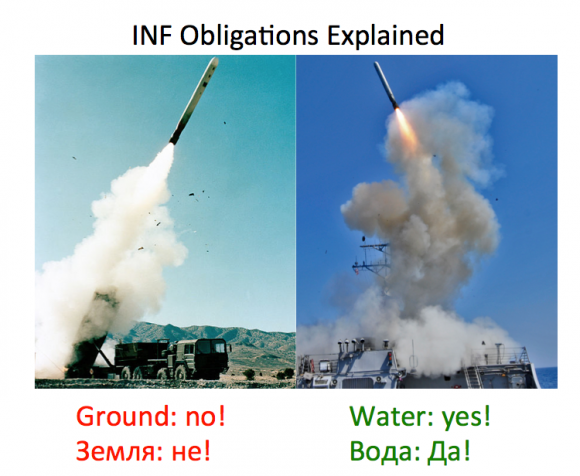
One benefit of concluding the the 3m14 and the 9M279 are likely similar is that we can infer something about the range of one based on the other. The United States has not offered a public assessment of the GLCM range, but the Russians have described the range of the 3m14 (SS-N-30A) as 2000-2500 km. That would imply a similar range for the 9M729 (SSC-X-8), depending on the type of warhead.
On other words, we have a heck of a problem here.