

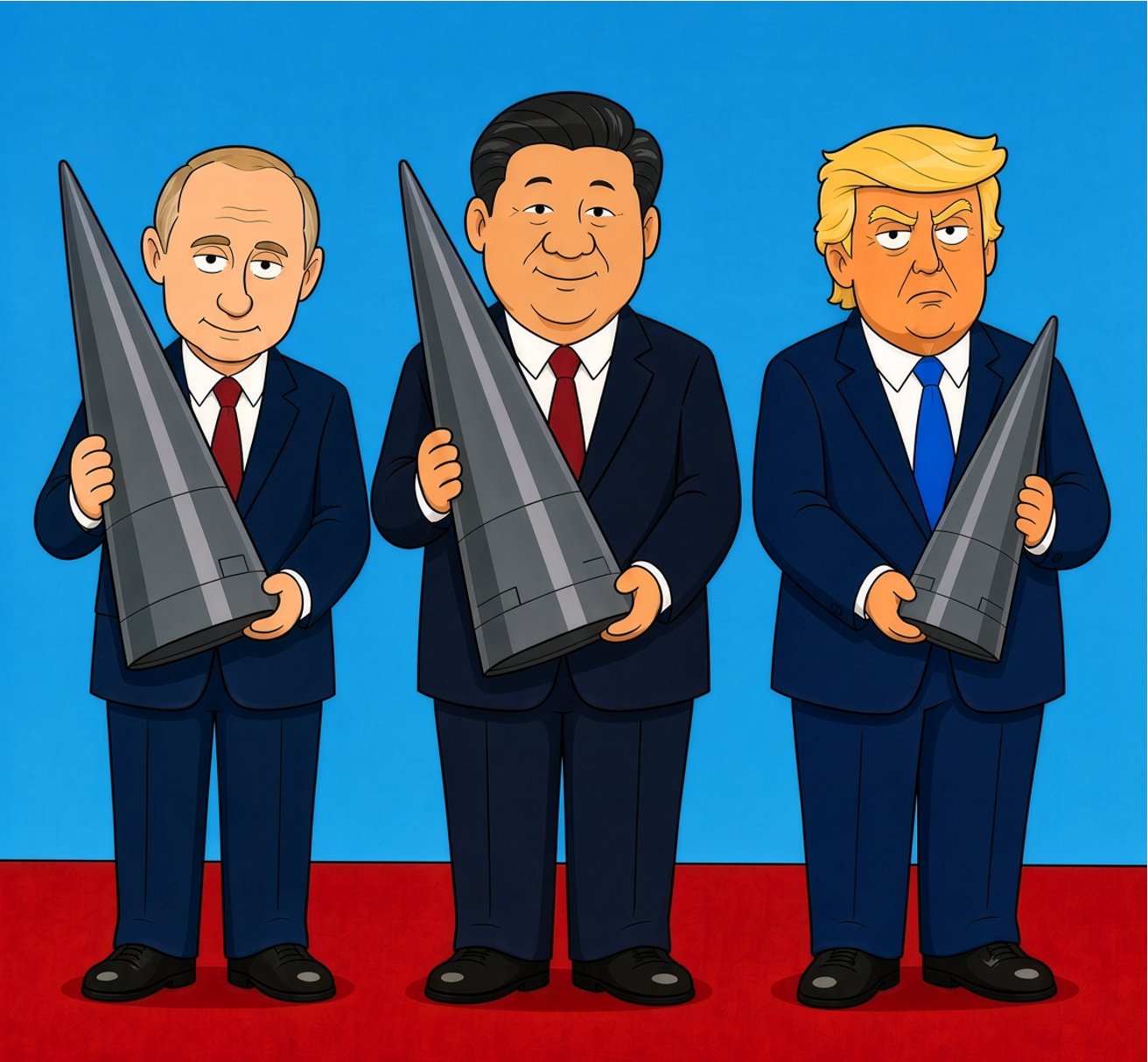
The idea: The United States, Russia and China should each pledge to stay at or below 700 deployed ICBMs, SLBMs and heavy bombers, the limit in the expired New START treaty.
- Why it matters: China’s buildup has no clear endpoint. Left alone, it pushes Washington and then Moscow to build more, and increases like that are hard to stop once they’re programmed in.
- Why 700: All three are already under it, so nobody has to cut anything. Missiles and bombers can be counted by satellite, so it needs no inspections, only a political commitment and a list of which systems count.
- Yes, but: The rules were written for U.S. and Russian forces and fit China awkwardly, especially its empty silos and the H-6N bomber. It also caps launchers, not warheads, so it won’t stop China moving toward parity.
- The bottom line: It isn’t meant to be a precise accounting. It buys time for the three to talk before the arms race really gets going.
In Shenzhen on November 19, Donald Trump, Xi Jinping and Vladimir Putin agreed to two sentences about nuclear weapons:
The three heads of state reaffirmed that a nuclear war cannot be won and must never be fought. The three countries will conduct a dialogue on reducing nuclear risks and preventing the proliferation of nuclear weapons.
It’s not much. In fact, it’s basically what the three countries said, along with Britain and France, in the P5 statement of January 2022. The one new thing is the promise of a dialogue, and a dialogue needs an agenda.
That’s not to say it’s disappointing. Getting past the platitudes was always going to be a challenge because the three countries have such different nuclear stockpiles. Trump laid out the problem to Fox News’s Jacqui Heinrich hours before the meeting: “We have 4,000 nuclear weapons. Russia has 3,800 nuclear weapons.” China, he said, has four or five hundred and is catching up.
The man’s not right, but he’s not wrong either. The United States had 3,748 warheads at last count, in September 2023. The head of U.S. Strategic Command told Congress in March that Russia has about 4,600 and China more than 600. Trump probably swapped the Russian and U.S. stockpiles and slightly undercounted the Chinese, who are on pace to have more than 1,000 warheads by 2030. But he’s got the basic idea: two big arsenals and one smaller, if growing, one.
And that disparity makes a trilateral agreement tough. As he told Reuters on the flight home, it is very hard for anyone to say, “We have 4,000 nuclear weapons, we’ll give up half.” The big two won’t drop down to the level China is building toward. And even if they did, verifying such an agreement would require inspections beyond anything China has accepted in any context.
But there is a simpler measure the three could take right away, one where their forces are easier to count and much closer in number: limit delivery vehicles, the missiles and bombers that carry the warheads.
Article II(1)(a) of New START, which expired in February, limited the United States and Russia to 700 deployed ICBMs, deployed SLBMs and deployed heavy bombers each. Russia already says it will keep to the treaty’s limits as long as the United States does. Washington never formally answered that offer. Ignoring the proposal offended the Russians more than flatly rejecting it would have. Each of the three presidents would simply state that his country will stay at or below 700 deployed strategic delivery vehicles as long as the other two do.
This doesn’t need to be a detailed agreement, just a political commitment. There is a precedent of sorts: in late 2009, with START about to expire, the White House proposed a short, politically binding pledge not to build beyond its limits. Moscow refused, partly because only a ratified treaty could admit foreign inspectors, a problem that doesn’t arise when there are no inspections. The only declaration needed would be a national statement of which systems count toward the limit. Everyone is already under it, so nobody has to dismantle anything to say yes.
| Deployed ICBMs, SLBMs and heavy bombers | ICBMs | SLBMs | Heavy bombers | Total |
|---|---|---|---|---|
| United States (September 2022) | 396 | 220 | 43 | 659 |
| Russia (September 2022) | 310 | ~160 | ≤70 | 540 |
| China (2025) | 400 | ≤72 | ~20 | ~492 |
| China, if every launcher is loaded | 550 | ≤72 | ~20 | ~642 |
| New START limit | 700 | |||
| The U.S. and Russian totals in the table are the last figures the two countries exchanged, as of September 1, 2022. The split by leg comes from the Congressional Research Service for the United States, from U.S. Strategic Command’s 2025 testimony for Russia, and from the Pentagon’s 2025 China report for Chinese ICBMs. The Chinese submarine and bomber figures are my estimates: six Jin-class submarines with up to 12 missiles each, and one H-6N brigade of about 20 aircraft. | ||||
A limit on delivery vehicles would constrain what worries us the most at the moment. China’s numbers are soaring upward with no clear endpoint. Eventually that’s going to put pressure on the United States to increase its forces, first by uploading more warheads onto existing delivery vehicles, but eventually by expanding the number of delivery vehicles themselves. That will in turn put pressure on the Russians. One lesson of the Cold War is that each side tends to program in big increases based on what it worries the other will do and, once those increases are programmed in, they’re hard to stop even if the other side stops short. That is what a number like 700 is for. As Rose Gottemoeller, who negotiated New START, puts it in her memoir of the talks, with the limit in place the United States knows that it “does not need to build and deploy more than 700 strategic missiles or bombers.”
None of this would stop China from reaching parity in delivery vehicles. That is coming regardless, and it is hard to believe the United States can outbuild China the way it did the Soviet Union. The point isn’t to prevent parity. It’s to avoid the yo-yo of build and counter-build that results in an arms race to nowhere.
Why would China agree? Xi Jinping has purged nearly the entire top military leadership on corruption charges, many of them tied to the Rocket Force. (Zhang Shengmin still holding on!) We don’t really know what drove China’s buildup, but it’s a good bet that a lot of people were wetting their beaks. With them now gone, this is the moment to test whether Xi might be willing to change course.
Why 700? It is the one New START limit that fits all three. The other, 1,550 deployed warheads, is so far above China’s force that it’s more of a target than a ceiling. In 2022 the Pentagon projected that China, at the pace it was then building, would have about 1,500 warheads by 2035. China has slowed since, and even 1,500 would have been every warhead it owns, not just the deployed strategic ones the treaty counted.
It is also a limit each can monitor with spy satellites — so-called national technical means (NTM). Silos, submarines and bombers at bases can be counted reasonably well in satellite imagery. Even mobile ICBM launchers have a fixed number of garages and fairly well-known unit structures. This is how arms limitation talks started: SALT I simply froze the number of launchers each side had and relied on satellites to check, because launchers are big enough to count from space.
China has room under 700 for every launcher it has built, but not for another round of silo fields. The United States and Russia would give up the option of answering China’s current buildup by deploying more missiles, though each could add warheads to existing forces.
There will be, of course, some complications. If you know one thing about arms control agreements, it’s that deciding which things to count and how to count them can be devilishly hard. Arms control agreements tend to have definitions that work for the parties, not necessarily for anyone else. That’s why New START counts every heavy bomber as one nuclear warhead, no matter how many it actually carries.
The New START counting rules were devised around U.S. and Russian nuclear forces as they were in 2010. They were meant to work tolerably well during the life of the treaty, not serve as some platonic ideal of a nuclear delivery vehicle. The best example is the definition of an ICBM that Washington and Moscow have used since SALT: a range of more than 5,500 km. That’s not any sort of technical threshold. That’s just how far the closest part of Russia is from the lower 48. Obviously that same geography doesn’t apply to China, which is farther from the United States and much closer to Russia.
As a result, the New START limits suit China’s force today somewhat awkwardly, but it’s basically doable. There are at least two problems.
Empty launchers are one. New START counts a launcher as deployed only when it holds a missile. The Pentagon credits China with 550 ICBM launchers and 400 missiles. Without inspections, nobody outside China really knows which silos are full, so my table shows both. There is a related problem with China’s submarines, since the United States and Russia would often declare some of their tubes as not deployed because the submarine was in overhaul. China could either accept that we are going to assume all of the silos and launch tubes are loaded, or make some effort to reassure us if its numbers approach 700. One measure might be opening some silo doors or launch tubes when a reconnaissance satellite is overhead. Or China could agree to New START’s other launcher limit, 800 deployed and non-deployed, which was written to prevent either side from stockpiling empty launchers. Using that definition, China is at about 642 launchers, still comfortably under the 800.
Bombers are another. The range of a bomber can be a nightmarish problem, as anyone familiar with the story of the Soviet Backfire bomber knows. China’s H-6N is a real edge case. It carries a nuclear-capable air-launched ballistic missile and can refuel in the air. Chinese state media have put the combat radius of the closely related H-6K at 3,500 km and its maximum range at about 8,000 km, right at New START’s threshold for a heavy bomber. The treaty’s definition of range alone is a mouthful:
For an aircraft, the maximum distance that can be flown, without refueling, by an aircraft of that type when carrying an ordnance load of 7500 kilograms, with a full fuel load in the internal and external fuel tanks and a flight profile optimized to ensure minimum fuel consumption per kilometer, taking into account the distance covered during climb and descent. The fuel remaining in the fuel tanks after landing shall be no more than five percent of the maximum capacity of the fuel tanks.
That definition wasn’t intended to stand the test of time as a definition of bombers forever. It was intended to capture the forces the United States and Russia cared about in a strategic exchange. The United States would likely insist on counting the H-6N, and China should just agree.
In practice, treaties just list the systems that count by name. New START did it in Article III(8). The counting rules are drawn around them. The three parties could do that unilaterally, updating their lists when new systems are deployed. A list is no substitute for agreed definitions, but it is enough to start. For the United States, that would be the Minuteman III ICBM, the Trident II D5 SLBM, and the B-52H and B-2A bombers. For Russia: the SS-18, SS-19, SS-27 and Sarmat ICBMs, the Sineva and Bulava SLBMs, and the Tu-95MS and Tu-160 bombers. And for China: the DF-5, DF-31, DF-41 and DF-61 ICBMs, the JL-2 and JL-3 SLBMs, and the H-6N bomber.
China has displayed all of these systems in parades, so none is a secret. And a Chinese military official privately provided such a list at least once to a U.S. congressional delegation, if a diplomatic cable leaked to WikiLeaks is to be believed.
It’s not perfect, but it’s good enough for now. The object of this approach isn’t a precise accounting down to a single bomber, or even ten. Small differences like that don’t really alter the strategic balance. Rather, our goal is to buy some time for the parties to talk about how their forces are going to evolve before they program in big increases.