

Summary
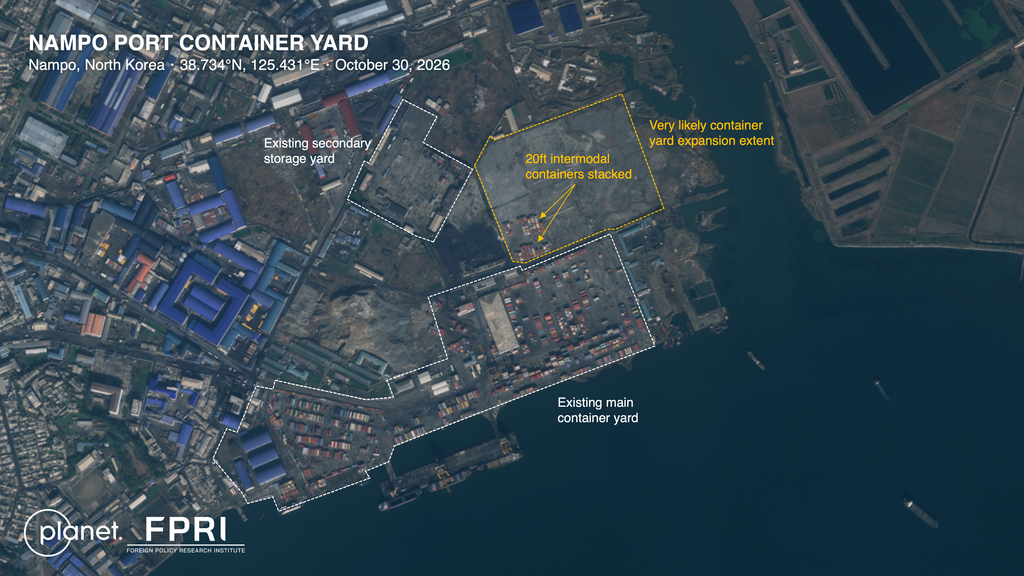
Nampo Port is very likely increasing the surface area of its primary intermodal container storage yard by at least 45% as of October 30, 2026. Because North Korea does not generally transport goods domestically using standard intermodal containers, this is a likely indicator of increasing trade activity with international partners including China and Russia.
Background
Nampo Port is North Korea’s largest port on the Yellow Sea and includes a diverse array of separate terminals handling containerized, bulk, coal, and petroleum, oil, and lubricants (POL) cargo. The container terminal, located at the eastern end of the port, initially became operational around 2008. It currently consists of a 300-meter berth with two dedicated quay-side container-handling cranes, a primary container storage yard with dedicated yard-side container-handling gantry cranes, a smaller multifunctional storage yard to the north, several warehouses and administrative buildings, and a fully-encompassing security perimeter with vehicle gates.
The container storage yard has undergone previous expansions in 2011, 2012, 2014, 2016, and 2018. This development marks the first major expansion of the container storage yard since 2018.
Assessment
Prior to 2023, the adjacent area directly to the north/northeast of the primary container storage yard was composed of undeveloped, swamp-like terrain with dynamic pools of water and likely industrial runoff. Beginning in 2023-24, North Korea initiated land reclamation efforts in the area.
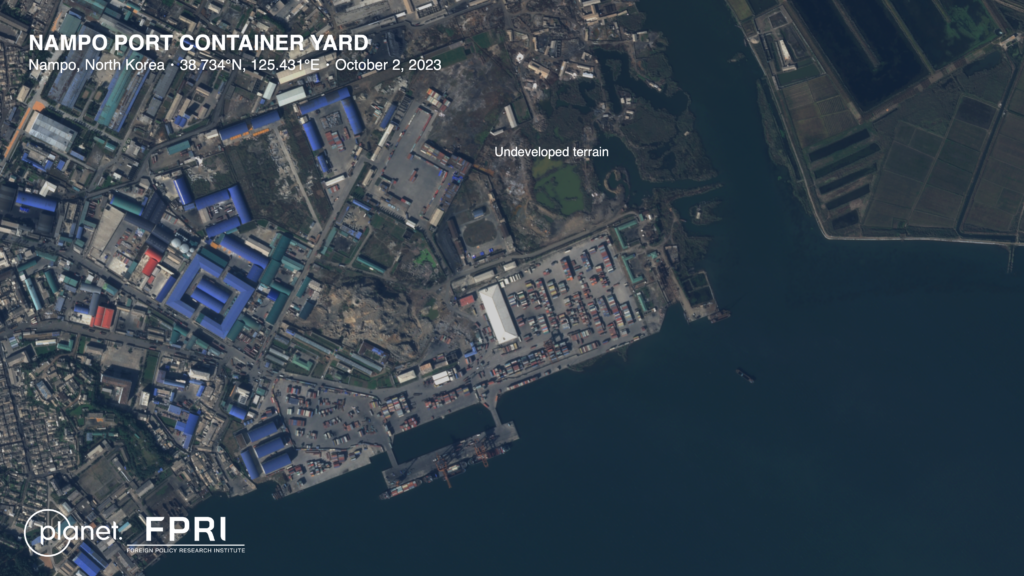
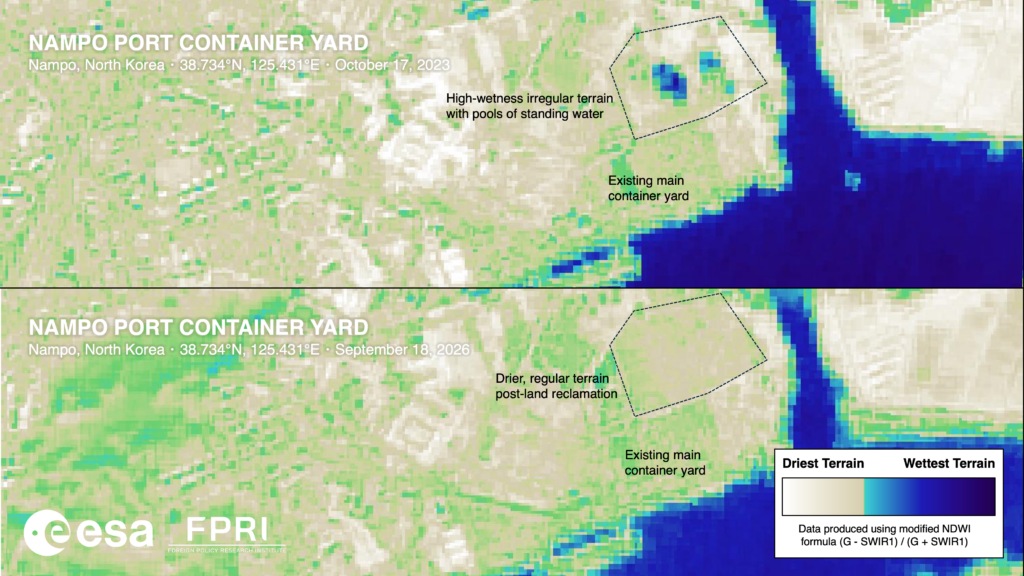
As of February 2024, the first part of the designated area was visibly filled and flattened by intermittently present construction vehicles. By February 2026, the entire extent of the designated area was visibly filled and flattened. Wide vehicle tracks along repeated routes inside the designated area are visible. Land reclamation progress was confirmed by a modified normalized difference water index (M-NDWI) analysis of Sentinel-2 multispectral imagery collected in 2023 and 2026. This analysis indicated a reduction in wetness variation across the designated area and the complete removal of pools of standing water and likely industrial runoff.
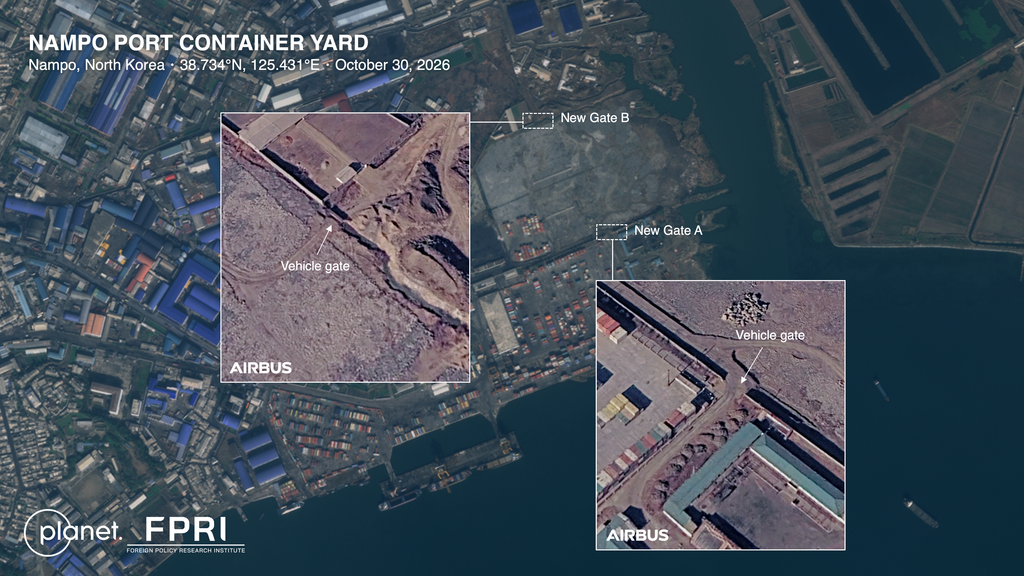
As of February 2026, the security perimeter on the north edge of the primary container storage yard has been modified to add a vehicle gate connecting it to the designated area (New Gate A). Additionally, berms have been constructed along the north edge of the designated area and a new vehicle gate is present in the center of the north edge of the designated area with visible wide tire tracks on the interior and exterior sides (New Gate B).
Beginning September 16, 2026, at least 12 20-foot intermodal containers were stacked and organized in standard patterns inside the designated area, located in its southwest, directly adjacent to the primary container storage yard. As of October 30, 2026, there are at least 80 20-foot intermodal containers stacked and organized in the same area. There is no imagery available directly confirming the operation of reach-stackers or forklifts in the designated area. However, container stack height calculations conducted using cast shadows visible in high-resolution imagery collected by Planet Labs PBC on October 23, 2026 indicate an estimated stack height of 5-6 meters, or approximately twice the height of a standard-orientation 20-foot intermodal container. With the exception of the yard-side gantry cranes used to move and organize intermodal containers inside their tracked area, container stacking at the Nampo container terminal is performed using dedicated reach-stackers and forklifts. This indicates that these specialized vehicles are now operating in the designated area.
While the primary container storage yard has a concrete surface, the Nampo port container terminal has historically stored, stacked, and organized intermodal containers in areas with non-concrete surfaces prior to the installation of concrete.
This combination of evidence indicates that it is very likely that the primary container storage yard will be expanded to include the designated area. The expansion of concrete-surfaced extent at the primary container storage yard does not generally follow a consistent timeline so it is not possible to forecast a precise installation schedule. However, the designated area is already being used for storage of intermodal containers and should practically be treated as active storage as of October 2026. If this assessment is correct, this expansion will constitute an increase in primary container storage yard area from 0.17 square kilometers to 0.25 square kilometers (approximately a 45% increase in overall surface area).
Sources
This assessment is based on analysis of multispectral imagery collected by Planet Labs PBC and Airbus from 2024 to 2026, historical imagery collected by Airbus and Maxar/Vantor from 2004 to 2024, and open-source multispectral imagery collected by Sentinel-2 from 2023 to 2026.