
Happy New Year everybody, this guest post is by Jack Ryan Johnson a Middlebury undergrad and promising Apprentice GEOINT Wizard who spent a long time looking deeply into and on to PLARF garages and then detailed his findings for us.
The People’s Liberation Army Rocket Force (PLARF), the PLA’s strategic and tactical missile force, is organized into six “bases” which control a combined 41+ combat missile brigades distributed across China. The majority of these brigades primarily field weapon systems that rely on ground-mobile launchers which in turn have specific facility and infrastructure requirements that can be observed at PLARF brigades. The most obvious of these facilities is the high-bay garage, or “high-bay.” These large garages with high clearances are generally used for drills, training, and other activities that require the full range of motion of the weapon system. There are a number of physical features of these buildings that make them identifiable using satellite imagery, which is useful both for identifying and understanding the operational readiness and capabilities of PLARF brigades.
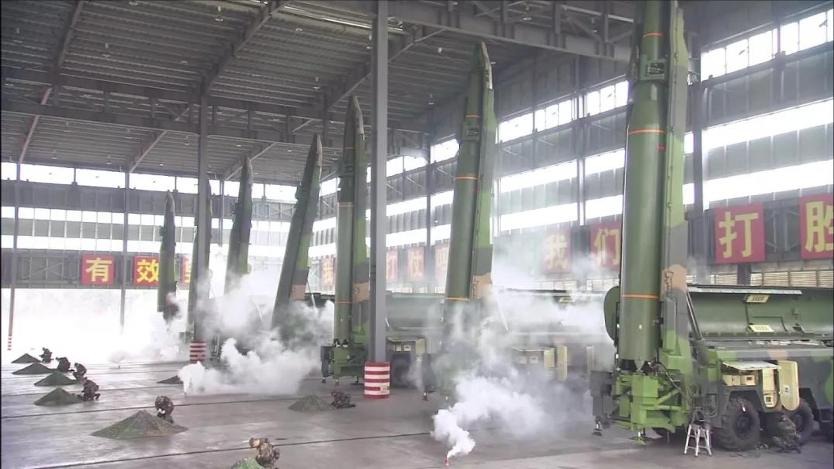
High bays can be identified using combinations of signatures including their heights relative to nearby buildings, general shapes, design features, locations within brigades, and observed activity. If available, imagery of their construction process can provide additional confirmation of the presence of a high-bay.
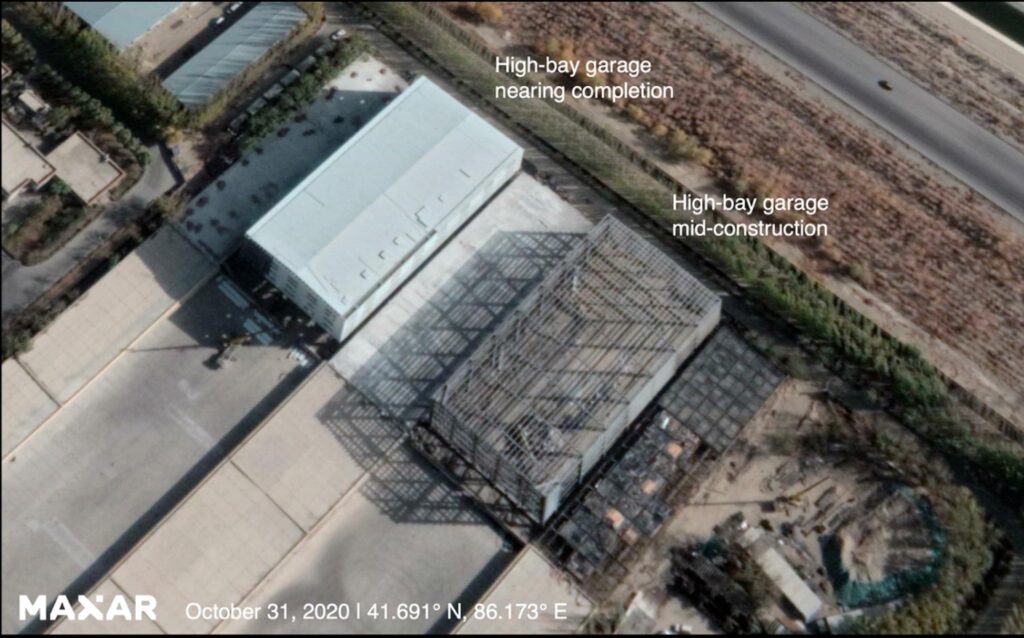
In general, total construction time for a high-bay at a PLARF brigade is about 18 months regardless of geographic location of the brigade, spanning from initial land clearing to final roofing. A high-bay mid-way through construction is visible in Figure 2. The phases of construction essentially consist of: land clearing and foundation construction (during this phase there is an obvious building footprint and construction material and vehicles spread throughout the site), main structure construction (this is when the full structure is visible but there is no roof or walls), and roofing and slat installation. This predictable timeline is valuable for forecasting readiness and future activity at brigades.
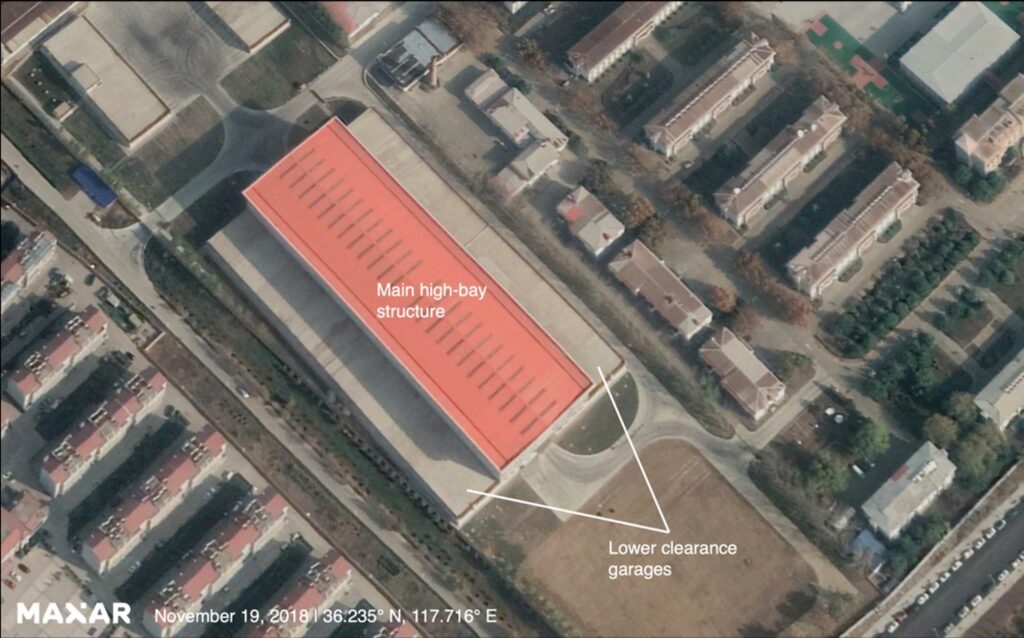
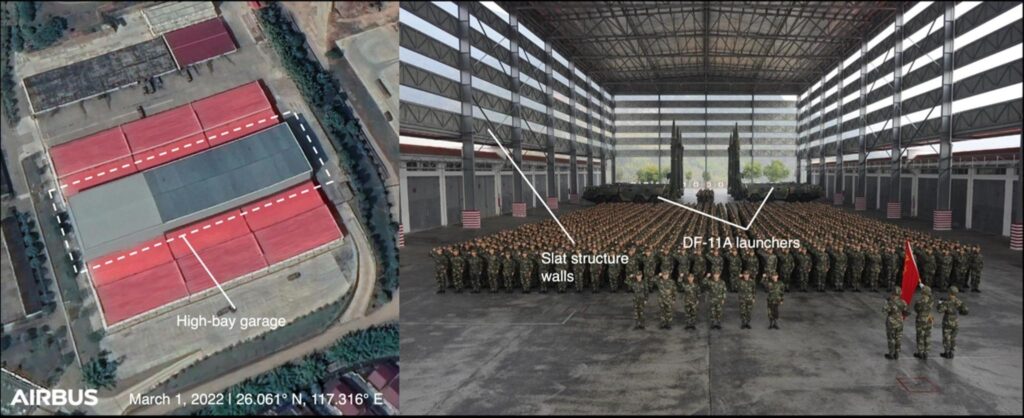
Estimated high-bay garage roof heights at 32 brigades across Bases 61, 62, 63, 64, and 65 range from 15m to 27m, with a mean roof height of 22m and a median roof height of 21.5m. Interior area of high bays generally ranges from about 1,800m2 to 8,000m2, and they are typically configured as long rectangles. While they are sometimes standalone structures, support vehicle and launcher garages are often found abutting high-bays on both sides, resulting in a larger building in the shape of an upside-down “T” as shown in Figure 3. High-bays have tall and wide open entrances, usually only on one side, to accommodate launchers. Additionally, their sides are often constructed as long slats over structural elements rather than continuous “walls.” These slats are more obvious in highly oblique images. They are not designed primarily for protection from the elements or long-term storage, as is obvious in Figure 4. Rather, their purpose is to conceal activities from overhead collection platforms like satellites.
This analysis excludes Brigade 618 located in Nanchang (likely high-bay currently under construction) as well as the other six brigades with no high-bays.
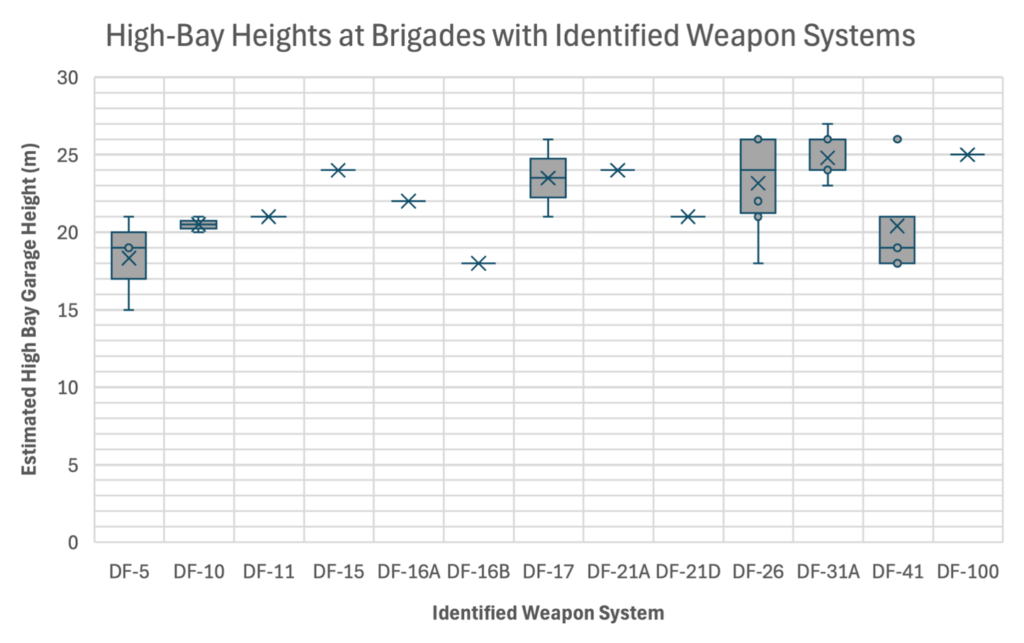
There is no obvious significant correlation between high-bay heights and fielded weapon systems at the observed brigades, as depicted in Figure 5. This may partially be due to sparse data, as many weapon systems are only fielded at a small number of brigades. Furthermore, I assume an error of about +/- 1-2m in roof height estimates; with estimated heights already within a narrow range, precisely and consistently identifying height discrepancies between high-bays is difficult.
Brigade location and weapon system data in this article generously provided from Decker Eveleth’s 2023 PLARF Order of Battle report.
