
A few days ago, Ukrainian President Volodymyr Zelenskyy stated that “The relocation of the Oreshnik system to the territory of Belarus is nearing completion. We understand where it will be deployed.”
But Zelenskyy didn’t share the location! Jon Landay at Reuters asked me whether the team had any idea where Orehsnik might be headed, so Decker, Michael and I had a look. Our friends at Planet Labs supplied most of the images.
We identified a site, the former Krichev-6 aerodrome, as a likely location and Jon got a confirmation through reporting. Full details and images below.
Oreshnik Deployment Site in Belarus
Michael Duitsman, Decker Eveleth, Jeffrey Lewis
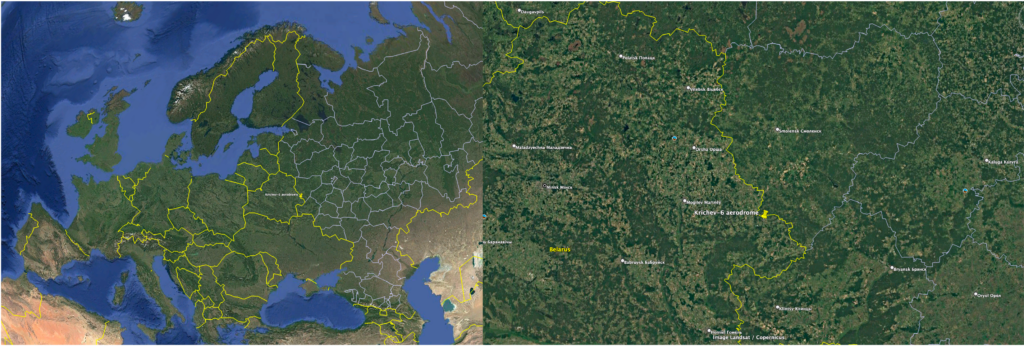
Researchers affiliated with Middlebury College have identified the likely location of Russia’s deployment of the nuclear-capable Oreshnik intermediate-range ballistic missile in Belarus using satellite imagery captured by Planet Labs. The location is the former Krichev-6 aerodrome, five kilometers from the Belarus-Russian border.
The team included Dr. Jeffrey Lewis, Michael Duitsman and Decker Eveleth, an alumnus who now works at the CNA Corporation.
The Oreshnik Intermediate-Range Ballistic Missile (IRBM)
The Oreshnik is believed to be a two-stage intermediate range ballistic missile (IRBM) comprising the first two stages of a Yars-type ICBM and a special combat payload. The Oreshnik combat payload consists of a post-boost vehicle and up to six nuclear warheads or containers of flechettes. In its multi-warhead configuration, the Oreshnik probably has a range of around 3500 km. The US government has stated that the Oreshnik was developed on the basis of the RS-26 Rubezh ballistic missile, which was tested at its full payload to a range over 2000 km. Russia launched an Oreshnik IRBM, with 36 inert flechettes, in November 2024 against PA Pivdenmash factory in Dnipro, Ukraine.
On December 17, Belarusian President Aleksander Lukashenko announced that, “The first positions have been prepared for the Oreshnik missile system. We have had it since yesterday, and it is going on combat duty before the end of the year.”
The Belarusian Defense Minister confirmed “the deployment of the Oreshnik system on Belarusian land.”
The deployment of the nuclear-armed Oreshnik follows the deployment of Russian nuclear weapons for delivery by Belarusian SU-25 ground attack aircraft and Iskander short-range ballistic missiles.”
Where we looked
Lukashenko made a number of statements about the location of the base, including four that led us to Krichev-6 aerodrome:
- Noting that some thirty sites had been considered. Our initial search focused on locations in today’s Belarus where the Soviet Union stationed SS-20 “Pioneer” intermediate-range ballistic missiles during the Cold War, as the Oreshnik is similar in size and function to the Pioneer. However, there are only 15 former SS-20 bases in Belarus, and the reference to thirty sites clearly indicated that other locations, such as disused military airfields, were also considered.
- Stating that he preferred a location close to the border with Smolensk oblast in Russia. This strongly pointed to Mogilev oblast in Belarus, although we could not rule out Vitebsk and Gomel oblasts, small portions of which also border Smolensk oblast. (There were no SS-20 bases in what is today Mogilev oblast, which further pointed away from a previous location.)
- Denied that the missiles were based near Slutsk. Previous reporting has focused on a facility under construction near Slutsk, but Lukashenko directly denied that location. “We never stationed Oreshnik in or around Slutsk,” he said. “We deployed it where it is more advantageous, but I will not speak about that.” The facility at Slutsk does have infrastructure associated with supporting the deployment of missile units, and likely fulfills some other purpose.
- Stating that the site had been prepared in an unusually short period of time, something that would draw attention. “Although, in time, it will no longer be a secret. Creating such a positional area in a short period (or a long one)… It will not remain secret.”
Unnamed Russian experts also pointed to locations in Mogilev oblast, noting that “Since the Oreshnik IRBMs should preferably be launched from areas protected from direct disarming strikes by the enemy, locations near Mogilev and Babruisk would be suitable. There are substantial forests there, a small population, airfields, roads, railways, air defense coverage, and proximity to the Russian border. American ATACMS missiles will have difficulty reaching this area. Deploying Oreshnik IRBMs further west could be risky, as the missiles would be vulnerable to enemy air defenses during their initial flight trajectory.”
These experts noted the Oreshnik might be located at two sites in Belarus. Commenting on this debate, Alexander Taranov has speculated that “Permanent deployment points may appear in Russia’s Smolensk oblast, while temporary deployment points could be set up in Belarus’s Mogilev and Gomel oblasts.” This suggests there may be a second deployment location in Belarus, as well as a larger home location in Smolensk.
Assessing the former Krichev-6 Aerodrome
The Soviet Union stationed Su-9 FISHPOT and later Mig-25 FOXBAT fighter aircraft at Krichev-6 aerodrome during the Cold War. The last units were withdrawn in 1993, following the collapse of the Soviet Union, after which the airfield fell into disuse. Images of the runway on social media demonstrate that the airfield was not usable.
Five kilometers to the west is a rail-connected ammunition depot.
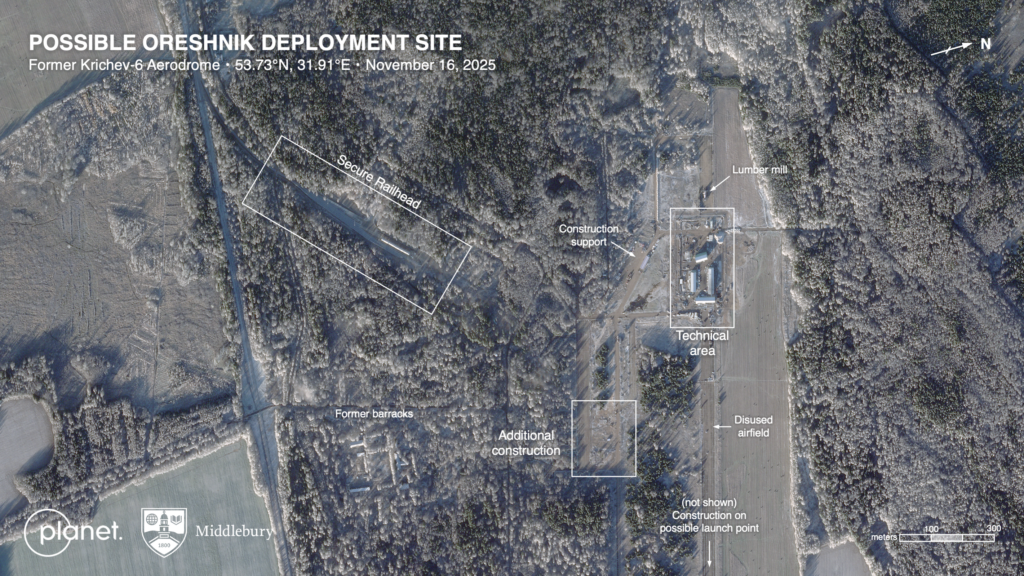
Between June 2020 and August 2025, the airfield appears to have housed a small lumber mill for timber harvested from nearby forests. Starting sometime between August 4 and August 14, consistent with Lukashenko’s observation about rapid construction, most of the buildings associated with the lumber mill were removed, areas were cleared, and construction activities began.
The most important indication is that construction crews completely rebuilt the railhead servicing the former airfield, a strong signature that the site is to be used by Russia’s Strategic Rocket Forces (RVSN). Below, you can see a satellite image of one of a railhead at the 7th Guards Division near Vypolzovo, as well as a ground truth image from an unidentified reference.
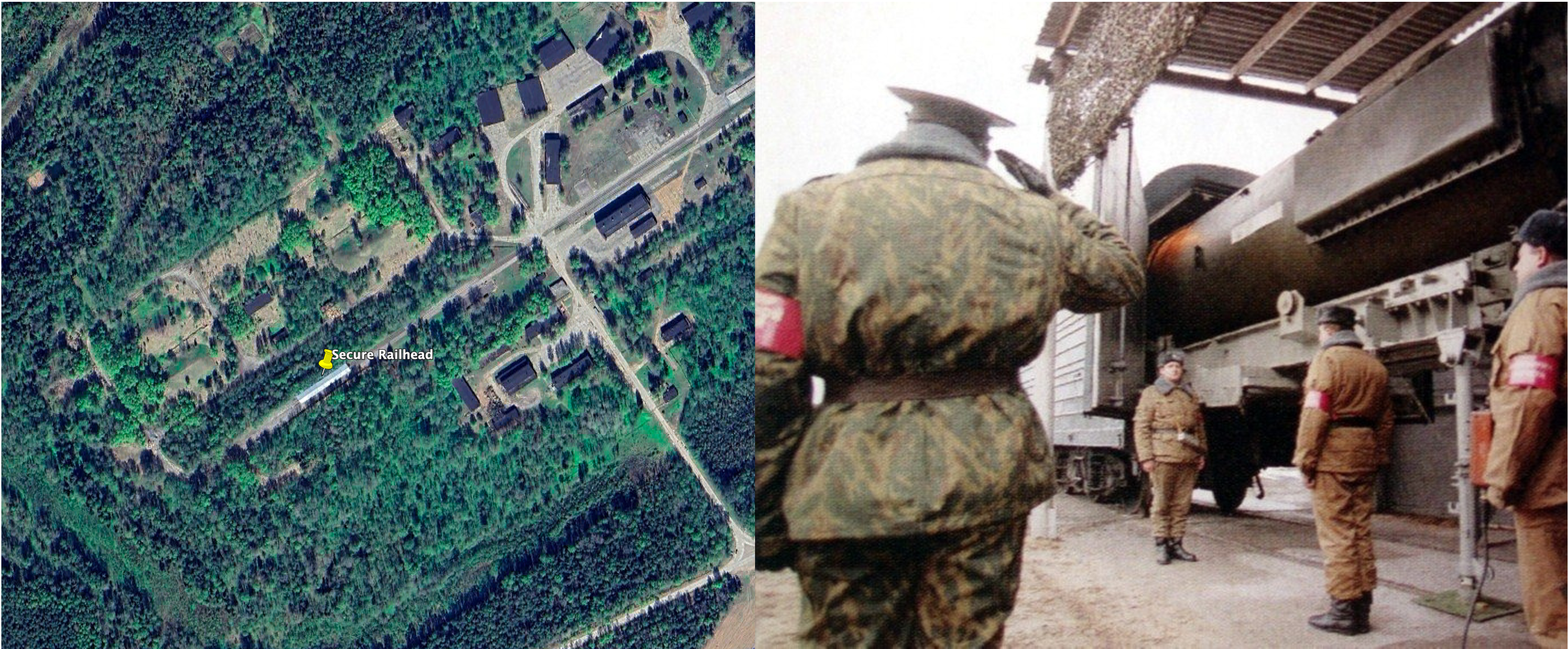
By contrast, Army units such as those that operate the Iskander ballistic missile generally do not have such railheads. Nuclear warheads for the Iskander are kept in separate storage locations managed by 12 GUMO. In the event that they are ordered to launch a nuclear-armed missile, Iskander launch units would rendezvous in the field with nuclear warhead transport units from 12 GUMO. At that time, the warheads would be mated to the missiles and then the nuclear-armed missiles would be placed on the launch vehicles. The construction of a secure railhead at the site is the primary indicator that this location is intended to house a nuclear-capable strategic missile system like Oreshnik held by RVSN unit, with some Belarusian support.
Russia also constructed a number of buildings inside a secure perimeter that was built across the disused runway. (The act of building across the runway largely excludes the possibility that Russia intends to restore it for air operations.) This area, which we refer to as the technical area, differs from known RVSN bases. The size of the area is relatively small, which is the basis for our judgement that this site is not intended to house a full regiment of 12 Oreshnik launchers. (It is about .035 km2 or 5-6 football fields.) Instead, a battalion sized element of 2-3 launchers seems more likely unless additoinal buildings are added. The small size of the area suggests that there may be another deployment site in Belarus either under construction or planned, as well a permanent deployment site across the border inside Russia.
Given the heavy cloud cover over Belarus in wintertime, we have limited access to high-resolution optical images. The most recent cloud-free, high-resolution images are more than a month old, from late November. More recent moderate resolution images, including from December 23 and December 24, show that construction has continued, but the lack of clear, high-resolution imagery limits the conclusions we can draw.
This is especially the case with regard to construction near the former parking areas for aircraft. Construction was simply not far enough advanced by mid-November to confidently assess the purpose of this area. That said, Russia cleared a large area (0.02 km2 or 3 football fields ) which could accommodate additional buildings or storage bunkers.
Finally, at the end of the runway, in mid-November construction crews poured a large concrete pad and then covered it with dirt, presumably to camouflage it. This may be a launch point or a hard-stand for parking vehicles, possibly under tents.
What it means
The deployment of Oreshnik so close to Russia’s borders does not result in any increase in the reach of the missile system. Indeed, there are many parts of the Russian metropole, to say nothing of peripheral areas like Kaliningrad, that are closer to London and Paris than is Krichev-6. The decision to base the Oreshnik less than 5 km from the Russian border illustrates the degree to which the deployment reflects political considerations, rather than an effort to seek some specific military advantage.
The deployment of the Oreshnik is probably intended to demonstrate Russian support for the Lukashenko regime, which fears a color revolution like the Orange Revolution that toppled a pro-Russian government in Kiev in 2005. The State Secretary of the Union State of Russia and Belarus, Dmitry Mezentsev, described the deployment as “a guarantee of the Union State’s security. Today, Russia and Belarus are forced to respond to unprecedented foreign pressure.”
The decision to deploy a nuclear-capable intermediate-range ballistic missile system does, however, represent a significant departure for Russian policy, beyond even recent decisions to deploy nuclear weapons for aircraft and short-range ballistic missiles in Belarus.
While the current Russian deployment of nuclear weapons involving Russian nuclear weapons matable to Belarusian aircraft and missiles could be presented as roughly mirroring US extended deterrent relationships, neither Moscow nor Washington has deployed strategic systems capable of ranging Moscow or Western European capitals since the 1987 INF Treaty led to the elimination of the intermediate-range systems and the 1991 START treaty prohibited the basing of longer-range systems subject to that treaty. Oreshnik is capable of striking Berlin, Paris, and London.
Finally, the deployment also likely violates the New START treaty, which does not expire until February 5, 2026. (Putin “suspended” Russia’s participation in New START in March 2023.) Russia reportedly declared the RS-26, which Putin appears to have renamed Oreshnik, as a modification of the RS-24 Yars ICBM subject to the treaty. Article IV, Paragraph 11 of New START states that “Strategic offensive arms subject to this Treaty shall not be based outside the national territory of each Party.” Russia previously declared the RS-26 as an ICBM under the New START treaty. If Lukashenko’s statement that the system is on combat duty is correct, then Russia appears to be in violation of the treaty.
The violation of New START bears on recent offers by Putin to continue observing the central quantitative limits of the New START treaty for one year, despite its expiration in February. The changing status of the Rubezh/Oreshnik – Russia says it is an ICBM when accused of violating the INF treaty, then says it is an IRBM when accused of violating New START – illustrates the degree to which central quantitative limits of New START are premised on a structure of definitions, verification and dispute resolution. Without that broader architecture, the central limits are of relatively little value.
In the place of arms control, Putin is laying the groundwork for reciprocal NATO deployments. That this norm is an important element of stability can be seen in the reported statements about US missile defenses in Poland, the impending deployment of Typhon to Germany, and possible future deployments of Dark Eagle that Putin and others have made. Although these systems are purely conventional, Putin has raised the prospect that they could be converted to nuclear-armed systems that could decapitate the Russian leadership in Moscow. This is precisely what he is now doing, by placing Oreshnik in Belarus.

This is not the case: “Russia reportedly declared the RS-26 […] as a modification of the RS-24 Yars.” RS-26 was declared as a prototype of a new ICBM, but not as a modification of RS-24 Yars.
Could there be a better excuse for Russia to send troops to Belarus -in case a need arose- than “securing” Russian nukes?