

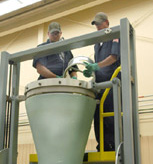
POGO claims that that workers at Pantex disassembling a W56 (exactly like that warhead) nearly made a big oopsie:
Now we have learned that in March 2005, there was a “near-miss” event while disassembling another W56 warhead. Apparently the production technicians were using a faulty tool, putting too much pressure on the warhead. On November 29, 2006, Pantex was only fined $110,000 – 18 months after the near-miss incident. What was not made public at the time the fine was levied, however, is that according to safety experts knowledgeable about this event, it could actually have resulted in the detonation of the warhead. This incident was particularly dangerous because the W56 warhead was deployed in 1965, pre-dating the three basic enhanced safety features which reduce the possibility of an accidental detonation that are now required on more modern weapons.
You can read more in the Los Angeles Times, where staff writer Ralph Vartabedian quotes a letter from employees warning that an “accidental nuclear detonation would kill everybody in the plant, destroy the complex and parts of Amarillo, as well as contaminate thousands of square miles.”

Scary stuff, but I don’t buy it. I am a skeptical that even Homer Simpson could have squeezed some yield out of this accident.
POGO doesn’t identify the “three basic enhanced” safety features—although if I had to guess it would be enhanced electrical isolation (or enhanced nuclear detonation safety), insensitive high-explosives and fire-resistant pits. Ray Kidder has a very helpful primer on the subject in Science and Global Security (which is a national treasure, as journals go).
As far as I can tell, only the lack of IHE is revelant—with the scenario involving pressure on the high explosive setting off the HE, compressing the plutonium.
I see how the pressure might make the explosive volatile, but the explosion has to compress the plutonium for any signficant yield … and US nuclear weapons are designed to be “one-point safe”—that is, “if, when the HE is initiated and detonated at any single point, the probability of producing a nuclear yield exceeding 4 pounds TNT equivalent is less than 1 in one million.”
The W56 is kind of famous (or infamous) because it is one of the four nuclear weapons designs to experience problems with one-point safety. As Steve Fetter explained in “Stockpile Confidence Under A Test Ban”:
The W56 warhead was also developed without enough tests to ensure inherent one-point safety. It too was fitted with a mechanical safing mechanism that jammed after a few years. In this case, the problem was eliminated with a small design change that did not require nuclear testing.
Chuck Hansen produced a somewhat longer discussion in Swords of Armagedon. I’ve posted the relevant excerpt.
The point is that a detonation of the HE in the W56 primary should be very unlikely to result in significant nuclear yield—although I will ask around.
Worth adding, as well, that there are no W56’s left to be disassembled.
Anyway, yield or no yield, an accidental explosion of the HE in a W56 primary would be extremely lethal to nearby workers, create a major environmental cleanup problem and seriously erode the public’s confidence in operations at Pantex.