
General Zhu Chenghu (below, right), Dean of the Defense College at the Chinese National Defense University (Guofang Daxue), told a group of Hong Kong journalists including the Financial Times’s Alexandra Harney that China might use nuclear weapons first in a conflict over Taiwan:
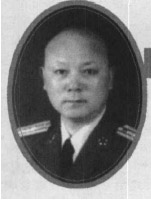
If the Americans draw their missiles and position-guided ammunition on to the target zone on China’s territory, I think we will have to respond with nuclear weapons.
Sean McCormack expressed the US State Department’s hope “that these comments don’t reflect the views of the Chinese Government …”
The Chinese Foreign Ministry obliged, calling the comments General Zhu’s “personal views.”
***
Since testing it’s first nuclear weapon in 1964, China has maintained a policy to “not be the first to use nuclear weapons at any time or under any circumstances.”
The second version of FT article—with Demetri Sevastopulo as a co-author—contains this important comment (likely from Washington):
“He is running way beyond his brief on what China might do in relation to the US if push comes to shove,” said one expert with knowledge of Gen Zhu. “Nobody who is cleared for information on Chinese war scenarios is going to talk like this,” he added.
DIA translated a reference book published by Zhu’s employer in 2000, the Chinese National Defense University (Guofang Daxue). Operational Studies (Zhanyi Xue) contains a chapter on Chinese nuclear operations that warns future nuclear commanders that, like it or not, they will be going second:
The campaign is in a bleak nuclear environment, and the position of protection is very important. According to our principle of “no first-use of nuclear weapons,” the nuclear retaliation campaign of the Second Artillery will be conducted under the circumstances when enemy has launched a nuclear attack on us.
Since the strategic missile force of the Second Artillery will be the important target of the enemy nuclear attack, it decides that the nuclear campaign corps of the Second Artillery will fight under very serious nuclear circumstances. The personnel, position equipment, weapons equipment, command telecommunication system and the roads and bridges in the battlefield will be seriously hurt and damaged. Whether the missile force can survive and whether it can maintain its nuclear retaliation capabilities becomes the important strategic issue that directly relates to the result of the nuclear retaliation campaign.
This means that the campaign protection of the strategic nuclear missile force of the Second Artillery has a very important position and function. Careful protection becomes an important means and precondition for guaranteeing the survival and successful nuclear retaliation of missile force.
Moreover, Chinese exercises suggest China’s nuclear missileers —the Second Artillery Corps—train to absorb a first strike. Read this description of a Chinese military exercise in 1994:
At a certain “Red Army” battlefield where a mountain breeze was softly blowing, the harsh sound of siren suddenly pierced the air. As “Red Army” battle personnel urgently withdrew, several “Blue Army” missiles exploded within some 100 square kilometers of the “Red Army” position. In an instant, the ground vibrated vigorously and the area was engulfed in fire. The entire site became a “death zone.”
In response to the sudden “nuclear attack,” scores of “Red Army” “cavalries” rapidly entered the “nuclear-attack zone” to carry out urgent nuclear and chemical pollution monitoring, cleaning, and battlefield rescue.
After safety taking refuge in a completely sealed “underground shelter” for several days, the “Red Army” strategic missile force began to carry out a “nuclear counterattack.” One after another, missiles shot up into the sky. Even before tremors in the mountains subsided, the target area had begun to convulse.
You fight like you train, they say.
***
Who is Zhu Chengfu? I am tempted to call him the Jerry Boykin of China.
Actually, Zhu isn’t as important as Jerry Boykin. Zhu is Dean of the Defense College at the Chinese National Defense University.
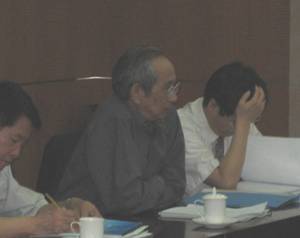
Zhu’s predecessor and former boss at China’s NDU, General Pan Zhenqiang (right), has a very different view than Zhu regarding China’s No First Use (NFU) pledge.
Admitting the existence of “a small but discernable voice … calling for the drastic change of China’s nuclear strategy,” Pan argued in 2002 that China will keep it’s NFU pledge:
It seems extremely unlikely that China will fundamentally change its nuclear policy; particularly its no-first-use position.
The reasons are many-fold:
First, from China’s grand national strategy of putting the sustained economic development as its top priority, and of continuing to seek a long-term peaceful and stable international environment, and greater international cooperation to ensure its security, it is clear that China’s defense modernization will continue to be at the backseat. This will definitely also apply to its nuclear posture and doctrine. China certainly is concerned the drastic implications if it changes its nuclear policy.
Second, China still does not believe that nuclear weapons are usable, or a nuclear war could really work in any country’s interests.
Third, change of its nuclear policy will inevitably lead to a nuclear arms race with the United States, which China certainly has no interest in. Finally, China may also be concerned that change of the nuclear policy will tarnish its image in the non-nuclear weapon states, which China has so consistently proud of.
Thus, all these considerations combined, China will make effort to enhance the survivability and effectiveness of its small nuclear force, but it will do so only in proportion with its defense needs. There is no reason to suggest that China will change its course of action in the nuclear field although one must acknowledge that the government will under greater pressure to review its nuclear doctrine and posture.
General Pan joined our workshop at Tsinghua University, The Prospects for Security Transformation.
***
Was Zhu’s statement inconsistent with “no first use”?
First, Zhu’s comment was in English—his second language. That complicates parsing his word choice, since he may not have chosen the words all that carefully.
A second comment by Zhu in the Harney article is more ambiguous:
“We … will prepare ourselves for the destruction of all of the cities east of Xian. Of course the Americans will have to be prepared that hundreds … of cities will be destroyed by the Chinese
Apart from the fact that China simply does not deploy “hundreds” of warheads mated to missiles that could reach the United States, the scenario seems to describe a much broader conflict than the mere “intervention” of the United States into a conflict.
This is not the first ambiguous comment by a Chinese General.
In 1996, Patrick Tyler of the New York Times reported that a Chinese official told Assistant Secretary of Defense Charles Freeman “that China could act militarily against Taiwan without fear of intervention by the United States because American leaders ‘care more about Los Angeles than they do about Taiwan,’ a statement that Mr. Freeman characterized as an indirect threat by China to use nuclear weapons against the United States.”
Freeman later clarified the comment, explaining that he felt the Los Angeles comment was “in a deterrent context” and “consistent with no first use”:
This statement came out in garbled form in The New York Times. It was made toward the end of a five-hour argument in October 1995, over what the probable effect would be of the military maneuvers the Central Military Commission had authorized in the Taiwan Straits. It was my position, which turned out to be correct, that if China carried through with its plans, it would get a good American military reaction. It was the position of the Chinese military officers, with whom I was speaking, that there would be no American military reaction.
At the end of the very heated argument, one of them said, “And finally, you do not have the strategic leverage that you had in the 1950’s when you threatened nuclear strikes on us. You were able to do that because we could not hit back. But if you hit us now, we can hit back. So you will not make those threats. In the end you care more about Los Angeles than you do about Taipei.” Please note the statement is in a deterrent context and it is consistent with no first use. It is not a threat to bomb Los Angeles.
Many people assume Freeman was referring to a comment by Xiong Guangkai, although Freeman has never identified the Chinese official. The New York Times story, written by Joseph Kahn, implies Zhu may have been the source of Chas Freeman’s story.
***
Analysts in the United States—particularly in the intelligence community—have a long history of seizing on the small but discernable voice” identified by General Pan to predict the imminent demise of China’s NFU pledge.
The 2003 edition of Chinese Military Power, for example, warns “despite Beijing’s ‘no first use’ pledge, there are indications that some strategists are reconsidering the conditions under which Beijing would employ theater nuclear weapons against US forces in the region.” [Emphasis mine]
DIA made the same prediction in 1985—China’s Evolving Nuclear Strategy DDE-2200-321-85 —using the same logic and some very similar phrases:
Existing forces provide Chinese leaders little flexibility for other targeting options. Recognizing the great disparity between Chinese and Soviet capabilities, some Chinese military writers have argued the need for more options—both tactical and theater—below the strategic level to respond to a limited Soviet attack.
[snip]
There are indications that the Chinese, having recognized this as a weakness in their strategy, are pursuing a variety of programs aimed at developing shorter-range ballistic missiles and other tactical systems more suited to battlefield use. When they reach fruition in the 1990s, such systems may have a major impact on … employment plans. [Emphasis mine]
This theme is an old one. An early analysis of China’s nascent nuclear doctrine by RAND’s Alice Langley Hsieh—“China’s nuclear-missile programme: regional or inter-continental?” China Quarterly 45 (1971): 85-99—concluded:
Chinese military literature contains continuing hints of an interest in tactical nuclear weapons. … These references provide us with clues … With tension along the border with the Soviet Union, the Chinese may now see further deterrent advantages in the possession of battlefield nuclear weapons. [Emphasis mine]
As a method for predicting change in operational doctrine, reading China’s military journals has been dead-wrong for thirty years. Time to get a new method.
Chinese proponents of such views appear to be a minority within the Chinese leadership. Hua Hongxun, a Chinese academic, argued in 1998 these authors “do not reflect the accepted views of the PLA and, indeed, they are criticized implicitly” in a speech by the Vice Chairman of the Central Military Commission.
The substantial criticism of NFU in Chinese military journals seems to me the best evidence that NFU remains China’s policy. After all, why criticize a policy if it doesn’t exist?
***
And what the hell, by the way, is the New York Times doing with this headline: “Chinese General Threatens Use of A-Bombs if U.S. Intrudes.”
A-bombs? What is this, 1957?
