Photo of jane

Everyone has probably caught the bits and pieces of headlines on the former Russian spy, Alexander Litvinenko, who was poisoned and died last week. There is little conclusive information and the assassination has been linked in the press both to the murder of Russian journalist Anna Politkovskaya and the Yukos affair. It’s a James Bond style mystery, but in that great BBC news voice.

The interesting part is that he was poisoned with polonium-210, an extremely rare and highly radioactive element. It is even rarer in quantities that could be used for poisoning, since they would have to be manmade. Most of the news sources are quoting experts as saying that the Po-210 could have only been produced in major laboratory. This point makes the theories (which I will describe below) about Litvinenko’s death very troubling from the standpoint of securing access to radioactive materials.

What’s Polonium-210 and where do I get some?

Polonium-210 is highly radioactive with a half life of 138 days. A very small amount, about the size of a pin head, would be enough to kill an exposed person. Exposure means swallowing or inhaling; although polonium-210 releases large amounts of alpha particles as it decays, these particles would not for example be able to penetrate your skin. (Take a look at this basic overview on Po-210 which the Royal Society of Chemistry put up on the web recently.)

Polonium-210 is often used as a neutron initiator in nuclear weapons, although it does have some civilian uses (batteries for satellites). Iran was found to have done Po-210 experiments in 2004, raising IAEA concerns. Polonium-210 of a substantial quantity would had to have been produced with a particle accelerator or nuclear reactor. Here is where all eyes turn to Russia. (Oh, beside of course Litvinenko also being a Russian spy and blaming Putin for poisoning him. That’s too obvious.)

The Observer (UK) points out why Russian institutes seem like a like source:

Such material, it is believed by experts, could only have come from the massive nuclear structures of the old Soviet Union where, during the collapse of the empire, security was often sacrificed. Polonium can only be gained from such reprocessing plants or equally complex nuclear research plants. You cannot buy this stuff from local criminals.

The speculations about this case generally fall into two groups: intentional the Russian government (or governmental organization) or intentional by someone who just had it out for this guy. (There is no evidence yet that the material did come from Russia. They detected Po-210 in Litvinenko’s body, the restaurant where he ate day he got sick, a hotel, his home, and a few other locations.)

Neither of these theories makes me feel any better about the security of radiological materials.

Assassination Theory 1 – The FSB, or someone otherwise acting on orders of the Kremlin.

The Kremlin wanted Litvinenko gone, they gave the word to someone (FSB, etc) and voila. The access to the radioactive material was easy though a number of Russian nuclear facilities.

There are several problems with this theory. If the material does turn out to be Russian, and traceable, then why would any government sponsor have chosen this particularly self incriminating method of assasination? The Moscow Times quotes Alexander Pikayev on this point:

[Alexander] Pikayev said that if a Russian intelligence agency had wanted to kill Litvinenko, it would have been foolish to use polonium because its source could probably be traced.

This of course does not rule out the FSB involvement. They could have just gotten non-Russian polonium-210, or even acted without Kremlin directive or approval. The government-sponsor or government agency theory leads to two possible conclusions: 1) Russian secret services like using overly elaborate and exotic assasination techniques 2) to high powered buyers, radioactive materials are available from either in Russia or perhaps even other sources. Since polonium is very difficult to make, only countries with highly developed nuclear programs have this capability. So where else did it come from?

note: Jeffrey pointed out that polonium-210 may be very difficult to detect, especially in a poisoning case where symptoms may suggest other substances, making this not such a crazy sounding approach after all. Perhaps those carrying out the attack actually hoped that it would leave not evidence, but miscalculated on dosage.

Assassination Theory 2 – One of Litvinenko’s many many enemies

No one denies that Litvinenko had many enemies. Perhaps one or several of these enemies acquired some polonium-210 from a less than perfectly guarded or bribe-able source, and carried out the attack independently.

However, some experts argue that this kind to lone attack would not be possible without government sponsorship and sophisticated technology.

“No individual could do this,” said John Large, an independent nuclear consultant. “What you are talking about is the creation of a very clever little device, a designer poison pill, possibly created by nanotechnology. Without nanotechnology you would be talking about a fairly big pill, a pea-sized pill. Either way you are looking at intricate technology which is beyond the means and designs of a hired assassin without a state sponsor.”

So far, experts have not found prior cases where polonium-210 was used as a poison.

Going with the non-government independent assassin theory is perhaps even more disturbing than FSB agents running around poking people with umbrellas or what not. It means that an extremely well prepared person or group of people managed to get their hands on a deadly radioactive substance which most seem to think is nearly impossible to acquire.

Regardless of which theory is true (and of course there are others), this incident also shows that it was clearly possible to smuggle polonium-210 into the UK. (Alpha particles do not set off radiation detectors.)

Lastly, an interesting side note. The Russian press is covering this story a bit differently. The papers are generally not touching the theory of a Kremlin sponsored assassination. Rather, they focus on other theories including some of their own, involving even Chechen militants, and comment on the British investigation.

Comment [30]

Photo of jeffrey

Wow, tonight’s Nelson Report is chilling stuff.

Chris warns that further investigative reporting will reveal…

... covert operations sounding very much like the Phoenix Program of kidnappings (and perhaps also murder) of terrorist suspects in one country, and the transport of them to a third country where the actual torture interrogation is carried out presumably “free” of even the presumed strictures imposed by Gonzales and his memo.

Calling the whole mess The Cambone Operation, Nelson reports that “the clandestine activities now coming to light may have been the result of decisions Secretary Rumsfeld made and set in motion, but that once in operation, Rumsfeld is kept clean of the details.”

“Strict legal responsibility, if any there be,” Chris notes, “falls to Undersecretary for Intelligence Steve Cambone.”

I am reminded of the serving three-star general who told Salon, “If we were being overrun by the enemy and I had only one bullet left, I’d use it on Cambone.”

Comments

Photo of jeffrey

Barton Gellman of the Washington Post reports that:

The Pentagon, expanding into the CIA’s historic bailiwick, has created a new espionage arm and is reinterpreting U.S. law to give Defense Secretary Donald H. Rumsfeld broad authority over clandestine operations abroad, according to interviews with participants and documents obtained by The Washington Post.
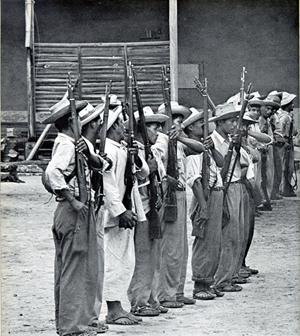

Our Friends in Guatemala, c. 1954.

The Pentagon promptly denied the report, but the Post’s reporting seems to confirm recent allegations that the Bush Administration is heavily employing covert operations, run through the Defense Department to evade congressional oversight.

Congress restricted covert operations for one excellent reason: Their track record is uniformly miserable, having done more damage to national security than not. Gregory Treverton, future Vice-Chairman of the National Intelligence Council, wrote in 1987 that “even the ‘successes’ of covert operations seem ambiguous or transient in retrospect, accomplished at significant cost to what we hold dear as a people and to America’s image in the world.”

Treverton’s judgement is based on the history of covert operations: every official review has suggested the United States use such operations less, not more. Here is a sample:

  • In 1961, out-going President Eisenhower received a report from his board of intelligence advisors on CIA covert operations, including “successful” efforts to topple governments in Guatemala and Iran. Looking back at those efforts, the President’s Board of Consultants on Foreign Intelligence Activities told Eisenhower that they had “been unable to conclude that, on balance, all of the covert action programs undertaken by CIA up to this time have been worth the risk or the great expenditure of manpower, money and other resources involved.” And those were the Agency’s salad days.
  • The 1960s ushered in a decade of the CIA’s worst covert operations. Beginning with the tragedy at the Bay of Pigs, the CIA set new standards for outright weirdness with spectacularly unsuccessful attempts to kill or discredit Fidel Castro (check out the depilatory cigar story). This period ended with the CIA’s now well documented role in deposing the democractically elected government in Chile and an ensuing congressional investigation—the Church Committee. (Some conservatives blame Church for destroying the CIA, conveniently ignoring the role played by ostensibly “covert” operations that went awry in the most publicly ways.)
  • During the 1980s, the Reagan Administration pursued a number of covert operations in Central America and the Middle East that converged in the Iran-Contra scandal.

The current restrictions, which the Bush Administration is dodging, resulted from the recommendations of the Tower Commission, empaneled in the wake of the Iran-Contra scandal. Congress incorporated the recommendations in The Intelligence Authorization Act of FY 1991. Title VI specifically addressed reporting requirements for covert operations:

The president must then make a written “finding” before beginning a covert action specifying that the operation is necessary to support an identifiable foreign policy objective and that it is important to U.S. national security. If Congress is not informed of the finding before the operation, the written finding must be transmitted in a timely manner to the relevant congressional committees, or to the bipartisan leadership of those committees. Title VI also imposes a limitation on the president’s war powers, that is, a presidential finding may not authorize any covert action that would violate the Constitution or any U.S. statutes.

Sounds reasonable. Bush 41, however, asserted Title VI unconstitutionally infringed on his right to withhold findings from Congress for unspecified periods of time—before the electorate constitutionally infringed on his right to be president. Clinton chose not to challenge the law, leaving us where we are now: Executive authority in foreign policy as stage setting for the weirdest Oedipal drama in the history of American politics.

Seriously, do you need another reason?

Perhaps, Congress should significantly restrict, or even ban, covert operations before somebody loses his eyes.

It is important to realize that covert operations do not include: activities to acquire intelligence, perform counterintelligence, improve or maintain the operational security of U.S. government programs, or carry out administrative activities. Covert operations also exclude traditional diplomatic, military, and law enforcement activities.

Rather, a covert action only refers to:

... an activity or activities of the United States Government to influence political, economic, or military conditions abroad, where it is intended that the role of the United States Government will not be apparent or acknowledged publicly.

In other words, assistance to prop up our friends and topple our enemies that if disclosed—even after the operation is complete—would harm the national interest.

Should the United States undertake operations that, if disclosed, endanger national security? Rarely, if ever, for two reasons:

  • First, covert operations are almost certain to be disclosed. Covert operations violate the first rule of life in Washington: Don’t ever do anything that you wouldn’t want to see on the front page of the Washington Post. The story by Bart Gellman helps drive the point home that, more often than not, covert operations eventually become public knowledge.
  • Second, covert operations often fail because they are covert. Shielding programs from Congressional oversight allows for small programs to devolve into gigantic, often bizarre, schemes that would never pass muster with Congress. Writing about the Iran-Contra affair, Treverton warned of the danger from centralizing White House control over covert operations. “Excluding the designated congressional overseers,” Treverton wrote, “also excluded one more ‘political scrub,’ one more source of advice about what the American people would find acceptable.”

Given that the challenge posed by AlQaeda is, largely, an ideological bid for the hearts and minds of millions of Muslims perhaps one more political scrub might not be such a bad idea.

Update: CNN has sources confirming the existence of the unit at the center of the Post’s story. Senator Chuck Hagel (R-NE) captured the essence of argument (2), noting that “the concern I always have in these matters as well as others when it comes to power in government is too much power concentrated in too few hands.” Hagel added, “That’s when a country gets into a lot of trouble, when you brush back the Congress and you don’t have oversight and you don’t have cooperation, and I see too much of that out of this Pentagon.”

Late Update: The New York Times weighs in with a we were scooped/mopping up article.

Comments [3]

Photo of jeffrey

Seymour Hersh suggests Washington is gearing up for an attack on Iran.

Or, at least, that is the headline. As far as I can tell, the news is

The President has signed a series of findings and executive orders authorizing secret commando groups and other Special Forces units to conduct covert operations against suspected terrorist targets in as many as ten nations in the Middle East and South Asia.

Now that is a big deal. Some of the countries Hersh lists—Algeria, Sudan, Yemen, Syria, Malaysia, and Tunisia—are at least tepid allies in the GWOT who may become a lot more so now that this story is out.

Hersh also notes that much of the capability and authority to conduct such missions has been centralized under the control of Secretary of Defense Donald Rumsfeld.

Then Hersh breaks the story that Iran is also a target:

The Administration has been conducting secret reconnaissance missions inside Iran at least since last summer. Much of the focus is on the accumulation of intelligence and targeting information on Iranian nuclear, chemical, and missile sites, both declared and suspected. The goal is to identify and isolate three dozen, and perhaps more, such targets that could be destroyed by precision strikes and short-term commando raids.

This would presumably include installations like Iran’s Bushehr light water reactor (above right).

Some of these missions, Hersh claims, operate out of Pakistan—in exchange for Islamabad’s cooperation, the US continues stifle the IAEA investigation of the A.Q. Khan network.

But does continency planning—and extensive documentation of a war party inside the Pentagon and Vice-President’s office—really add up to a military strike?

Its hard to find a smoking gun anywhere in the article—though there is nothing to rule it out either.

Late Update: Well, the inevitable Pentagon denial has been issued and … it doesn’t actually deny any of the important parts of the story.

***


View from an Israeli F-16 during the strike on the
Osirak reactor (source).

Hersh obviously thinks such a strike would be foolish, but he repeats a myth that is at least partially responsible for the ardor of proponents of a strike against Iranian facilities:

In 1981, the Israeli Air Force destroyed Iraq’s Osirak reactor, setting its nuclear program back several years.

Dan Reiter, a professor at Emory University, has written The Osiraq Myth and the Track Record of Preventive Military Attacks arguing that “closer examination of the Osiraq attack reveals that it did not susbantially delay the Iraqi nuclear [weapons] program and may have even hastened it.” [Emphasis, mine.]

After e-mailing Dan, I did a little research myself.

I think that he is probably right:

  • In memoirs and interviews, largely published after Operation Iraqi Freedom, Iraqi nuclear scientists have been unanimous in stating that Osirak was not part of a clandestine nuclear weapons program. The reason is simple: the two strategies for using the reactor in this manner—diverting HEU or secretly producing Pu—would have been detectable by IAEA inspectors and produced relatively small amounts of fissile material. A technical analysis by the IAEA in 1981 supports these accounts.
  • The scientists were also unanimous in dating Saddam’s pre-Gulf War effort to acquire a nuclear weapon through a clandestine uranium enrichment program to the days immediately following the Israeli attack. The effect of the attack was probably to transform a “virtual” bomb program into a very real one that may or may not have succeeded without the intervention of the Operation Desert Storm.

If Tehran is pursuing a virtual bomb, as I and others have suggested, then the military option will likely collapse diplomatic efforts, further radicalize the Iranian regime, and guarantee a crash program for the bomb.

Come to think of it, that does kind of sound like something Rumsfeld would do …

Comment [1]