
This video is just a little more interesting than watching paint dry—until you realize that it is sound causing that little bright dot in the center! Sonoluminescence, light emitted by a plasma created at the center of a converging spherical sound wave, can be yours for about $100. Here are the instructions and here is a Scientific American article on the phenomena, which is closely related to the UD3 neutron generator.
I’ve been thinking about a small detail involving UD3 imitators ever since Jeffrey first published his very interesting post showing A. Q. Khan in front of a blackboard detailing Pakistan’s bomb design: why uranium deuteride? The uranium doesn’t participate in the nuclear aspects of the neutron generation, so why use it? I’m still not convinced I’ve understood the reasons behind this choice of material but the process of trying to understand it has been very enlightening.
Of course, one answer might be purely practical: there’s a whole bunch of uranium sitting in a bomb not doing anything until the first burst of neutrons is generated. Why not use it in the initiator? Such practical considerations undoubtedly do play an important role. But uranium has a very nice property that deuterium gas, for instance, does not: it’s very massive, an important consideration for shock compression. That mass, and how it’s packaged, might play a critical role in generating the pressure spike that compresses and heats up the deuterium to the 12 million degrees as reported in the Chinese paper.
What potential benefits does that mass bring to the initiator? The internal energy caused by the shock of the collision at the center of the device is proportional to the density of the material. Not the density of deuterium alone, but the total mass density. And the change in internal energy is also proportional to the shock pressure associated with this collision, which is much, much more intense than the shockwave that propagated through the UD3 to get it accelerating toward the center.
I’ve been trying to guess how fast that initial shock velocity was; another thing the Chinese paper—by not fully describing their experimental set up (they only give the outer radius of the high explosive as 8 cm)—has managed to conceal. I’ve estimated it as between 7 and 17 km/s, depending on how big the air gap between the aluminum and steel liner and the core really is. (The particle velocity is less than that.) One possible measure of just how important the uranium mass is comes from the paper reviewing Kaliski’s experiments using D2 gas, as pointed to by Robert Cross in Jeffrey’s original post. Through a fairly complex apparatus for focusing the shockwaves from a shaped charge (complicated if you wanted to place it next to a nuclear weapon’s pit, that is), Kaliski reported a particle velocity striking the deuterium gas of 50 km/s. Needless to say, the smaller the required velocity of the “strike,” the easier it should be to cause fusion.
But It’s More Than Just the Mass
Of course, just because deuterium is bonded to uranium doesn’t mean the compound has a high density. The theoretically maximum density of UD3 is about 11 g/cc; still quite dense if considerably less than the 19 g/cc for uranium metal. But that 11 g/cc is for a monolithic crystal. This is where material engineering really comes into play. You can increase the shock pressure—a seemingly important factor for increasing the final temperature—by increasing the density of the material. But you can also increase the temperature by making it more porous. In the language of shockwaves, you are increasing the change in “specific volume” (which is just the inverse of the density) as the material is crushed by the shock. This crushing, or compression, performs work on the material and heats it up. (That’s why the sonoluminescence experiment mentioned above needs a bubble in the center.) A monolithic crystal of UD3 would have a high pressure associated with the collision but not much work would be done—because of the relatively small compression associated with the solid crystal—and hence would not produce much of an increase in temperature. The Chinese, on the other hand, used a material with an initial density of 6 g/cm^3, which I assume is in the form of a sintered powder.
The effects of increasing the porosity of a material has been well documented in the open literature. Furthermore, increases in temperature appear to increase with increasing density of the porous metal’s “parent material” (bulk copper, for instance, is the parent material of copper powder). But most reproducible results involve temperature changes less than 10,000 K; about a factor a thousand less than the Chinese report. Of course, it is possible that the results mentioned in the literature were based on bulk temperatures and the fusion-type environments only happen over a very small volume that can only be measured by looking for the fusion-induced neutrons. (Just to be clear, I’m purposely grasping at straws here.) On the other hand, the Chinese measured a maximum of 48 neutrons in their detector and “corrected” that value by a whopping big factor to infer a yield of 50 thousand neutrons. To make maters worse, I saw nothing in the Chinese paper to indicate that they measured the effects of setting off 252 high speed detonators close to the sensitive preamps attached to their barium fluoride proportional counters. That might cause a lot of ringing in the signals.
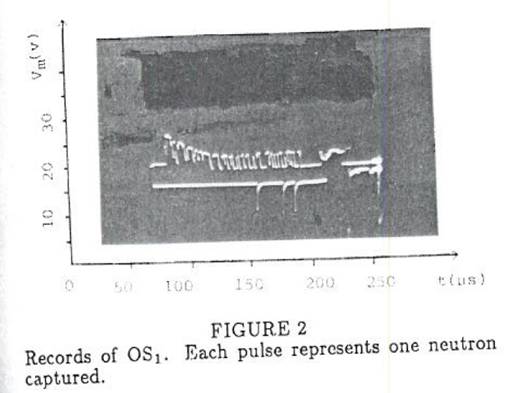
Figure from the Chinese paper. After reading their caption, try saying “preamp noise” to see how that fits. (The darker black areas are in the original article.)
At the end of this process, I still don’t know why it is uranium deuteride. Can such high density materials like uranium be used to provide exactly the right balance between the two countervailing needs: high shock pressure and crushability? Or is UD3 a red herring and that famous (or infamous?) blackboard photograph an instance of carefully constructed of misdirection? As you might have guessed, I’ve become increasingly skeptical about the possibility of using UD3 as a source of fusion neutrons initiated by conventional explosives.
Note on Proliferation: I’ve tried mightily to extract the UD3 shock Hugeniot from the Chinese paper and haven’t figured out a way of doing it. Through a carefully selected set of information actually published, I think the Chinese have managed to convey their results without creating a proliferation problem since that Hugeniot is really what you need to design an initiator. However, just because I can’t do it doesn’t mean it is impossible so I agree with Jeffery’s decision not publish the paper here. This, of course, just propagates the problems arising from censoring science: a lack of full peer review etc.
I’d like to thank Prof. Andrew Higgins for pointing me to a number of important papers in the literature and helpful pointers as I tried to understand this issue. I highly recommend one of Andrew’s suggestions: Paul Cooper’s “Explosive Engineering” Of course, any mistakes I’ve made here are entirely mine.
Appendix: Hugoniots “Explained”
Once again, it has been pointed out to me that I’m way too techno-wonky on this one and failed to explain what a Hugoniot is. Of course, the best way to learn about them would be to read chapters 14 through 17 from Explosives Engineering. (Don’t worry, the book is excellent and you can jump in right to those chapters, which give a very readable physical explanation of shock waves. They get progressively more “mathy” but its all algebra and I urge you to work through them. If you don’t feel like that, just read Chapter 14, which doesn’t use any math at all.) But for the skinny, let me say that a material’s response to shocks can be characterized almost entirely by one graph and that graph can, for most materials, be characterized by a single number. The graph is a plot of the shock velocity vs. the velocity of the particle and the single number is the slope of that line in what is, in most cases, a straight line. This is called the U-u Hugoniot and other Hugoniots associated with the material are simply derived from it.
As you might expect, a shock wave, which is just a pressure wave has a higher velocity that the particles that get accelerated by the shock as it pass over them. But once the these parameters have been determined, it can be used to plot the same Hugoniot line but in terms of different variables, all of which are related to the original line by the laws of physics. In particular, you can plot the pressure of the shock wave verse the “specific volume,” the inverse of the density. This plot is important because the area under a line drawn from the initial, unshocked state, to the state after the shock wave has passed through is equal to the internal energy of the material. In our case here, by increasing the porosity of the material, we have increased the area under the graph and hence the total internal energy. A word of warning: the temperature is different from the total internal energy.

An example of a typical Hugoniot where pressure is plotted against specific volume (i.e. the inverse of density). The area under the Raleigh line is equal to the shock induced internal energy (including potential energy stored in chemical bonds of compressed materials.)

We cannot replicate it to prove or disprove. It remains theoretical.
If one were to take the PRC scientist’s claims at face value would their work yield a usable neutron initiator? Does an order of 10^4 – 10^5 neutrons per pulse make an effective neutron trigger? Polonium-Beryl urchin or TOM type device or an array of neutron pulse tubes kick out on the order of 10^8 – 10^10 neutrons. In particular, an external array of neutron pulse tubes is fairly easy to manufacture, calibrate and troubleshoot, produces orders of magnitude more neutrons than the claims for UD3. Furthermore such an array can be be a modular plug and play unit as opposed to any internal neutron trigger which much must hydrodynamically matched to a particular science package. This perhaps in some measure explains why modern PRC warheads utilize pulse tubes as opposed to imaginary UD3 cores.
Given the original “translation’s” call for a replacement of UD3 with TiD2 it should be safe to conclude that Philps’s assertions that the Iranians were working on a shock compressible neutron trigger were unsubstantiated by her ‘evidence’ Rather her proof seems to suggest more a deuterium impregnated target for deuterium ion beam bombardment in the service of a neutron generation. As far as AQ Kahn’s blackboard? What does it matter? The man was not a weapons designer, his alleged PRC blueprints were never deemed credible enough by the Pakistanis nor the DPRK to be utilized in their respective programs.
I think Arms Control Wonk is a wonderful site, but it has a tendency to deviate from the realm of hard science off to la la land whenever presented with a sufficiently juicy ‘leak’. That does a disservice to the technical side of this site.
The UD3 shock Hugoniot is probably not too different from the UH3 Hugoniot, which can be deduced from the shock EOS parameters which Carey Sublette has published here It would not be very difficult to determine the neutron yield from shock compressed UD3 using a standard radiation hydrodynamics code and reasonable implosion velocities. I plan to do that when I have time to play with the code. However I am reluctant to post the results if everyone thinks the Chinese paper is proliferation sensitive. If the Chinese paper claims a neutron yield of 50 thousand per pulse, I have doubts about the viability of that yield for initiating a persistent neutron chain with a high probability, but it depends on the pulse width and its temporal relationship to the maximum device compression.
Robert,
The Hugoniot entirely depends on the material’s porosity, something that I presume is adjustable.
Geoff wrote: “The Hugoniot entirely depends on the material’s porosity, something that I presume is adjustable.” Yes, indeed. I believe it depends on the pressure applied during the sintering process; I think there may be a LANL report on the subject. But we have no way of knowing the porosity of the Chinese UD3 or the putative Iranian UD3 either. That’s the advantage of a hydro code simulation, one can use different values of parameters such as porosity and implosion velocity to see what is possible. I might have a better starting point if someone could e-mail the Chinese paper to me.
Robert Cross,
Great analysis. Standing behind a diagram of an implosion device does not necessarily imply that Pakistan used the Chinese bomb design as a basis of its nuclear weapons. It has been publicly stated that Pakistan used a Po-Be neutron source in its initial weapon designs while weapon design, development and testing itself was PAEC’s mandate and responsibility.
A Q Khan tried to set up a parallel weapon’s program at KRL that did not have the sanction of the government and most likely failed.
PAEC also set up a Fast Neutron Physics Group, a Theoretical Physics Group (set up in Dec. 1972), a Diagnotiscs Group, a Uranium Metal Lab, a Beryllium Metal Plant, a Chemical High Explosive Group as part of the Directorate of Technical Development.
These specialized groups were formed in PAEC from 1974 owards under the Directorate of Technical Development that carried out the first cold test of a working nuclear device on March 11, 1983 and subsequently 24 more cold tests and the 1998 hot tests at Chaghi.
Only PAEC had the facilities to produce a variety of neutron sources, or RDX/HMX or the testing and manufacturing facilites for nuclear weapons and not KRL, as the latter’s mandate was restricted to centrifuge enrichment and not weapons development or the rest of the fuel cycle.
A Q Khan obtained a Chinese bomb design in competition with PAEC whose Theoretical Physics Group had completed its bomb design by 1978 which was successfully tested in the March, 1983 cold test. This implosion device was less than half the size of India’s PNE of 1974.
You may refer to Mr. Munir Ahmad Khan’s and Dr. Samar Mubarakmand’s speeches that shed light on these issues.
Regards.
I’d like to remind readers of two things: First, Khan asserted, on the blackboard, that a bomb design might use UD3 as an initiator.
The four Chinese scientists who published the paper are nuclear weapons scientists — the Southwest Institute of Flud Mechanics is where, for example, China did its subcritical experiments through the 1990s.
Not technical issues, I know, but important facts nonetheless.
Geof, the book by Cooper you recommended is excellent, but it doesn’t treat shock compression of porous materials. There are other references, such as “Fundamentals of Shock Wave Propagation in Solids” by Lee Davison (Springer, 2008) which treat the problem you have posed. Chapter 11 of Davison shows the method for extrapolating the Hugoniot for the parent (non-porous) solid to the porous state.
An advantage of hydro codes with sophisticated equations of state (such as QEOS ) is that these codes can automatically treat the problem of shock compression of an initially porous solid without too much fuss. The better codes can also handle shocks with appreciable energy in the radiation field, a situation not easily solved using the Ranking-Hugoniot equations.
Jeff, it has been pointed out that Kahn is not a weapons physicist per se, and I’m not sure how much weight the blackboard photo-op deserves. With respect to the fact that the authors of the paper work at a weapons lab, LANL and LLNL publish a great deal of work that is not directly weapons related. I don’t think the “Iranian” paper can be ignored, but neither is it a smoking gun. I feel sure that they are working toward weaponization, but this paper is very weak evidence, and may be the work of some intelligence organization or other.
In the discussion above I seem to see only a consideration of UD3 being shock compressed from a “fluffy” sintered powder to a unit density of 11 g/cm3.
I suspect that a spherical implosion in an actual bomb would drive it to much greater density.
Yale,
Its the work done on the material that counts; not so much its compressed density, which I assume COULD be much greater than 11 g/cc. If you compress a solid material, you are storing energy in the atomic bonds. That is recovered during the decompression shock. It is irreversibly crushing the voids that actually heats up the material. (Or so I understand. There are, of course, exceptions to this. For instance, if the solid material undergoes a phase change when compressed that energy might not be recovered in a “coherent” manner and would presumably have a larger component turned into heat.)
I think calculating the final density and temperature is hard. Much harder than you guys are giving it credit for.
By the time you reach a few hundred eV temperature and at (compressed) solid density, you are going to be in a plasma regime that is very difficult to calculate. There will be a bunch of electrons ionized, but the number will be sharply dependent on the density of electron states in the condensed solid – a density which will be about equal to the number of ionized electrons. Furthermore, the threshold ionization energy is changing rapidly with increasing ionization and the amount of energy absorbed in ionization is therefore sharply dependent on the ionization level. And then there are all the excited but unionized states in a complicated outer shell. Meanwhile, in order to propagate the shock to the fusion spike, you presumably will have to travel through what seems a very likely rearrangement of the Uranium f-shell, so I really don’t think you’re even going to very well know what terminal approach to the pressure spike after exiting the shell rearrangement you have anyway.
Porosity is the least of your difficulties.
These problems sort of go away as the temperatures rise because the degeneracy becomes so large and the ionization far more predictable, so you have a chance of estimating the equation of state without understanding the detailed electronic structure and the compression acts more like a perturbation. This is the region that really matters for fission weapons.
I think that what is of interest here is the implied gruneisen parameter from the code datapoints provided in the chinese paper. Again, I would say that these points are going to be largely irrelevant to the design of the primaries. For general application, the densities are too high and the temperatures too low. On the other hand, the data is going to traverse a region of the state plane that is very relevant for the design of the secondary stage – 10-20 times solid density and 100 eV or so. The additional hydrogen will not make too much difference up at this pressure. Of course, this all depends on trusting the Dong et als. datapoints being correct. Do you see my point?
In reference to the Iran documents, they state that “policy is to develop co-operation with research and university centres in order to carry out the projects outside of the centre” and that samples are to be produced “by mutual co-operation … [then presented] to other research centres for marketing purposes”. It seems unlikely that nuclear weapon projects would be distributed among several universities, or weapon parts marketed to research centres.
Titanium deuteride is used to store deuterium gas so that the gas can be generated when it is heated. It seems to me, therefore, that the function of UD3 is to generate deuterium gas so that it can be used in a plasma focus neutron generator. The neutron generator could then produce isotopes for use by other laboratories, hence the reference to market samples.
A neutron initiator for a weapon needs precise timing: this is difficult using implosion by chemical explosives. Khan is a highly unreliable source. The document does not discuss obtaining neutrons by implosion: it discusses using pulsed neutrons presumably obtained using oscillating magnetic fields.
Geoff,
I was mentioning the compressed state in a real bomb for couple of reasons including shorter MFP of the neutrons plus the value of the u in the ud3 as a potential neutron multiplier – capturing the fast neutrons and emitting more than 2. The U could actually work as an initiator of the chain. I wish I had a copy of the paper.
Norman – Yes, a neutron initiator does need precise timing, that is why “Urchin”-style initiators – which the Khan diagram shows – are so clever. They don’t need external timing. They compress just as the core compresses. (In principle they actually fire a bit early, but in practice, for reliable early generation designs, they provide good enough efficiency)
Norman,
Your analysis leaves unexplained why the document published by The Times proposes a progression from “detection experiments using NGs and PFs” to “detection experiments using a hot source” or why there is a need for “decisions on finding the appropriate location to conduct experiments which cannot in practice be conducted within the Institute. Furthermore, decisions must be taken regarding the locations where such experiments used to be conducted.”
You make much of the proposal to “produce more samples by mutual co-operation, then present these samples to other research centres for marketing purposes.” However, you fail to note that this was prefaced by the remark that it falls under “the document that covers ordinary activities” or to explain what is meant by the distinction between “ordinary” and “special” work which appears throughout the memo. You leave completely unexplained the emphasis on security and political sensitivity, the need for “trustworthy personnel within the organization”, “specific safeguards”, and “mobile laboratories”.
I mean, give me a break. The Times’ memo is, if anything, entirely too suggestive and incriminating, and some of what is referred to may involve using hydrides as deuterium generators for experiments using plasma machines to produce neutrons, but if so, what is the purpose of that, and why is it a preparatory step to the “detection experiments with hot sources”?
You cannot explain this away as innocent activity. What you can say is that, first of all, the memo does not report ongoing work, but only proposes a program of work; second, this program would only represent a low level of continuing research to provide Iran with the basis for an option to develop a bomb, but proves little about intentions or the likelihood of success in negotiating a peaceful outcome with Iran forgoing nuclear weapons; and third, that this document smells pretty funny, since it is so obviously incriminating and makes all these references to security concerns and is so vague and cryptic about the exact nature of the work while providing more than enough details to connect it with nuclear weapons. It may well be a forgery, crafted for effect as disinformation.
Yale
You should phrase your assertions in the form of a question, for I feel more comfortable answering you than correcting you.
Let’s see when you state, “the compressed state in a real bomb for couple of reasons including shorter MFP of the neutrons plus the value of the u in the ud3 as a potential neutron multiplier – capturing the fast neutrons and emitting more than 2. The U could actually work as an initiator of the chain.” From this I can deduce that you wish to know if autocatalytic fusion/fast fission driven by chemical shock compression can initiate the neutron chain reaction. The answer is no. Consider, if you will, why urchin initiators were developed in the first instance; the quick disassembly period of the fissile core coupled with the exponentially beneficial attributes of skipping generations in the neutron chain reaction of the core by neutron seeding. An attempt to use an autocatalytic neutron initiator would actually be a step backward, it would in fact be an attempt to place a subcritical boosted device in the heart of a bomb. Sure the fizzle, if the compression were high enough, would supply a neutron burst, but unfortunately the surrounding fissile core would have disassembled by that time.
Simkin, your second question, I deduce to be something like; “Isn’t the urchin type initiators a thing of simplistic beauty why were they replaced with those cumbersome inelegant external neutron pulse tubes?”. Well the problem with Urchin and TOM was exactly the calibration of the timing. Everytime a new weapon is developed, the internal initiator will have to be carefully matched to the the weapon hydrodynamically and even then the timing of the neutron pulse may still not be optimal, resulting in a less efficient design. External pulse tubes on the other hand can be precisely calibrated in lab, whether they are US or PRC designs that can actually be multifired or old soviet one shot designs running off an EFCG. Furthermore these external triggers are interchangeble for the most part save for some packaging concerns.
I also detect an implicit question from you, something along the lines of “Can UD3 be chemically driven to yield a workable neutron initiator for an atomic warhead?” The answer is of course no. Consider the claims of the authors of the paper, as rightfully pointed out they are persons in the employee of a weapons lab, they assert that their cumbersome setup produced 10^4-10^5 neutrons per pulse. Consider that inelegant design insensitive external neutron triggers produce 10^10 neutrons. In simple terms that’s 100 thousand to a million times more neutrons and of course the difference between a bang a fizzle.
I hope I’ve answered your questions, feel free to post more.
John Field wrote “I think calculating the final density and temperature is hard. Much harder than you guys are giving it credit for.”
I agree that it is not trivial back-of-the-envelope physics. That’s why I proposed using a radiation hydrodynamic code of the type used for calculating inertial confinement fusion (ICF) implosions. The codes include the effects of ionization on the equation of state and the radiative opacities. These effects have been studied extensively by astrophysicists and those involved in ICF target design. It is hard, but certainly not impossible. High energy density physics has become much less mysterious with the increase in computing power over the last two decades.
I don’t think some of qualitative arguments I’m reading are amenable to proof one way or the other without resort to an integrated multi-physics code.
Yale Simkin wrote “I was mentioning the compressed state in a real bomb for couple of reasons including shorter MFP of the neutrons plus the value of the u in the ud3 as a potential neutron multiplier – capturing the fast neutrons and emitting more than 2.”
Yale, if this hypothetical UD3 initiator could be made to work, when triggered it would be sitting in the center of a compressed mass of fissile metal with a prompt alpha exceeding 10^8 per second. That’s about the most effective neutron multiplier yet conceived by man. How much additional neutron multiplication do you think could be achieved by a few grams of UD3?
I agree with other posters who find your arguments for the advantages of an ‘urchin’ over a pulsed external source somewhat unsatisfying.
What evidence for bomb initiators can actually be found in the Iranian document? (And remember the doctor’s adage: “When you hear hoofbeats think horses, not zebras.”)
The discussions of NGs and PFs are reasonably explained as referring to conventional accelerator tubes and dense plasma focus generators. The reactor is described as a device that fits in a glove box and produces D gas for PF system. Now a metal hydride gas generator is a laboratory device that fits the bill neatly, and can use UD3 and TiD2, the two hydrides mentioned.
Now plasma focus generators are devices that create a very hot plasma through a hydrodynamic means (initially driven by electromagnetic fields) – so conceivably the references to “hot sources” and hydrodynamic calculations could refer to work with more advanced PF devices.
The size of the program described amounts to some 14.3 man-years (by western reckoning) of work spread over 4 years. Is this excessive for such a research program? Its certainly a substantial program, but whether it is suspiciously excessive in size I can’t say.
What internal evidence is there that this is specifically weapons-related work?
The arguments offered are that this describes mobile labs (and are presumed to be for reasons of secrecy); that while item 1-4-1 calls out using “NGs and PFs”, item 1-4-2 separately refers to “a hot source” (presumed to be a weapon device); that item 1-3 calls for “experimental conditions similar to real conditions in order to detect pulsed neutrons obtained from hot sources” indicates that real conditions for hot sources are distinct from “experimental conditions”; the repeated use of the term “special”, which echoes western use (in the U.S. for example) as code language for classified activities (“special weapons”, “special nuclear materials”, “special intelligence”, etc., the first two referring to nuclear weapons, the last not).
The latter arguments for a classfied connection are pretty persuasive, taken together, though most of the program appears to be unclassified.
What evidence is there that this specifically refers to a UD3 implosion driven neutron initiator as the “hot source” instead of, say, a sub-critical U-235 implosion test, or a weaponized PF initiator, or (if coded language is being used, and hot may be a code term) any weapon-related initiator?
I’d say, nothing at all. The reference to UD3 seems to me to be a reasonably clear reference to a glove box gas generator. ISIS, to my eyes, made a moderately wild leap of faith (inspired by a Pakistani blackboard diagram of questionable value), and many others are simply leaping after them.
Some comments specifically about the Q. Dong paper and whether implosion-driven initiators can be made to work.
The entire lengthy discussion of crystal densities, compressibilities, porosities and atomic bonds is not terribly germane to the problem. Fusion occurs in a plasma state in a very small volume at very high temperatures, and the real issue is whether you can get a shock to converge to such tiny dimensions at all (John Field touches upon this fact).
Converging shocks are unstable. Irregularities present at the outset get relatively worse as the shock converges (the reverse is true for diverging ones). One can contemplate shocks converging to extremely small dimensions and extremely high energy densities, but actually doing it requires either inherently highly symmetric physical systems (where nature works to your advantage), or extremely good implosion systems. In the former class are sonoluminescent bubbles and the clever UTIAS system of Sagie and Glass.
The UTIAS work, using a diverging point-initiated D2-O2 ~800 psi gas detonation to trigger a 10 cm radius PETN shell that drove the implosion achieved extremely good symmetry. How good? Good enough that the effects of gravity on the gas in the horizontally mounted chamber impaired the symmetry (think: scale height effects at 10 cm). Their convergence was on the order of 10000:1 (from 10 cm to 10 microns). From this they got neutron yields of ~500,000.
The Dong paper states the initiation simultaneity is 0.03 microseconds. With a 7500 m/s detonation velocity HE this is a 0.225 mm irregularity, or a initial dissymmetry in an 8 cm radius system no better than 1 part in 350. They state that the max deviation of the waveform is 1.1 microseconds. This is so large (8 mm) that it can’t be right. I assume that this is a typo and it is supposed to be 0.1 microseconds (0.75 mm, or 1 part in 110). According to Evans (Phys. Rev. E Vol. 54, No. 5 Nov 1996, p. 5005-5011) the relative growth rate of perterbations in a spherically converging shock in a perfect gas is to the power 0.89 of the convergence so that a 200-fold convergence of Q. Dong shock would destroy the symmetry entirely (the limit is less than 600-fold even with the 0.03 microsec figure). This also suggests Sagie and Glass were better than 1 part in 3000.
Given this, Q. Dong’s simulated convergence calcs down to 0.04 cm are plausible (calculating a 73 neutron yield) with 0.013 cm the absolute limit (not quite reaching the 0.01 cm which gives a yield of 43,000 which matches their claim).
These degrees of symmetry are far in excess of what you need to compress a fissile core really, really well (88% of the material in a solid core is in the outer half of the radius, a convergence of 6 or so in a 80 cm U-235 weapon). Would you go to this kind of trouble just to initiate the chain reaction when polonium initiator and “zipper” technology is so well established. How reliable would your bomb be with stockpile aging?
Now, on how many neutrons you need to initiate. The absolute limit is enough so that the probability of no immortal convergent chains being established is less than the overall probability of failure from other causes. That would be like 10 neutrons or so. With million or billion neutron pulses you gain additional design flexibility since you don’t need 20 or 30 generations to incubate your neutron population. I think most any nuclear power wannabe would desire that flexibility.
Typo: “immortal divergent“ not “immortal convergent” of course.
Dear Mr. Sublette,
Plasma focus devices are great basic learning tools but are not viable candidates for neutron initiators in a portable nuclear weapon. Consider that compact external neutron source initiators have negligible mass in comparison to the overall atomic weapon whereas a PF with enough oomph to get the job done will mass roughly 200+ kg and require a complex pressure system versus a simple sealed tube. Add to this the fact that PF are notorious for inconsistent behavior and often require multiple discharges before settling down to plateau value and further consider that the partial deuterium gas in a PF is susceptible to ionization from nearby atomic detonations thus resulting in greater potential for non optimal performance. Under these circumstances it becomes obvious that PF’s are simply not a good fit to the neutron trigger role.
I believe the whole PF as neutron trigger thing started during the Iraq war justification period. Certain ‘analyst’ were attempting to claim that Iraq had subverted the UN PF program to forge a viable neutron trigger; it was preposterous then and remains so to this day.
Azrael – that’s what Carey said, in his main posts’ second to last paragraph.
In the first thread we had on this, I pointed out the issue without any detail – why would anyone bother with one of these systems?
The little particle accelerators for external neutron generators / initiators are easy, not terribly complicated, and cheap. They’re not intricately linked to the imploding primary physics envelope, and therefore can be tested to satisfaction without an all-up system yield test.
The Polonium systems have the advantage of being simple themselves, but require you to be able to access the pit regularly (either for IFI, or stockpile maintenance every few Po half lives, which isn’t very long at all).
ENI have a functional half-life of either decades (D-D, electronic component aging) or 12 years (D-T). Their timing can be more precisely controlled. You can fit more than one of them fairly easily, as they’re small, so one or more can fail without impairing weapon performance.
As long as your explosive assembly and neutron reflector aren’t too opaque to externally generated neutrons, they’re an obvious huge win.
Carey Sublette, thanks for your nice dissection of the ‘Iranian’ document. I agree that ISIS made a leap of faith that seems unjustified by the evidence I’ve seen discussed openly.
In discussing the required neutron source strength you wrote “That would be like 10 neutrons or so.” I checked this for myself and thought other readers might be interested in the origin of this number, at least as I worked it out.
Using the methods of “Hansen”: http://www.csirc.net/docs/reports/ref_097.pdf it can be shown that the required neutron source strength required for a 90% probability of initiation is about 2 × 10^7 neutrons per second, assuming that the maximum keff is about 1.25. This assumes that the time interval of maximum compression (before core rebound) is about 0.5 microseconds, so about 10 neutrons would be required over that time interval.
Looking at the Dong paper I’m not certain of the time scale for emission of their claimed 5 × 10^4 neutrons. If those neturons were omitted over a 10^-6 second interval, the source strength would seem more than adequate. Whether this pulse can be reliably timed to coincide with maximum device compression is another story altogether.
Mr Herbert,
To which main posts are you referring to? Mr. Carey’s first post, penultimate paragraph reads ‘What evidence is there that this specifically refers to a UD3 implosion driven neutron initiator as the “hot source” instead of, say, a sub-critical U-235 implosion test, or a weaponized PF initiator, or (if coded language is being used, and hot may be a code term) any weapon-related initiator?’ This is in no way parallels my claims that PF are not well suited to serve as neutron triggers.
On a more general note,
With respect to the neutron flux required, the brighter the neutron source and therefore the more intense the initial neutron flux thru the core the more efficient the design. Peak compression is a small time period in which to burn up all the fuel, in a pure fission device, or to ignite a DT burn in a shock boundary layer, in a boosted design. A bright neutron source requires smaller amounts of fissile material, in the case of a pure fission device, and smaller quantities of DT gas, in a boosted configuration. Of course if one is willing to accept a less efficient design, then stray cosmic rays should suffice to start the neutron multiplication thru the core, such a design is of course fraught with the risk of fratricidal detonation from a nearby nuclear burst, in the case of the pure fission device.
An alternative reading of the memo is that an immediate program is proposed to set up a pulsed neutron detection capability with ongoing experiments, providing cover for it as scientific activity, and further, perhaps uncertain goals including production of a “hot source” and “detection experiments” which have to be carried out under “experimental conditions similar to real conditions.” Materials for the hot source will be produced in a “reactor” and placed in a glove box. These or other materials will be further processed in “mobile laboratories” and from them the “source” will be assembled. “Required tests” of this “source” have to be carried out under “appropriate conditions” at an “appropriate location” which might be one of “the locations where such experiments used to be conducted.” “Source hydrodynamics” and “neutron-related calculations” need to be done. It is pretty hard not to conclude that this “hot source” is a bomb initiator, even if the UD3 is a red herring, used only in hydride gas generators for the open plasma focus experiments. Perhaps it is Po/Be after all, with the Po produced in “the reactor” and transferred to glove boxes in the mobile laboratories.
Or, then again, perhaps this is just one elaborate fiction that we have decoded.
Azr@el –
I was referring to Carey’s second post, of Dec 27 02:09am, where he said (among other things, in his second to last paragraph):
These degrees of symmetry are far in excess of what you need to compress a fissile core really, really well (88% of the material in a solid core is in the outer half of the radius, a convergence of 6 or so in a 80 cm U-235 weapon). Would you go to this kind of trouble just to initiate the chain reaction when polonium initiator and “zipper” technology is so well established. How reliable would your bomb be with stockpile aging?
It appears likely on reflection that Carey’s was on moderation hold while you wrote yours (that I replied to) 30 min later. But it is there now.
Dear Mr. Herbert,
It seems we are having a bit of xiangsheng without much progress. So lets back up and go to the beginning. It is my opinion on the matter, that plasma focus devices, either Mather or Filippov variant, will not serve as weaponizable neutron initiators. This is separate from the main discussion of the utility of UD3 as a shock compressible neutron initiator.
During the run up to the American-Iraqi war, round 1, several individuals eager to make the point that Iraq was on the cusp of nuclear weapon status attempted to smear the UN plasma training initiative, which involved training third world physicist on dense plasma focuses. The libel was that Iraq had leapfrogged the rest of the world scientific community by weaponizing bulky PF’s.
It was shear rubbish of course, but that particular accusation never quite died away and ‘til this day still haunts legitimate efforts to propagate plasma physics education thru the third world such as the efforts of ‘Asian African Association for Plasma Training’. My fear is that Mr. Carey’s continued repeating of this silly libel on sites such as this may adversely effect science education policy.
As we have seen by the recent Dutch berufsverbot laws against Iranian students, uninformed political leaders can sleepwalk into morally wrong and scientifically detrimental decisions based on an overcautious fearful approach to science bred from popular misconceptions and rumors.
I have no love of the Iranian government, but I will never advocate a policy of ethnic or national discrimination because of my sentiments. Nor will I support a policy of limiting access to science for tens of thousands of potential third world because of someone’s mistaken understanding of plasma physics.
I hope this has cleared up our confusing cross talk Mr. Herbert.
Azr@el,
I am glad you brought up the tie to science policy in the developing world. It touches upon a very important “conflict”: how the developed world sees proliferation while the developing world sees modernization. Unfortunately, the developed world seems to refuse to see that a legitimate difference even exists. Im afraid that blindness will be at the heart of any failure at the forthcoming NPT review conference. But that discussion, of course, deserves its own post.
Azr@el –
Carey can of course speak for himself, but I for one am somewhat perplexed by your claim of his participating in some sort of scientific libel.
The most significant comment in response to the whole UD3 documents and thread so far is, and remains, “Why would anyone build this anymore?” Carey extensively looks at several alternate NG designs, but comes back to this point. “Zipper” type ENIs are a far better idea.
Dear Herbert,
I for one am more perplexed by his participation in such a scientific libel more so than I for two am regarding my allegations of said participation. PF’s do not make for viable neutron initiators for weaponizied nuclear devices, this is a fact, peeps who say otherwise are as you put it, participating in some sort of scientific libel.
In Mr Carey’s ‘interpretation’ of the alleged Iranian smoking gun, he makes reference to a “weaponized PF initiator”, such a thing does not exist, nor would anyone ever wish to make such a thing in lieu of the more reasonably proven, reliable and compact alternatives. Claims to the otherwise only serve to bolster proponents of scientific apartheid.
And all of this talk about the uranium deuteride initiators presupposes that the documents are even authentic.
The subject of the two-page document which the Times published in English translation would be highly classified under any state’s security system. Yet there is no confidentiality marking on the document, as can be seen from the photograph of the Farsi-language original published by the Times.
The document also lacks any information identifying either the issuing office or the intended recipients. The document refers cryptically to “the Centre”, “the Institute”, “the Committee”, and the “neutron group”.
The document’s extreme vagueness about the institutions does not appear to match the concreteness of the plans, which call for hiring eight individuals for different tasks for very specific numbers of hours for a four-year time frame.
Azr@el, I understand your point regarding scientific apartheid, however I wonder about the strength of some of your arguments. You say that a weaponized PF initiator does not exist nor would anyone ever wish to make such a thing. Are you aware that Iraq did indeed investigate PF as an initiator around 1990? If your are not aware of this I can provide references to this known fact.
As someone who has built high voltage neutron sources I also agree that a PF would not be my first choice for a design, but I wonder why you are so convinced that it is not feasible or likely.
Have you considered that a PF might be preferred over a zipper by someone without ready access to tritium?
Verma et al published an article “Compact sub-kilojoule range fast miniature plasma focus as a portable neutron source” in Plasma Sources Science and Technology in 2008. The abstract is here, but gives few details. I urge you to look at the full article, in which the authors report pulses of 1 × 10^4 neutrons on a nanosecond time scale. The unit is not light weight, but neither was the first zipper used in US weapons. The reported PF could undoubtedly be optimized, just as the zippers were optimized, and I believe weaponized.
It would not be my personal choice for an initiator design, but I think it is quite feasible.
I believe you should consider the information in the scientific literature instead of making firm statements without supporting evidence.
Meanwhile,
U.S. Intelligence Found Iran Nuke Document Was Forged
Gareth Porter*
http://www.ipsnews.net/news.asp?idnews=49833
WASHINGTON, Dec 28 (IPS) – U.S. intelligence has concluded that the document published recently by the Times of London, which purportedly describes an Iranian plan to do experiments on what the newspaper described as a “neutron initiator” for an atomic weapon, is a fabrication, according to a former Central Intelligence Agency official.
Philip Giraldi, who was a CIA counterterrorism official from 1976 to 1992, told IPS that intelligence sources say that the United States had nothing to do with forging the document, and that Israel is the primary suspect.
….
“Israel is the primary suspect”
I’m glad Andy and Barney figured that out. As I said last week in the first thread “The provenance of the document is also questionable, reminding me of nothing so much as the “proof” offered by Rumsfeld, Powell and Rice in the run-up to Iraq. It seems like thinly-disguised cover for a certain hot-tempered nuclear-armed nation in the Middle East to launch an attack in “self-defense”.”
Dear Robert,
I’m painfully aware of allegations of Iraq attempting to utilize a PF as a neutron initiator. I’m also very much aware that these allegations were without merit. Iraq did have a PF program, it was however a cover for their work with fast electronic switches not related to development of a neutron trigger.
PF’s are well understood and are more or less at an equivalent level of developmental maturity as compact accelerators. Making small PFs will result in small multirad yields, making large PFs will result in large multirad yield. For a device capable of producing 10^10 neutrons per burst, you’re either looking at a few hundred kgs with capacitors or a couple hundred kgs driving it with an EFCG: device, driver, pressure unit.
And for the record, compact accelerators can produce neutrons using D-D, the yield is an order or two of magnitudes less than D-T but this is by no means an insurmountable bottleneck. If PFs had any advantage whatsoever over compact accelerators, then during the nuclear arms race, when money and resources flowed like rivers, one side or the other would have pressed a PF into service. Now, in this age when scientific resources are restricted, you seem to expect scientist and engineers from the periphery of the major centers of learning to leapfrog the core and make fundamental advancements that would allow for a compact bright PF. Do you also anticipate the Iranians will soon have tanks driven by fusors, or North Koreans to make aircraft driven by electrodynamic wind? The most important characteristic of a scientist is to maintain a skeptical inquisitiveness in the face of wild claims and multitudes of failed avenues of inquiry.
Az@el, you wrote “Iraq did have a PF program, it was however a cover for their work with fast electronic switches not related to development of a neutron trigger.”
However in the first UD3 thread I posted a link to an IAEA report which contains a progress report from the Al Atheer weapons lab as an appendix. This is an Iraqi document. On page 22 it states “ Also the requirements for the dense plasma focusing laboratory were prepared. Work is continuing within the frame work of research and development with the goal of using it in the future external initiator.”
That statement speaks for itself. You can continue to deny facts, but there they are for all to see.
You mention a PF unit delivering 10^10 neutrons and weighing hundreds of kilograms. The paper I referred you to claims a yield of 10^4 per pulse, probably adequate for an initiator (see my post above) and weighs 25 kg. I stand by my statement that this unit could be optimized to a lighter, brighter neutron source. I think any country capable of building and operate centrifuge cascades is capable of performing this optimization without difficulty.
Dear Robert,
I’m not sure which reference you are claiming, this url http://www.iaea.org/OurWork/SV/Invo/reports/s_23122.pdf
clearly states that Iraq’s work at al-atheer was geared towards the production of polonium 210 in service of their neutron initiator. There are a number of basic errors in the report, such as reference to U233 instead of U235. I’m not sure if this is due to translation or the poor quality of Iraqi super scientists who were on the verge of pioneering a bright compact PF source ;-).
In deciding between the difference between facts and assertions I tend to err on the side of what is within the known state of the art. So lets correct some fallacies before we move on. First, the reason compact PF are not possible is the same reason why PF make such great learning tools; their scalability. The linear density of charge flow divided by the half power of the reaction fluid(D2 gas) mass density describes optimal parameters of a PF to within 10%. This is not an immature technology in need of a bit of elbow grease and a slide rule. PF’s are simply, in terms of neutron pulse production, an inefficient technology with relation to the optimizing parameter of overall unit mass; device, power supply, pressure system.
Second, the external neutron initiator is just that, external to the fissile core. Thus when I speak of 10^10 neutrons, I’m automatically compensating for the fact that the bulk of the flux will not intercept the core. Thus when you speak of a 25 kilo unit pumping out 10^4 neuts per pulse, you should also understand that a little less than a thousand of those neuts are actually intersecting the fissile core. Further, I have seen the number 10 neutrons tossed about as the theoretical minimum to set of the neutron multiplication in the core. In practice however weapon design states seem to shoot for bright neutron sources yielding above 10^8 nuets per pulse. Why? Well maybe the open source approach to bomb design has missed a key fundamental point not lost on weapon states.
To recap, Iraq produced polonium 210 for the express purpose of developing an urchin type neutron initiator. Defecting Iraqi scientist concur that polonium 210 was their goal and that the PF program was simply a cover for their attempts to master fast electronics for the purpose of synchronous implosion of a fissile core.
Azr@el certainly has an interesting way of “correcting fallacies”, or at least any information that he deems fallacious. Unfortunately he tends to ignore and belittle any evidence that doesn’t agree with his pre-conceived opinions and dogmatic assertions, all the while offering no evidence to support his assertions.
Perhaps he should take his own advice: “You should phrase your assertions in the form of a question, for I feel more comfortable answering you than correcting you.”
I find it somewhat surprising that I am being accused of conspiring against the science programs of developing nations given that one of my main points about the UD3 document is that it its internal content does NOT support the specific weapons-link claimed for it, and that I do support legitimate scientific research in developing nations with dual-use technology, but rather than argue motives I would rather look at concrete physical arguments.
Azr@el apparently asserts that bombs cannot be designed that do not require large neutron pulses to initiate them (specifically asserting that 1000 neutrons hitting the core would be insufficient for unspecified reasons).
The source strength of a Po-Be source is about 10^6 neutrons/sec per curie. The Urchin used 50 curies of Polonium, and so had a strength of 5*10^7/sec, or one neutron per 20 nanoseconds. It would have taken 0.2 microseconds to get 10 neutrons, which is about the length of the period of maximum compression so clearly Azr@el’s theory is incorrect.
It is an odd place to take a stand for a point of bomb physics to be unknown to public science, given that the theory of divergent neutron chains is one of the simplest aspects of nuclear engineering.
As to why advanced nations prefer huge pulses, I already addressed that on this thread. Azra@el should take another look.
A 25 kg unit that irradiates a bomb core with a 1000 neutron pulse would be quite adequate for a nation using 500 to 750 kg bomb designs, which would fit on Iran’s missiles. I think an accelerator design would be better, and more likely, but one can’t rule out unusual technology choices in clandestine programs.
Azr@el’s dogmatic statements regarding weapon physics, without any supporting evidence or references, along with his mysterious hints that’s he’s in the know, reminds me of an old saying around DOE:
Those who know don’t tell and those who tell don’t know.
The numbers he tosses out are way off base.
Dear Mr Sublette,
I think you’ve made a couple of errors in your physics. First quick history lesson, during sandstone an urchin device containing only 2.6 mg of polonium or roughly a quarter of the normal urchin charge was tested. The results were positive. From your math this implies that 2.5 neuts during peak compression is sufficient to trigger a reliable detonation in a relatively efficient design. Seems to be a bit at odds with your earlier claim that 10 was the minimum.
But lets leave that behind and look at the numbers a little more closely. Urchin used about 11 mg of polonium 210 which is about 1.8 terabecquerels, which translates to about 3.2 *10^5 alpha particles emitted during the 0.2 usec period you reference. Now under normal conditions these alpha particles will output few neutrons from the intermixed beryllium due to their low capture rate. If only there was a way of increasing the capture rate…such as compressing the beryllium and reducing the mfp of the alpha particles even further. Now how can we go about increasing the density of the Po-Be trigger…wait it’s in the focus of an implosion, I believe that will do the trick. Did you perhaps ever give thought to why urchin triggers were not for sake of logistics external to the core? Give that some thought, it’s quite an enlightening avenue of investigation especially as it relates to beryllium. Irrespective, by compressing the po-be trigger as opposed to just mixing it results in quite a deal more neutrons than 10 per 0.2 usecs.
I must admit I have not been following this discussion very closely. However, there appears to be an increasing incidence of what could be called personal digs approaching insults. Lets remember to play nice!
I can’t speak for Carey, but the figure for 10 neutrons in my post is not a minimum, it is the value corresponding to a 90% probability of a persistent chain.
The number of neutrons required to achieve initiation at a given (90%) probability is inversely proportional to the multiplication factor k. The levitated Sandstone devices achieved much higher compression than did Fatman, and thus a higher k and they could be inititated with a weaker neutron source. (Post-war weapons also contained more Pu-240 than did Fatman and this resulted in a stronger inherent neutron source strength, and in turn a less strong external source of neutrons was needed.)
Quick history lesson: the urchin used in Fatman was known to contain much more Po than needed, it was overdesigned intentionally to incorporate a large safety margin to allow for possibly imperfect mixing of Be and Po.
The mean free path of Po alphas is of the order of microns in Be and no alphas escape the urchin. The limiting factor on neutron yield is the (alpha,n) cross section, not the atom density of Be and Po. Compressing the urchin does not significantly increase neutron output. Compressing the pit DOES increase neutron reactivity, because the leakage probablility for neutrons is so high, unlike the case for alphas.
The urchin is located at the implosion focus so the incoming shock will trigger it at about the time of maximum compression, not because it needs to be compressed.
Interesting theory, but your speculation is not correct, for the reasons I gave.
Although the compact plasma focus we have been discussing above gives 10^4 neutrons per pulse and is probably adequate as an inititator in a first generation weapon, this paper describes a compact table-top plasma focus which yields 2 × 10^7 neutrons per pulse.
Azra@el:
Actually I said that it “would be like 10 neutrons or so” that is, I was setting a rough order of magnitude value (in contrast to the millions or billions you were claiming were necessary but a few posts back).
One neutron is enough to initiate a detonation, if you are not unlucky and the neutron (or its immediate successors) do not undergo radiative capture, or escape the fissile assembly, and there are sufficient generations available to grow the population. The capture probability vs fission in Pu-239 is not high (~1%), escape is more likely.
For a minimum strength initiator in the center of a highly supercritical assembly (i.e. low chance of escape) 3 or so neutrons would give a probability of initiation lower than the other combined causes of bomb failure. Adequate – but you wouldn’t build your Urchins this way, because then your stockpile life would be very short.
A somewhat higher number entering the core is needed for reliable initiation if the source is external but other factors the same (less favorable geometry, scattering out of the core is more likely).
“Did you perhaps ever give thought to why urchin triggers were not for sake of logistics external to the core?”
Certainly: two reasons – the source strength is too low (you pointed out the neutron loss with an external initiator yourself), and it relies on the actual implosion to be its own timing trigger. A separate timing and mixing mechanism would be needed otherwise.
Do you have any support for your novel theory that the neutron yield in a Po-Be source goes up by orders of magnitude when compressed by a mere factor of two?
Didn’t another Murdoch owned news source claim Iran was working with neutron initiators in 2008?
http://www.foxnews.com/story/0,2933,346091,00.html
And the National Council of Resistance in Iran was talking about Iranian work with initiators all the way back in 2005:
http://www.ncr-iran.org/content/view/242/1/
So for those who believe this, they probably already believed Iran had this. For those who are skeptical, it is not clear whether the documents are authentic, it is unclear when the document was written, and it is unclear whether any experiments have ever actually been performed. The IAEA has been unable to authenticate the documents, and no Western intelligence agencies have offered authentication to the documents. There is scant direct mentioning of relation to weapons, and intelligence agencies have said that if authentic the documents are authentic it is unclear whether they provide new insight in to Iranian research.
It would seem quite plausible that the documents were released merely to attempt to increase pressure on Iran. One would question why no one is confident enough to release the original documents or publicly stand behind the authenticity of the documents. It’s wonderful that a translation can be released in to the public domain at a convenient time, but this appears to be a bit desperate.
ISIS has posted an interesting further analysis of the purported Iranian document. It goes even further out on the precarious limb of asserting the document describes an inititator for an implosion weapon. They state that the “hot source” is a “hydrodynamic device” and an “implosion” device.
I think this assertion is quite frankly a little over the top: “That the experiment is hydrodynamic in nature, a reference to shock compression which has nothing to do with NG and PF devices and the need for mobile laboratories, implies that the hot experiments involve tens of kilograms of high explosives.” The words “shock” and “explosive” are not used in the document, as best I can tell. ISIS is even able to discern that “kilograms” of high explosives are to be used.
ISIS quotes a passage from Glasstone’s Introduction to Nuclear Weapons” which can be interpreted as meaning that initiators can made using the D-D reaction initiated by high temperature rather than electrostatic acceleration, but Glasstone makes no mention of UD3.
ISIS has replaced the many ambiguities in the purported Iranian document with a plethora of detail without describing the reasoning behind these leaps of imagination.
I’d be interested in the views of others about this new “analysis” by ISIS.
ISIS is ignoring reports that US intelligence believes the document to be a (most likely Israeli) forgery. I find the argument that the “source” of the document would not risk his/her credibility with a forged document rather unconvincing. If so concerned about credibility, why did he/she go to a Rupert Murdoch newspaper? Also ignored by ISIS is the report that this document was known to US intelligence for something like a year prior to its publication.
ISIS is certainly ignoring or distorting the discussion that has taken place here.
I didn’t see anyone claim that the document has anything to do with “developing” NG or PF devices. The suggestion was that UD3 and TiD2 might be used for deuterium storage for Iranian PF devices, which, at the time of the document, may have been idle or used with other gases in experiments unrelated to neutron production. There is a digression above with Carey and Azr@el arguing about whether a PF initiator could be developed, but neither seems to think that is what Iran is doing or would do, or that it is what the document is about.
Personally, I find that suggestion that the UD3 and TiD2 is all about storage for PFs unconvincing but, as I posted above, it fits an interpretation of the document in which the PF and NG devices are to be used for calibrating the neutron counters, and the actual “hot source” is more likely to be Po/Be, with the Po-210 prepared in “the reactor” and transferred to “the glove box” in “the mobile laboratories” where “preparation of the source materials” will take place. ISIS completely ignores this alternative interpretation of the document.
The quotes from Glasstone are assembled from two different places in the text and it is not clear that he is not using “neutrons required for initiation” to mean “initiation” in the sense understood here together with “boosting.” Therefore I don’t think these quotes can be taken as unambiguous proof that a UD3 initiator is viable, although the discussion here seems inconclusive on that question.
I do agree with ISIS that the references to “source hydrodynamics” combined with “neutrons” and many other features of the document make it inescapable that the document either describes a proposed development program for a weapon initiator, or is intended to look like it does.
Well, for the doubters, try Googling the assassinated Iranian physicist Massoud Ali Mohammadi and you will find this paper: Preliminary results of neutron production in Sahand plasma focus device (Second International conference on Nuclear Science and Technology in Iran April 27-30, Shiraz University). It obvious that Dr. Ali Mohammadi was an expert in neutron production — oddly the exact topic of the Iranian document uncovered by the Times. I believe it could be argued that his expertise would be useful in the design of a pulsed neutron source in an atomic weapon. So what is the probability that Dr. Ali Mohammadi knew something about the topic of the alleged document — if he himself was not the source to the Times? Obviously a quite high probability — perhaps 80%. This is too much to be coincidence, and we have to conclude that Dr. Ali Mohammadi knew something and that someone wanted to make sure he did not talk. I have seen unconfirmed articles quoting his students that indicated he perhaps was preparing to defect. Further, I have seen analyst who were surprised by the speed at which the Iranian authorities were quick to blame this on the Israelis or the Americans. I believe that we have to conclude that the leaked document was real and that unfortunately this scientist was killed either in reprisal, or to prevent further disclosures about the neutron initiator development.
Clearly someone, most likely in Iranian internal security, thought the document was real. This man paid the price.
“I believe that we have to conclude that the leaked document was real and that unfortunately this scientist was killed either in reprisal, or to prevent further disclosures about the neutron initiator development.”
I believe the only thing we can conclude from this is that you are jumping to conclusions.
Anonymous wrote “It obvious that Dr. Ali Mohammadi was an expert in neutron production…”
Googling in fact shows that the plasma focus paper is by a different guy
The Iranian government themselves in the aftermath of the murder indicated that this Dr. Massoud Ali Mohammadi was a neutron expert. Perhaps the Iranian secret police got their Dr. M Ali Mohammadi’s mixed up, or perhaps it was a convenient way to eliminate a dissenter to the June elections?
“Perhaps the Iranian secret police got their Dr. M Ali Mohammadi’s mixed up, or perhaps it was a convenient way to eliminate a dissenter to the June elections?”
It seems you have things a bit backwards; you are assuming the IRI set off a bomb in their own capital and then you are devising theories to explain why. For the rest of us, we have no particular insight into the culpability of any party for this action and thus we must restrain ourselves to the facts. Who was the fellow in question? A nuclear scientist with skills applicable to the Iranian nuclear program or not, a basiji affiliated with the regime or a dyed in the wool mousavi activist? etc…
So far all we know for sure is that his field of study was not directly applicable to the nuclear fuel chain nor nuclear weapons design, but then again that’s true of many of the Manhattan project scientist & engineers. Could a theoretical physicist with a background in computational physics have been useful to a clandestine weapons program? Especially if all Iranian scientist with more applicable skill sets are being monitored by at least 6 different foreign intelligence agencies?
Where did he stand on the Mosavi-Ahmadnejad divide? And what relevance does that have? First there is no major difference between Mousavi and Ahmadnejad on any matter that would affect an American. The so called Iranian street demonstrations are nothing more than a replay of the schism in Thailand, between the globalized urban aspects of their society and the rural hicks in the northern Thailand. In Iran, it’s between the globalized North Tehran urban elites and rest of the nation. The elections were most likely reflective of this reality and in any case do not affect the foreign policy of Iran in any substantive manner. This scientist seems to be at the same time a supporter of his governments policy, a product of the basiji system and an ardent, if low level supporter of mosuavi all without finding any contradictions in his convictions so who are we to draw such contradictions?
If anything these troubles in teheran will allow an opening to dismantle Iran into smaller more manageable pieces and for that the world can be grateful.