
click on the image for a larger version
There has probably never been a discussion on ACW that has aroused as much animated technical discussion as the thrust vector control (TVC) for Sejil. This is almost entirely due to the troubling ambiguity of two cables/tubes that run down the lower half of the first stage. I had thought we had put this discussion aside when images showing the inner face of the “boxes” hanging below the nozzle appeared. They were very persuasive that the Sejil uses jet vanes, perhaps using advanced composites wrapped around a metal core. (It certainly rules out that the Sejil uses vernier engines, which was my original hypothesis.) Those images apparently did not convince everyone! Instead, Japan is suggesting in a confidential briefing to the MTCR that the Sejil uses those boxes for the pressurization controls of a Liquid Injection TVC (or LITVC). (Note that the slide shows the liquid injection occurs inside the nozzle and presumably before the box starts on the outside.) Again, I have to admit a feeling of sympathy for Japan’s argument.
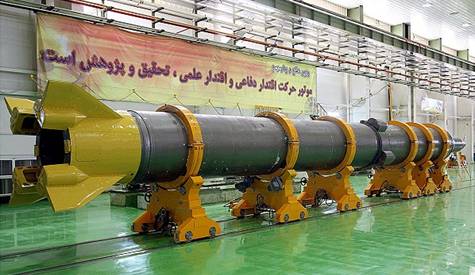
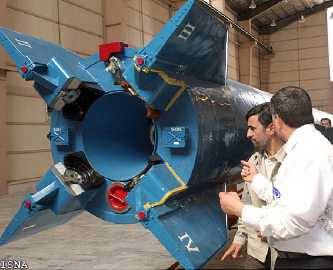
I think I found a high resolution version of the image Japan includes in the lower right hand corner of its briefing slide. A portion of the image is reproduced below together with a close up of the faces where Safir’s jet vanes attach. (Here is the full Sejil image and here is the full Safir image.)
click on the image for a larger version
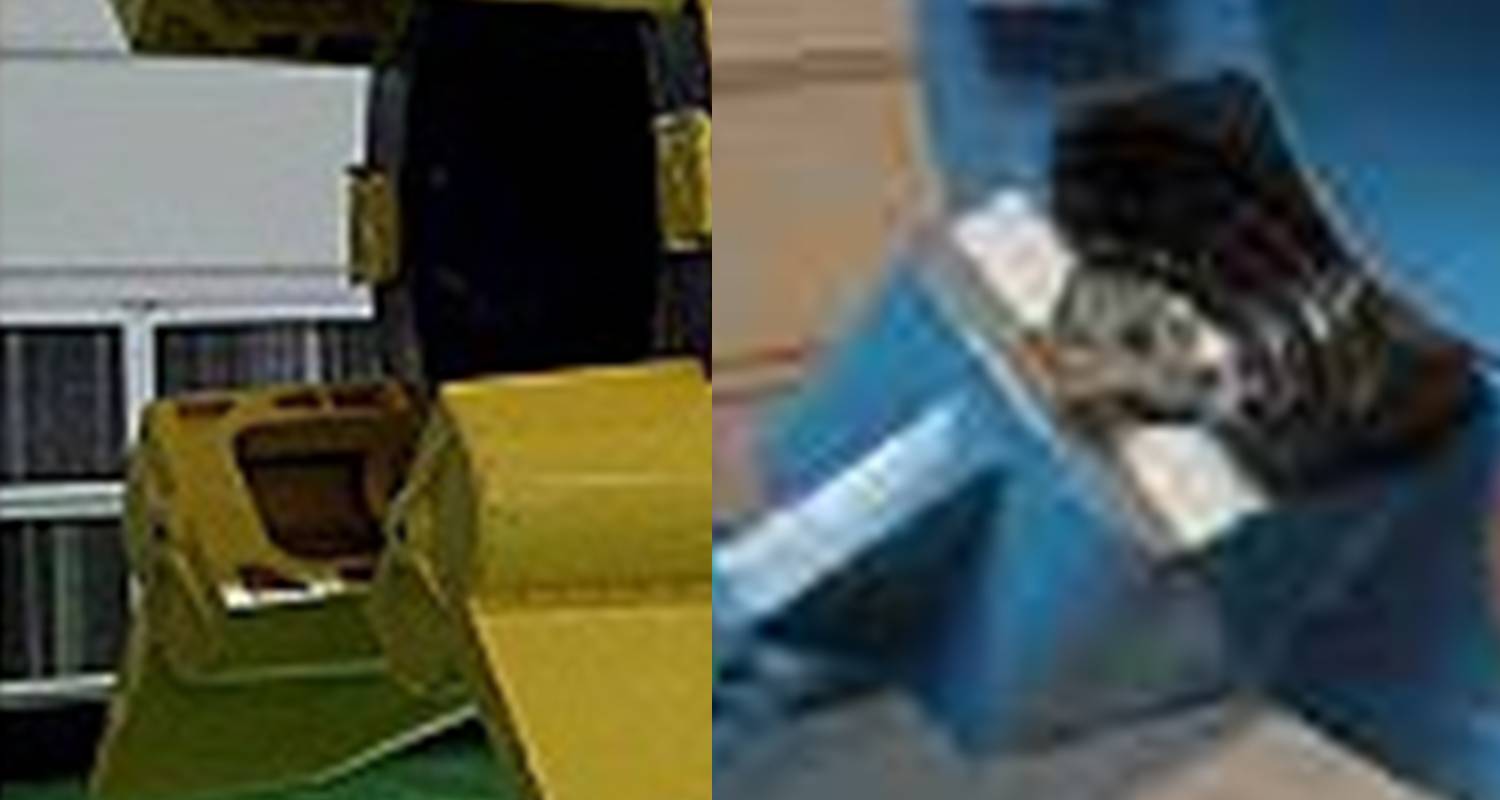
What you notice first is that the box hanging below the nozzle is empty. Perhaps the face for the jet vane “slots,” as visible in the Safir image on the right, have not been installed yet. Or perhaps the boxes are, as Japan suggests, the housings for the pressurization system for the LITVC system. The problem with this hypothesis, however, is that it assumes that the Sejil uses exactly the boxes for second stage that are shown in the first stage and yet there is no indication on the Sejil, whose staging event was clearly visible in videos of its launch on 20 May 2009, of such side pipes. That means that you have to accept that the Sejil uses two different TVC systems whose external components look exactly the same. (Another is the choice of either pressurizing that external pipe to combustion pressures—roughly 3000 psi—or paying the weight penalty for both a depressurization and then another repressurization systems.)
Sorry, Japan! I feel your pain, but I think we have to conclude that both stages of the Sejil are pure solids. I still have my problems with the retrojet hypothesis for those side pipes (such as their placement along the rocket body) but I think that those are now side issues (please excuse the pun!). When we understand why they are placed there we might understand more about the staging difficulties Iran might be having but it won’t really influence our judgment about the rocket.


Hi, Geoff – Charles Vick over at globalsecurity has been saying much the same thing as the japanese.
http://www.globalsecurity.org/wmd/world/iran/sajjil.htm
I must admit though, like you i’ve yet to hear a totally convincing argument regarding those mysterious side pipes.
Here is a much higher resolution of the Sejil image:
http://www.jamejamonline.ir/Media/images/1388/02/30/X00907277415.jpg
For more high resolution images:
http://www.jamejamonline.ir/pics.aspx?newsnum=100907277288
you need to click on the magnifying glass to get the high resolution images.
Safir’s higher resolution:
http://img.tebyan.net/big/1387/05/189159167961851921797920852210722415139205.jpg
I don’t think it’s a hybrid. Start-up behavior and plume IHMO clearly shows a solid.
Liquid injection for TVC might be possible. But why fiddle with the limited space in the former jet vane boxes for the bottles for the Freon, Hydrazine or whatever? If you really need space for the TVC liquids than drop those old jet vane boxes and apply a new design with no such restrictions (e.g. an external tank like the one used on TITAN IV).
Personally, I think it still uses conventional jet vanes, more or less identical on both stages. Occam’s razor applies 😉
This does not explain the tube on the side though.
I thought we were through with this…
First of all: i agree with Berger Bruno. I, too, see no signs of anything else but a solid rocket.
Second: The volume for liquid fuel would be rather excessive; compare this to other solid-fueled missiles with some sort of injection-TVC like the upper stages of the RT-2PM Topol/SS-25/Sickle-A or the israeli YA-3/Jericho-2 – those use considerably smaller vessels for the injected component.
Third: LITVC allows only pitch- and yaw-control – where is the additional roll-control-system (we can exclude the “sidepipes” – no tangential openings visible, only an oval cover on the chamfered upper end)?
So i, too, assume that the Iranians use jet vanes on both stages of the Sejil. That is the type of TVC they have experience with, and the Sejil works too well to be equipped with a new, untried type of TVC the Iranians have no documented experience with.
Last but not least, i think the general shape and size of the “sidepipes” resembles retro-rocket-packs (with cable-ducts to the tail-section) of comparable missile systems quite well (although i must add that i haven’t yet figured out what the particular reasons for their placement or even the presence on the lower stage would be – maybe range-restrictions for the burnt-out lower stage? Problems with excessive lower-stage thrust decay, since it’s not thrust-terminated (BTW, this implies that that missile has a minimum range)? Any other ideas?).
BTW, Geoff:
These japanese “experts” seem to have copied your old idea 1:1; I’d consider a lawsuit for plagiarism if i were you…
Jochen,
Not at all! The Japanese hypothesis is very different from what I was suggesting.
Geoff:
I hope you accept my apology; Of course, you suggested vernier-nozzles back then, not LITVC.
But you’ll have to admit, on first sight, the speculative interior views of both hypotheses look somewhat similar…
Nonetheless i’m wondering why everybody (apparently including Mr. Vick) comes up with such far-fetched, ultra-over-sophisticated alternative explanations for the TVC of the Sejil. What is wrong with the good old jet vanes? The Pershing-1 used them. The Jericho-2 lower stage uses them. The Pioneer/SS-20/Saber and the Topol/SS-25/Sickle-A used them on their lower stages. The Tochka/SS-21/Scarab uses them (additionally to the waffleiron-like air vanes). Most chinese solid-fueled missiles use them. Why should the Iranians not use them???
On the other hand, how many missiles use LITVC on their lower stages? Only the argentinian Condor II comes to my mind, and that one never left the drawing board (it was completely reworked into the Vector/Badr-2000 with a flex-nozzle)…any other examples i forgot about?
(BTW, i personally would have expected the Iranians to come up with a non-thrust-terminated solid lower stage plus a liquid-fueled upper stage – an RT-20P/SS-15/Scrooge- or Agni-TD-like solution – for their first large solid booster. Thrust-termination of solid-fueled missiles is not at all simple to master; Nonetheless, the Iranians seem to have learned from the failures of such ostensibly easy-to-implement solid-liquid-projects in the past…)
Hey, by the way, Iskander/SS-26/Stone uses jet vanes, too!
I think that the most telling sign is that there’s no opening for a propellant pipe or appropriate inter-tank seam in the assembly bay Sejil-on-cart photos, though the unit is clearly incomplete.
From:
http://www.jamejamonline.ir/Media/images/1388/02/30/X00907277474.jpg
…you can see one of the short tubes goes up to a protrusion about a third of the way up the third stage. I’ve seen avionics/systems bays on a stage configured sort of like that before – some of the Atlas variants did that. It could be batteries, or electronics for the first stage, or any systems they want moved further away from the nozzle and its acoustic and thermal environment. There’s not a lot of space in the base for equipment that’s not likely to get a bit toasty and vibrated to heck around the nozzle.
Also a good location for range safety charges. Linear shaped charges to breach the SRM case are long and thin…
Solid motor with jet vanes, almost certainly. The ‘boxes’ are poorly placed for liquid-injection, and ideally placed for jet vanes. They look like Safir-style jet vane actuator mounts. And there’s no sign of a separate roll control system, which would be required with TVC.
The ‘side pipes’ have the wrong position and geometry for retrorockets, IMO. But a jet vane system is most likely going to be hydraulic or pneumatic, rather than electrically actuated, so in addition to the obvious cable housing there’s going to need to be a tank of hydraulic fluid or a gas generator. There doesn’t seem to be room for that in the base of the vehicle, the ‘side pipes’ are about right in size, shape, and placement, and I believe there is precedent in some older Russian rockets.
On Iranian interest in Thrust Termination of solid rocket motors – see for example:
Thrust Termination Dynamics of Solid Propellant Rocket Motors
A. Tahsini, Sharif University of Technology; M. Farshchi, Sharif University of Technology
Journal of Propulsion and Power 2007
0748-4658 vol.23 no.5 (1142-1142)
doi: 10.2514/1.26576
It was presented at AIAA meeting in Cincinnati on 2007.
To George William Herbert:
“It could be batteries, or electronics for the first stage, or any systems they want moved further away from the nozzle and its acoustic and thermal environment.“”
You’d be right if that would not be a solid-fueled missile. At that position directly adjacent to the, in essence, thrust chamber, the vibrations and/or noise level won’t be significantly lower than around the nozzle.
Besides, the guidance compartment of the Sejil is clearly located in the truncated cone directly beneath the triconic warhead.
“Also a good location for range safety charges.“
Wouldn’t linear charges cover all of the first stages’ length, not just about one third?
To John Schilling:
“The ‘side pipes’ have the wrong position and geometry for retrorockets, IMO.“
Hmmm, in my opinion, the boxes at the upper end ‘sidepipes’ have exactly the right size and geometry for housings of retro-rockets (compare them e.g. with the retro-rocket-packs on the intertank/guidance-section of the R-14/SS-5/Skean).
As i wrote before, i’m still trying to understand why the Iranians would place them at that particular position (or why they would be required at all), but it’s not neccessarily a particularly stupid or totally improbable location for retro-rockets, either.
“But a jet vane system is most likely going to be hydraulic or pneumatic, rather than electrically actuated“
Actually, it’s traditionally electro-hydraulic since the days of the Aggregat-4/V-2 (it’s neccessary to electronically process the control currents to the vane actuators to get expedient results); The characteristical power source in missiles of any type (solid and liquid) is usually an electrical battery (although there are exceptions with a turbo-generator; but that’s normally only neccessary in such power-hungry cases as excessive burn-duration, huge size or extensive manoeuvering) inside of the guidance compartment. Oh, and there are examples of missiles with pneumatic actuators, but those are usually comparably small (SAMs or air-to-air types).
BTW, there should be more than enough room for hydraulic actuators etc. not only around the nozzle throat of the Sejil, but also inside of the boxes at the aft end of each stage (compare e.g. how small the electro-hydraulic actuators of the R-17/SS-1c/Scud-B are and how well they fit inside of the small boxes on the aft end of that missile). I think that’s what those boxes are explicitly meant for: to contain the servos and hinges of the jet vanes (although i have no doubt that some skeptics will come up with spectacular alternative explanations until there is striking photographic evidence of this – and even then, some people will have difficulties abandoning their most-liked pet-hypothesis, as illogical that one may be…).
“…and I believe there is precedent in some older Russian rockets.“
Could you please name the particular case(s) you’re thinking of? I have difficulties identifying such an example…
To Tal Inbar:
I have no doubt that the second stage of the Sejil is thrust-terminated (although we do not know if that feature is already operational!). Otherwise, a solid-fueled surface-to-surface missile wouldn’t make sense at all: it would be impossible to determine the range and thus impossible to intentionally aim at a specified target!
Besides, in a lot of photos, it’s possible to identify the (rectangular) coverings for the termination ports directly below the frustrum-shaped guidance-compartment.
In contrast, such structures can not be identified anywhere on the lower stage of the Sejil, thus i assume that that one is not thrust terminated. But this is not at all unusual for multi-staged solid-fueled missiles (see e.g. Topol/SS-25/Sickle-A, UGM-133 Trident II D-5, MGM-31 Pershing I etc.), it just means that that missile will have a minimum range (since the thrust of the first stage can’t be terminated after ignition before all propellant is used up). No big deal if there are no potential targets inside of that minimum range (i estimate something in the range of 150-250km in case of the Sejil).
It’s interesting nonetheless that the Iranians avoided falling into the trap of the seemingly easy solution of putting a liquid-fueled upper stage (with comparably simple thrust-termination: just shut off the propellant…) on top of a non-thrust-terminated solid-fueled first-stage and opted for the apparently more intricate technology instead. Unexpectedly to most people, such a solid-liquid configuration usually generates a lot more problems than it solves (see RT-20P/SS-X-15/Scrooge or Agni-TD; And we’ll have to see if these configuration-inherent problems can be sufficiently overcome, with a lot of engineering effort, technological compromise and additional cost, in case of the man-rated Ares-1)…
Can the mentioned jet vanes be seen in this image?:
http://www.irandefence.net/attachment.php?attachmentid=34162&stc=1&d=1227362029
Is shape and configuration of jet vanes still the same as those used for Shahab missiles?(the manufacturing materials is clearly different than for a liquid fuel one)
Jason:
Good question(s)!
I’d tend to say yes, there can be seen jet vanes in that picture, but most people will certainly answer “i don’t see anything, thus it’s clearly some sort of hyper-antigravity-quantumflux-timewarp-TVC“ – it’s basically a matter of faith and/or what you want to see.
Unfortunately, that video-stillframe (or rather the whole video of the Sejil-1 launch) simply isn’t explicit enough to be absolutely convincing to even the most stubborn skeptic.
And i must admit that i, too, wouldn’t dare to make any substantiated assertions about “shape and configuration” of (still somewhat hypothetical) Sejil-jet-vanes based on that particular picture.
My guess is that such jet vanes would indeed be similar (not identical, at least not in all aspects!) in shape, size, general configuration and even material (in essence; maybe a slightly different composition or surface-coating, but nothing radically different) to those used on the Shahab-3/Nodong-line. And those are, scale neglected, without doubt fully comparable to the jet vanes used on the R-17/SS-1c/Scud-B (which were an advanced/enhanced adaptation of the old A-4/V-2/R-1/SS-1a/Scunner graphite vanes).