
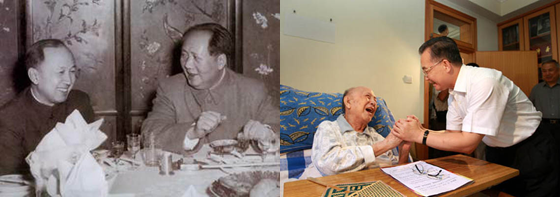
Update | 12:42 November 3, 2009 As if on cue, Michael Wines in the New York Times ledes Qian’s obituary with the grossly inaccurate statement that Qian “single-handedly led China’s space and military rocketry efforts.” No, he didn’t. Not single-handedly, at least.
Qian Xuesen — often called the “father of China’s space and missile programs” — has died. He was 98.
The late Iris Chang wrote a wonderful biography of Qian, Thread of the Silkworm, which I heartily recommend.
Qian was a more complicated figure in the development of China’s space program than mere partrimony suggests. Gregory Kulacki and I, in our monograph A Place for One’s Mat, argued that Qian’s legacy is profound, if mixed:
The historical accounts also shed light on the role of certain personalities. Qian Xuesen is rightly lauded as the “father” of China’s space program. But from the historical accounts, he emerges as a more complex, human figure than in English-language accounts. Qian is, first and foremost, a cheerleader, pressing China’s leaders to consider the possibilities of interplanetary spaceflight even as China endured one of the worst famines in human history. In some cases, Qian’s enthusiasm may have undermined China’s space development. In other cases, he was essential to move the bureaucracy. In the United States, a certain mythology has grown up around Qian, suggesting that, were it not for his deportation from the United States, China might not have developed missiles and satellites. Qian was undoubtedly a major figure linking the scientists and engineers to the political leadership. But Qian, for all his technical skill, was not the principal designer of any of China’s rockets or satellites. Dozens of other Chinese scientists, many of them trained in the United States, made invaluable contributions. American myths about Qian reflect views about “great men” in history, as well as the debates about McCarthyism, not Qian’s role in China’s space program.
This is a carefully worded paragraph. I recommend the entire monograph to get a sense of the role that Qian played. (Peter Brown observes our portrayal put Qian in a somewhat different light than Chang. I am happy to let readers judge for the themselves.)
Our conclusions are based, in part, on a two volume set of Qian’s correspondence that Gregory hauled back from China:
钱学森. 钱学森书信选 1956.2 -1991.12. 国防工业出版社, 2008.
钱学森. 钱学森书信选 1992.1 -2000.7. 国防工业出版社, 2008.

More archival material concerning Qian is apparently on the way, reported Xinhua on October 31:
“According to the Shanghai Jiao Tong University Press, the press is currently compiling a picture album of Qian and a collection of his writings based on 800-plus-page documents retrieved from the U.S. National Archives, which include details about his encounters with the U.S. government and his trip back home.”
History does not have what-if’s. What if China did not have Mao or Qian? China is a big country with a huge genetic pool. Someone extraordinary will arise, be he from a lowly village in Hunan or the best engineering school in America. A few catalysts would surely help, be them General MacArthur in Korea or Senator McCarthy from Wisconsin. However, the thermodynamics is highly in favor of China’s historical position in the world. A few kinetics bumps will be ironed out, sooner or later. Comrade Qian’s name will be carved in China’s long history, along with many, many who have defended the country against invaders ranging from Genghis Khan to the Japanese Imperial Army. As a very capable ally, the United States should be very proud of making the young Mr. Qian the “father of China’s space and missile programs”. We should not dwell on Senator McCarthy – it’s not personal for him. The urge to hunt a witch goes pretty far back, and every country does that, too. Qian had witnessed a great many in China. The attrition and waste in any human system is unavoidable. Thus, a bigger tenant pool is needed. Comrade Qian can rest at peace in his motherland, knowing that many more will follow his path. The trip from Pasadena does not need a return ticket.