
click on the image for a larger version
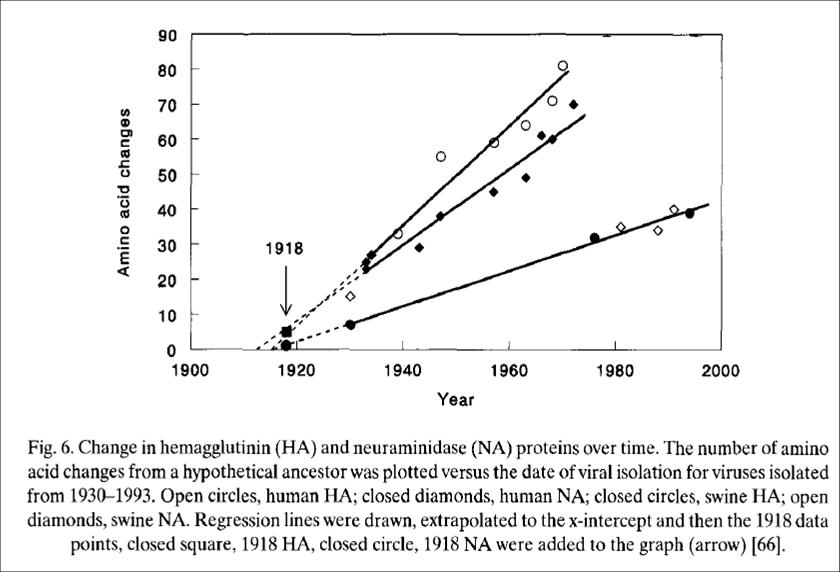
The Mother of All Influenza Viruses. This graph indicates that all the H1N1 viruses that circulated since 1918 were mutations of the Spanish Flu. (From Taubenberger and Reid, Influenza, ed. C. W. Potter, p. 118.)
Nothing says dual-use like biology. And, seemingly, nothing worries some policymakers more than the spread (or discovery) of biological knowledge. Of course, the reasons for this are obvious if you are more worried about the misuse of knowledge than the benefits that knowledge can give to humanity. The suspects in the 2001 anthrax attacks, and their association with Fort Detrick, add a certain punch to this belief. On the other hand, making bio-agents is often the first step in making a vaccine or other beneficial medicine. I remember seeing large bags being filled with tetanus toxin produced in a developing country and then “denatured” to produce shots that obviously save a lot of lives. On the other hand, the larger fermentors used for its production could easily be used to produce botulinum toxin or other anaerobic bacteria suitable for weaponization.
We see the same tensions playing out in the nuclear field with a sizeable chunk of policymakers (most seemingly from developed countries) and across a wide range of the political spectrum saying that nationally owned enrichment centers pose a significant danger to proliferation. At the same time, important statesmen for developing countries have stated: “The assumption should not be that some nuclear technologies are safe in some hands but not others.” This debate will not be easily settled and is well worth discussing. ( I come down in favor of limiting and eventually ending nationally owned enrichment facilities, through out the world and including in the United States, in favor of multinationally owned ventures . However, the deals must be made so economically favorable, by using economically efficient centrifuges, as to induce countries to join voluntarily.)
I was struck once again by this balancing act between acquiring knowledge and banning certain types of research when it was recently announced that the H1N1 virus (aka swine flu) in the current outbreak did not have the “genetic markers” associated with really virulent 1918 “Spanish Flu.” That flu virus’s genetic code was sequenced in 1997. The dangers associated with such procedures were discussed almost immediately by a number of authors. I recommend this article in Nature for a considered discussion of how to weight the pros and cons of reconstructing the 1918 Spanish Flu virus. Of course, that was written before the current pandemic-scare. I find the fact that the genetic markers (so far, I have not been able to find out which markers they are talking about) of this current flu are different from the 1918 variety very reassuring. It should also have a significant impact on what choices public health officials make. None of that would be possible without the sequencing of the virus.

What’s wrong with the assumption that some nuclear technologies are safe in some hands but not others? What rational equivalence is there between say the United States on the one hand and a nuclear and aggressive totalitarian state such as Iran or North Korea? Not a lot IMHO.
WASHINGTON — Contractors at one of the nation’s major nuclear weapons complexes repeatedly used substandard construction materials and components that, could’ve caused a major radioactive spill, a recently completed internal government probe has found.
One of the materials used at the Savannah River Site on the South Carolina – Georgia border failed to meet federal safety standards and “could have resulted in a spill of up to 15,000 gallons of high-level radioactive waste,” the Energy Department’s inspector general found.
The inspector general’s five-month investigation also found that contractors bought 9,500 tons of substandard steel reinforcing bars for the Savannah River Site near Aiken, S.C.
The faulty steel was discovered after a piece of it broke during the construction of a facility to convert spent nuclear weapons-grade plutonium and uranium into mixed-oxide, or MOX, fuel for civilian reactors.
Replacing 14 tons of substandard rebar — the steel bars commonly used to reinforce concrete — that already had been installed cost $680,000 and delayed the completion of the $4.8 billion MOX facility, the investigation found.
Geoff, believe it or not I’ve been thinking. I’ve just changed my mind about enrichment. I now feel that with powers like the United States around, enrichment is more safely conducted by a supranational body. Do you remember in the previous thread a few days ago I called Obama possibly the worst President since Carter? For those who think this was a bit tough on Obama we are in rather good company. Former US House Speaker Newt Gingrich (yesterday) blasted Obama’s foreign policy approach on the Middle East as “the clearest adoption of weakness since Jimmy Carter.” (Jerusalem Post) Thanks Newt for more or less quoting me, but the point one needs to make is this: call me a cynic but with Obama I think we are better off decommissioning all US warheads and scrapping the triad, selling all of the surplus B52s to local flying clubs and pulling out of NATO because a fat lot of good all this stuff will achieve under a weak administration that is hell bent on appeasement at any price. On the other hand, with a few sane Americans left such as Newt (whom I now suspect has visited ArmsControlWonk), maybe there is some hope?