
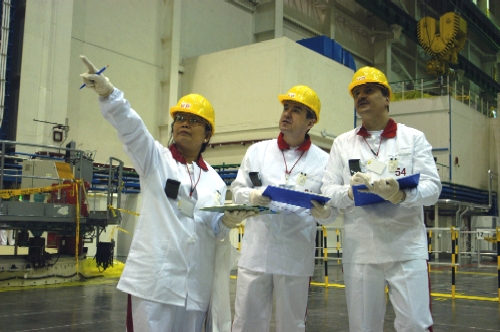
Having had a chance to digest the India safeguards agreement, I’ve become interested in what is left out. Specifically, how will the IAEA analyse and draw conclusions about Indian compliance?
How the Agency analyses information is, in many ways, just as important as the safeguards agreement itself. Moreover, it has changed considerably since full-scope safeguards were introduced in the early 1970s.
Prior to efforts to strengthen safeguards in the 1990s the Agency adopted what was termed a “facility-level approach”. It had a set of inspection goals for each facility in a state. If those objectives were met at each and every facility then, at the end of the year, the IAEA concluded that there had been no diversion of nuclear material in the state concerned.
Following the shock of discovering Iraq’s clandestine nuclear programme in 1991, the Agency pioneered a new “state-level approach”. The IAEA safeguards glossary defines it thus:
a safeguards approach… developed for a specific State, encompassing all nuclear material, nuclear installations and nuclear fuel cycle related activities in that State. A State level safeguards approach defines the application of safeguards measures at each facility and location outside facilities in the State and, where an additional protocol is in
force, the safeguards measures … that would enable the IAEA to draw and
maintain a conclusion of the absence of undeclared nuclear material and activities in
that State….
(For a less terse discussion, but one still written in Agency-speak read this).
The Agency never gives examples so let me give one of my own which (I hope) illustrates the idea.
Say a state has a declared enrichment plant capable of producing 100 tonnes of LEU per year. However, the state declares it only uses the plant to produce 60 tonnes of LEU per year to feed two reactors. This might well be because the state built too much enrichment capacity and doesn’t need to use it all. However, it also raises the possibility that the enrichment plant is being used for some undeclared (“excess”) production.
Under the state-level approach the Agency will flag up this potential mismatch and will look into it before drawing any conclusion about the state’s compliance. Under the facility-level approach, it would have “blindly” applied safeguards at the enrichment plant and reactors without looking into the difference in capacities.
The state-level approach is, incidentally, applied in all states with a safeguards agreements in force, whether or not they also have an additional protocol in operation (although the Agency’s conclusions is modified accordingly).
Anyway, this all raises the question of whether the Agency will be applying the state-level approach in India.
Obviously it can’t apply a state-level approach per se since India’s military facilities will remain unsafeguarded. However, if India cleanly splits it civilian and military facilities, I can see no reason why the Agency can’t apply a state-level approach to the whole of India’s civilian fuel cycle: a state within a state, if you will. Using this kind of analysis in India will significantly enhance the credibility of conclusions drawn by the Agency.
I don’t think this question has ever come up before with the IAEA as it has never attempted to safeguard an entire fuel cycle in a state outside the NPT (safeguards are applied in such states but only to particular facilities).
However, Euratom must face a similar problem in applying safeguards in the UK and France. Like India, the UK and France have a military fuel-cycle but their civilian fuel cycles are comprehensively safeguarded (by Euratom). Does Euratom adopt a state-level approach in the UK and France? I don’t know, but I’d like to find out.
In any event, I think that the India safeguards agreement does give the IAEA the necessary authority to use the state-level approach. Specifically, article 11 specifies which facilities, material and equipment require safeguards. Its authority appears to be sufficiently broad to enable the Agency to ‘track’ all nuclear material around the fuel cycle, wherever that leads.
I don’t want to give the impression that the omission of the Agency’s safeguards “concept” for India from the safeguards agreement is a deficiency—safeguards agreements never specify it. But, I do think we need to know what this concept is before we can properly assess the value of safeguards in India.

Jefrey,
Do you think India will divert material from safeguarded facilities?
FYI
Safeguards Statement for 2007
Source: http://www.iaea.org/OurWork/SV/Safeguards/es2007.pdf
“1.3. States with Safeguards Agreements based on INFCIRC/66/Rev.2
23. Under safeguards agreements based on INFCIRC/66/Rev.2, the Agency applies safeguards in order to ensure that nuclear material, facilities and other items specified under the safeguards agreement are not used for the manufacture of any nuclear weapon or to further any military purpose, and that such items are used exclusively for peaceful purposes and are not used for the manufacture of any nuclear explosive device.
Status of Implementation
24. As of 31 December 2007, safeguards agreements based on INFCIRC/66/Rev.2 were
implemented at a number of facilities in India, Israel and Pakistan. None of these States had concluded an additional protocol with the Agency. The Secretariat carried out 45 inspections utilizing approximately 480 CDFVs in these States.
Deriving Conclusions
25. The conclusion described in paragraph 4 of the Safeguards Statement is reported collectively for these three States, and relates to the nuclear material, facilities and other items to which safeguards were applied. To draw such a conclusion in respect of these States, the Agency evaluates all safeguards relevant information available, including verification results and information about facility design features and facility operations.
Overall Conclusions for 2007
26. On the basis of the results of its verification and evaluation activities, the Secretariat concluded that nuclear material, facilities or other items to which safeguards were applied in India, Israel and Pakistan remained in peaceful activities.”
Will India in the future have its own section in this document?
Without venturing into the question of whether or not the India deal is another slippery slope towards irrelevancy for the NPT, a few observations:
1) Once any agreement is ready for implementation, if not before, the safeguards staff will do a state assessment. This includes an analysis of proliferation paths from safeguarded facilities. Presumably this will be a fairly straightforward exercise, since India will have its separate military fuel cycle.
2) Because of the Agency’s desire to prepare itself in advance, there should be some sort of future facilities list (not unlike similar provisions in the US-Japan and US-EURATOM agreements with the US) that comprises or relates to the facility attachments that will become an integral part of the safeguards agreement. There are all kinds of understandings below this level of detail that will be worked out between the inspectorate and Indian authorities This exercise should take a good bit of time, and will also include discussions surrounding India’s commercial considerations.
This is all potentially boring as hell, but these matters are important. Who knows whether the implementation of safeguards in India might not also provide new opportunities to improve the Agency’s technical capabilities in remote unattended monitoring, etc.? As I recall, there are actually some vagaries in INFCIRC/66 agreements that may provide more flexibility on a facility basis than do INFCIRC/153’s.
If it really matters to “X,” of course India could have its own section in the SIR. That is an editorial decision.
IMHO, a key issue is cost. Unless the Agency pulls off another major budget increase, the size of the Indian exercise will eat into other, arguably more important, safeguards priorities, from recruitment to knowledge management to management to the hoped-for expanded activities in the DPRK and Iran. Fortunately the Agency has for some years now been preparing for the eventual application of safeguards at the Indian reprocessing plan once/if it start a campaign with spent fuel requiring safeguards application.
Sorry, that’s “state evaluation,” not state asessment, as Ms. Renis’s paper notes. It’s really a good paper, and deserves a read by anyone intereted in the nuts and bolts.
Safeguarded material can be tracked to facilities mentioned in 11(f) but safeguards (and hence inspections) are confined to Para 11 facilities. Para 5 specifically clarifies what the Indians are calling a “non-hindrance clause”, i.e. that what India does in its non-safeguarded facilities is its own business.
I should add, though, that the question of India withdrawing safeguarding material (incidentally the word “diversion” is not used anywhere in the text) simply does not arise. Safeguards have been running in Tarapur and Rawatbhata for years without any problem. This agreement simply increases the number of such facilities to be safeguarded but does not alter the rules of the game.
Dear X,
although your question was directed to Jeffrey and not to me, I still feel a need to answer with a quote from:
HENRY SOKOLSKI IN TODAY’S WALL STREET JOURNAL ASIA -“Negotiating India’s Next Nuclear Explosion” (07-12-2008):
http://online.wsj.com/public/article_print/SB121562768791139877.html
“This is where the trouble begins. It turns out that fueling India’s civilian reactors with foreign fuel is not all that peaceful. As K. Subrahmanyam, former head of India’s National Security Advisory board noted, “Given India’s uranium ore crunch . . . it is to India’s advantage to categorize as many power reactors as possible as civilian ones to be refueled by imported uranium and conserve our native uranium fuel for weapons grade plutonium production.”….”
Ak Malten,
Global Anti-Nuclear Alliance